Meta Weighs $720 Million Won Bond Sale in South Korea as AI Funding Race Goes Global
Summary
- Meta has begun reviewing a won-denominated corporate bond sale in South Korea, including domestic credit ratings, regulations and investor demand, with a goal of raising more than 1 trillion won ($720 million).
- U.S. Big Tech companies are increasing local-currency bond issuance around the world as AI investment expands, comparing borrowing costs, exchange rates and swap expenses.
- As issuance by U.S. AI companies' corporate bonds increases, investor fatigue and rising long-term Treasury yields are emerging, prompting calls for caution on overseas bond investments.
Forecast Trend Report by Period


Rising Treasury Yields Push Issuers to Diversify by Region
Funding Costs and Currency Moves Are Key Variables
Meta Platforms Inc. is exploring a won-denominated bond sale in South Korea as it broadens funding sources for artificial intelligence investment.
According to investment-banking industry officials on Aug. 27, Meta recently sounded out a South Korean credit-rating agency about a private preliminary rating ahead of a possible corporate bond sale. The process is used to gauge a likely credit rating and borrowing cost before issuance, and the result is not made public.
The company is also reviewing the regulations, disclosure requirements and investor demand tied to a bond sale in South Korea through domestic and international securities firms. Market participants estimate Meta could raise at least 1 trillion won ($720 million) from the Korean bond market.
Bond-market participants say it remains unclear whether Meta will proceed. A foreign company that sells publicly offered corporate bonds in South Korea must submit periodic filings including quarterly, semiannual and annual reports. Even if an issuer enters the market for one-time funding, it still takes on continuing disclosure obligations, a structure that can be burdensome.
Funding costs could also be a hurdle. Meta would need to weigh not only the won-dollar exchange rate, but also swap costs incurred when converting won proceeds into dollars. It would also need to assess whether South Korea's bond market can absorb more than 1 trillion won ($720 million) of supply at competitive yields.
U.S. artificial-intelligence companies including Meta have been raising funds aggressively overseas. Alphabet Inc. and Amazon.com Inc. have sold about 90 trillion won ($64.8 billion) of local-currency bonds this year in markets including the UK, Europe, Switzerland, Canada and Japan. Earlier this month, Alphabet sold A$5.5 billion of Australian dollar-denominated kangaroo bonds.
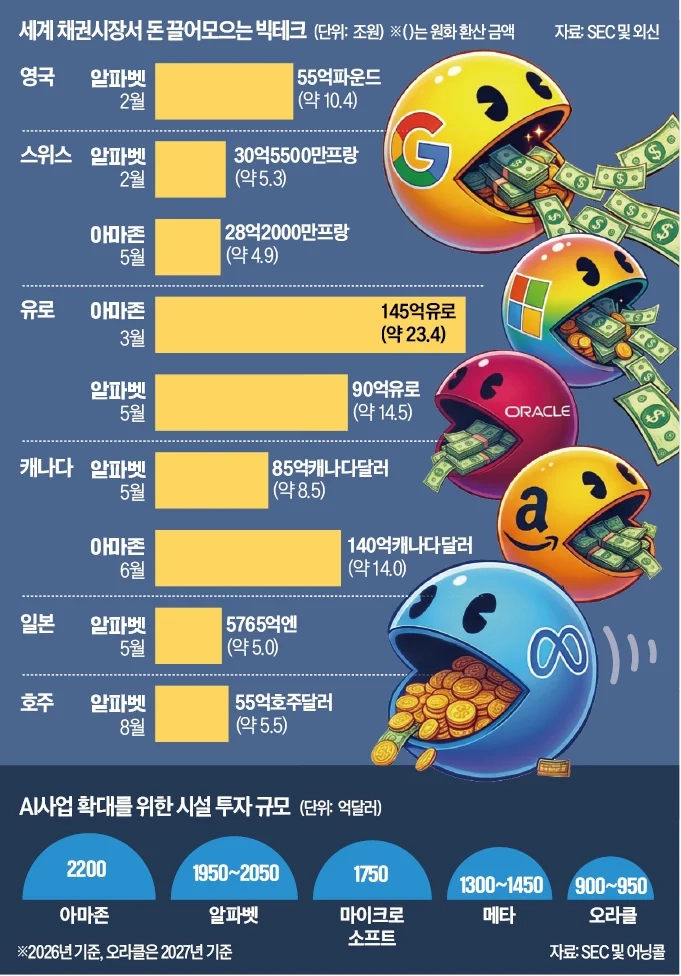
From Japan to Australia, Big Tech Scours Global Markets for Cash
AI Funding Race Spreads Beyond the U.S.
The financing wave from U.S. Big Tech has reached South Korea after sweeping through the U.S., Europe and Japan. Meta, Amazon, Alphabet, Oracle Corp. and Microsoft Corp. are issuing corporate bonds across multiple markets as borrowing conditions at home worsen, with rising long-term U.S. Treasury yields pushing up the rates used to price corporate debt.
Big Tech Raised $194 Billion Through Bonds This Year
Goldman Sachs said on Aug. 27 that Amazon, Alphabet, Meta and Oracle sold $194 billion of corporate bonds from the start of the year through last month. That was nearly double last year's full-year total of $108 billion. Goldman projects issuance from those companies will keep climbing, reaching $250 billion this year and $400 billion in 2027.
Issuing bonds in multiple countries is another notable shift. Alphabet followed sales in the UK, Switzerland and Japan with an A$5.5 billion offering in Australia this month. The strategy reflects an effort to raise money in several currencies by tapping markets with relatively lower borrowing costs, rather than relying solely on U.S. dollar debt, where heavier supply can push funding costs higher.
Big Tech companies are also stepping up spending on AI-related facilities. Meta initially guided for 2026 capital expenditures of $115 billion to $135 billion at the start of this year. It raised that range to $125 billion to $145 billion after first-quarter earnings, then lifted the lower end again to $130 billion to $145 billion in the second quarter. Alphabet also increased its capital-spending plan from $175 billion to $185 billion at the start of the year to $180 billion to $190 billion in the first quarter, and then to $195 billion to $205 billion in the second quarter.
Companies are also making active use of structured finance through special-purpose vehicles. Rather than investing directly in data centers, Meta is drawing in outside capital by setting up joint ventures with Blue Owl Capital and BlackRock, among others.
In the U.S. bond market, investor fatigue is building as supply rises quickly. Order books for AI-company bond sales fell from nearly five times covered in February to less than two times in July. Amazon's dollar bond sale in March drew orders equal to 3.4 times the deal size, while a $25 billion bond offering in July drew only 1.6 times.
One asset-management executive said the pattern resembles the shift in sentiment around Korea Electric Power Corp. bonds in 2022. Investors initially welcomed the supply as high-grade paper, but later began complaining as issuance kept coming. AI-company debt could follow a similar path, the person added.
Big Tech Bond Sales Are Also Affecting Rates
Heavy corporate bond issuance by U.S. AI companies is also contributing to higher long-term Treasury yields. The yield on the 30-year U.S. Treasury rose as high as 5.27% the previous day before ending the session at 5.162%.
Industry participants say the long end of the Treasury curve has kept trending higher as the U.S. government continues to add debt and AI companies raise money on a large scale as well.
There is also growing concern that as funding needs increase, U.S. AI companies will keep looking abroad for new investors. An official at a credit-rating company said U.S. investors began cutting back on subprime exposure around 2006, after which related products were sold to overseas investors including those in South Korea. Investors should be cautious when products that are difficult to place domestically begin to be marketed abroad, the person said.
Bae Jeong-cheol, Hankyung.com reporter, bjc@hankyung.com

Korea Economic Daily
hankyung@bloomingbit.ioThe Korea Economic Daily Global is a digital media where latest news on Korean companies, industries, and financial markets.