Korea’s $578 Billion-Plus Budget Push Raises Questions Over BOK Rate-Hike Impact
Summary
- Concerns were raised that the government’s push for expansionary fiscal policy of more than 800 trillion won could blunt the impact of the Bank of Korea’s benchmark rate hikes.
- Governor Shin said fiscal spending could support monetary policy if it is used for investment in future growth that lifts the potential growth rate.
- Experts said they are concerned that large-scale fiscal spending could worsen fiscal conditions and increase pressure on inflation.
Forecast Trend Report by Period


Debate grows over a mismatch between monetary and fiscal policy
Shin says spending could help if it lifts potential growth
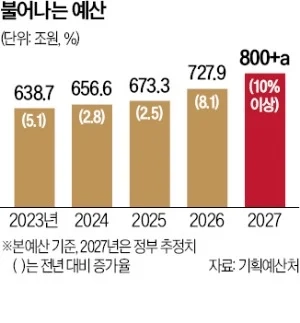
The Bank of Korea’s Monetary Policy Board raised its benchmark interest rate for a second straight month on Aug. 27, saying it would act preemptively against high inflation. But debate is growing over a possible policy mismatch as the government moves to draft a budget of more than 800 trillion won ($577.6 billion) for next year. Concerns are mounting that expansionary fiscal policy could blunt the impact of the BOK’s monetary tightening.
Shin Hyun-song, the BOK governor, addressed the issue at a news conference after the rate-setting meeting on Aug. 27. Fiscal spending would not amount to a policy mismatch if it helped lift the economy’s potential growth rate, he said. Whether the policies are at odds depends on the size of the spending and how the money is used. If funds are directed toward investment that supports future growth, that could raise potential growth and in turn help monetary policy. Markets interpreted the remarks as a broad statement of principle, on the assumption that fiscal resources are used efficiently to improve growth.
A presidential office official pushed back on the criticism. The official said the BOK should manage market liquidity through monetary policy, while the government should use fiscal policy to address inequality and foster future growth drivers. Tightening by the monetary authority does not mean fiscal authorities must tighten as well.
Still, some economists say large-scale fiscal spending could worsen the government’s finances and fuel inflation rather than lift potential growth. Kim Sang-bong, an economics professor at Hansung University, said budget outlays do not immediately increase supply, and even agricultural products face a lag between production and shipment. Efforts to use fiscal spending to build infrastructure and expand productive capacity could boost demand first during that gap, adding to price pressures.
Kim Ik-hwan, Hankyung.com reporter, lovepen@hankyung.com

Korea Economic Daily
hankyung@bloomingbit.ioThe Korea Economic Daily Global is a digital media where latest news on Korean companies, industries, and financial markets.