Markets Cheer BOK’s Back-to-Back Hike as Shin Signals a Dovish Path
Forecast Trend Report by Period


▶3.00% — Tightening, Paid Up Front
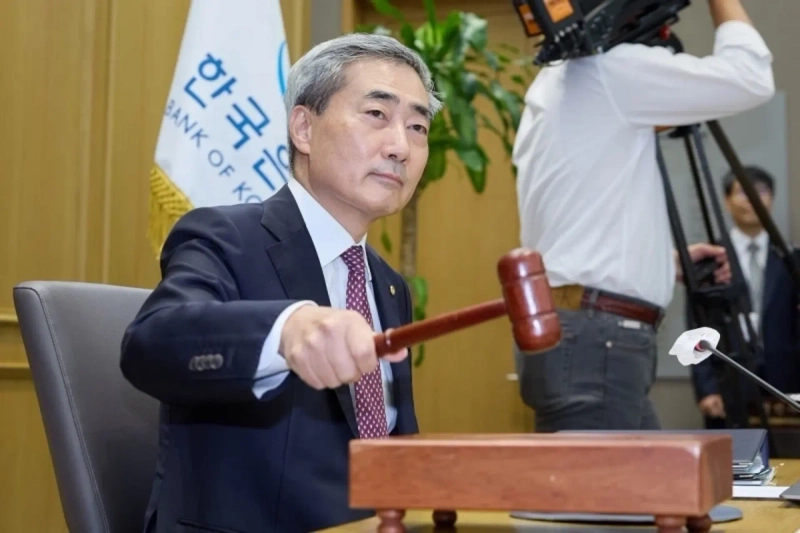
The Bank of Korea’s back-to-back rate increase was an aggressive move. Governor Shin Hyun-song called it a departure from convention. That does not mean the central bank intends to keep raising rates at a rapid pace.
Instead, the BOK is trying to bring forward rate increases now to contain inflation expectations, rather than wait for price pressures to spread and then be forced into larger hikes later. Shin described it as acting early to avoid needing a much bigger response later.
The logic is that preemptive action can reduce both the eventual intensity and the duration of tightening. In that sense, it amounts to paying for tightening up front. Price stability remains the primary goal, but policymakers also expect the move to help cool home prices in the Seoul metropolitan area and curb household debt growth. For investors, what matters more than the 3.00% rate itself is how many more hikes lie ahead.
▶3.25% — The Figure That Reassured the Bond Market
The median six-month policy-rate outlook among Monetary Policy Board members was 3.25%. Even after raising this year’s growth forecast to 3.3%, the board pointed to only one additional increase from the current level.
The policy statement also dropped language saying it was necessary to continue the rate-hike stance. Shin said he expects a gradual path over the next four meetings, amounting to about one more increase from current levels. The central bank wants to gauge the impact of two consecutive hikes first.
The baseline path implied by the dot plot is 3.25%, though many in the market still see the terminal rate at 3.25% to 3.50%. That helps explain why South Korea’s three-year government bond yield fell 6.1 basis points to 3.755% and the 10-year yield dropped 5 basis points to 4.238% on the day. For bond investors, the moment is approaching to gradually extend duration with a possible rate peak in view. Rising long-term US Treasury yields remain a variable.
▶3.3% — Why the Stock Market Held Firm
The BOK sharply raised its growth forecast for this year to 3.3% from 2.6% and next year’s to 2.9% from 2.1%. It expects the semiconductor boom to lift exports and corporate earnings, with that strength feeding through to tax revenue, bonuses, wages and consumption, ultimately adding demand-side inflation pressure.
Shin also said the GDP gap, initially expected to turn positive next year, could shift much sooner. That would mean demand pressure intensifying as actual output exceeds potential output.
Higher rates increase the discount rate applied to stocks and compress price-to-earnings ratios. Stronger growth, however, lifts corporate profits and earnings per share.
The Kospi rose 1.53% to 6,912.37 on the day. Nvidia’s surprise earnings provided a powerful tailwind, but the BOK’s sharp upward revision to growth also helped cushion the impact of higher rates. Investors now need to focus less on the index and more on stocks whose earnings outlook is genuinely improving.
▶1,380.9 Won — A More Complicated Calculation for Korean Buyers of US Stocks
Shin said the won has dropped sharply recently but remains at a historically high level. He also said a somewhat stronger won would help stabilize import prices.
The won briefly strengthened to 1,377.3 per dollar immediately after the rate decision, then ended at 1,380.9 per dollar as the dot plot was interpreted as more dovish than expected. A narrower Korea-US rate gap, a large current-account surplus and strong semiconductor exports all support the Korean currency.
Korean investors in US stocks need to look beyond share-price gains and account for foreign-exchange losses if the won strengthens. The same applies to Seoul-area real estate and leveraged investments. Shin described monetary policy and macroprudential policy as catalysts for each other. In other words, the effect is greater when interest rates and lending rules move in the same direction.
▶The Next Battleground Is October — The Numbers to Watch
Shin said every upcoming Monetary Policy Board meeting is live. In other words, it has not been decided whether 3.25% will be the terminal rate. The next indicators he singled out were inflation data for August and September, second-quarter preliminary GDP and nominal GDP figures, and consumption and sentiment indicators.
If inflation slows and growth and won stability continue, expectations for a rate peak near 3.25% could solidify after one additional increase. That would be a favorable mix for both stocks and bonds. If core inflation picks up again and concerns over Seoul-area home prices, household debt and a weaker won converge, the expected terminal rate could rise to 3.50% or higher. That would weigh on bonds and high-PER stocks.
Sim-gi Lee, senior editorial writer, Hankyung.com, sglee@hankyung.com

Korea Economic Daily
hankyung@bloomingbit.ioThe Korea Economic Daily Global is a digital media where latest news on Korean companies, industries, and financial markets.