Trump Weighs Self-Defeating Chip Tariffs as Pressure Tactic to Spur US Investment
Summary
- Concerns are growing that the Trump administration’s review of steep tariffs on imported semiconductors could raise costs for US big tech companies and data centers.
- The prevailing view in Washington is that the US is using high tariffs as a tool to pressure companies from South Korea, Japan and Taiwan into investing in the US and expanding US-based investment.
- South Korean semiconductor companies, especially SK Hynix, are weighing additional investment after breaking ground on a US semiconductor packaging plant, while also considering the risk of oversupply if the semiconductor cycle turns lower.
Forecast Trend Report by Period


The Trump administration is considering steep tariffs on imported semiconductors, Politico reported on August 27. The prospect is drawing strong concern in Washington.
Critics say imposing tariffs on chips would undercut the administration’s goal of securing a competitive edge in artificial intelligence.
Semiconductors are already in short supply. In that environment, tariffs would likely raise costs not for producers but for buyers, including major US technology companies. That would leave American firms paying more to make products that depend on chips.
The policy would also directly raise the cost of building data centers, one of the biggest sources of chip demand. Companies such as Amazon.com Inc. and Microsoft Corp. could face a significant burden.
US chip designers such as Nvidia Corp. and Advanced Micro Devices Inc. would also strongly criticize such a move, Politico reported.
The criticism has also been steady at Washington think tanks. Michael Sobolik, a senior fellow at the Hudson Institute, told Politico that de-risking supply chains and reducing vulnerabilities are core geopolitical issues. But producing large volumes of chips in the US would be extremely expensive, he said.
Sujai Shivakumar of the Center for Strategic and International Studies said higher tariffs would not produce more engineers, shorten permitting timelines, or secure enough power and water. Tariffs alone would not immediately increase semiconductor production in the US, he said.
Even so, there are two main reasons Washington may be reviewing the option. One is political. As voter backlash against data centers grows, a message centered on rebuilding the manufacturing base may resonate more than one focused on preserving an AI edge.
The other is that the tariffs could serve as a temporary tool to draw more investment into the US. In Washington, the prevailing view is that the Trump administration wants to send a tougher message to South Korea, Japan and Taiwan as it presses them for more US investment. One scenario is that Washington uses high tariff rates to push companies to invest, then ultimately eases the burden on US companies through exemptions or other programs.
South Korean chipmakers are watching closely. Commerce Secretary Howard Lutnick has repeatedly said the US could introduce a program that partially exempts companies from tariffs in exchange for domestic investment. Lutnick has repeatedly threatened companies with a choice: invest in the US or face tariffs of 100%. Any relief would likely be tied to the size of a company’s US investment.
Even if tariffs are imposed, the cost could still be passed on to consumers. But South Korean companies that have already committed to investing in the US say it is difficult to ignore pressure to expand those commitments.
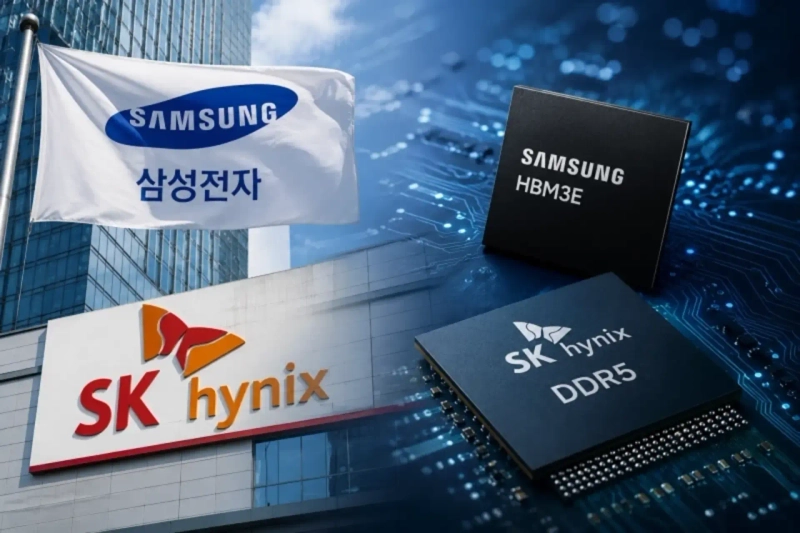
SK Hynix held a groundbreaking ceremony on August 28 for a semiconductor packaging plant in Lafayette, Indiana. Since then, talk has been growing that the company is weighing additional investment locations and terms. Unlike Samsung Electronics Co., SK Hynix has yet to make a large-scale investment in the US, leaving room for further spending. The concern is that any investment made now could expose the company to oversupply and other risks if the semiconductor cycle turns down later.
As the US fleshes out its semiconductor tariff policy, the focus is on how it could shape the investment plans of South Korean companies.
Lee Sang-eun, Washington correspondent, Hankyung.com, selee@hankyung.com

Korea Economic Daily
hankyung@bloomingbit.ioThe Korea Economic Daily Global is a digital media where latest news on Korean companies, industries, and financial markets.