Warsh’s Jackson Hole Debut at 11 p.m. Puts Kospi 7,000 in Focus
Summary
- Warsh’s remarks will help determine the direction of US long-term yields and the won-dollar exchange rate, key drivers for Korean equities and whether the Kospi 7,000 level can hold.
- Two straight benchmark-rate increases could leave construction and real estate, some brokerage shares, richly valued growth stocks and Kosdaq-listed names relatively vulnerable.
- If US long-term yields stabilize and stronger AI investment and improving semiconductor earnings continue, they could ease the burden of higher rates and support the floor for Korean equities.
Forecast Trend Report by Period


Fed Chair Warsh to deliver first Jackson Hole keynote on Aug. 28 at 11 p.m. Korea time
More important than September is how he judges inflation and long-term yields
US 30-year yield briefly topped 5.3%; further gains could spur foreign outflows
BOK has raised rates twice in a row, adding pressure to Kosdaq and high-PER stocks
This article appeared on Hankyung Premium 9, the Korea Economic Daily’s paid investment platform. Subscribers can find more investment stories at www.hankyung.com/premium9.
Monetary policy in South Korea and the US is nearing a pivotal moment for Korean equities. The Bank of Korea has raised its benchmark rate for a second straight meeting, while Kevin Warsh is set to deliver his first Jackson Hole speech since taking office as Federal Reserve chair. If Warsh signals that higher long-term Treasury yields already amount to substantial tightening, Korean stocks may get some relief. If he instead underscores the need for further rate increases to curb inflation, the Kospi could face another sharp pullback.
Investors are focused less on whether Warsh sounds hawkish or dovish than on the reaction function he lays out for future policy decisions. His assessment of long-term Treasury yields, which have climbed to their highest levels since 2007, is emerging as a key factor in whether the Kospi can hold above 7,000.
Long-Term Yield View May Matter More Than a September Hike
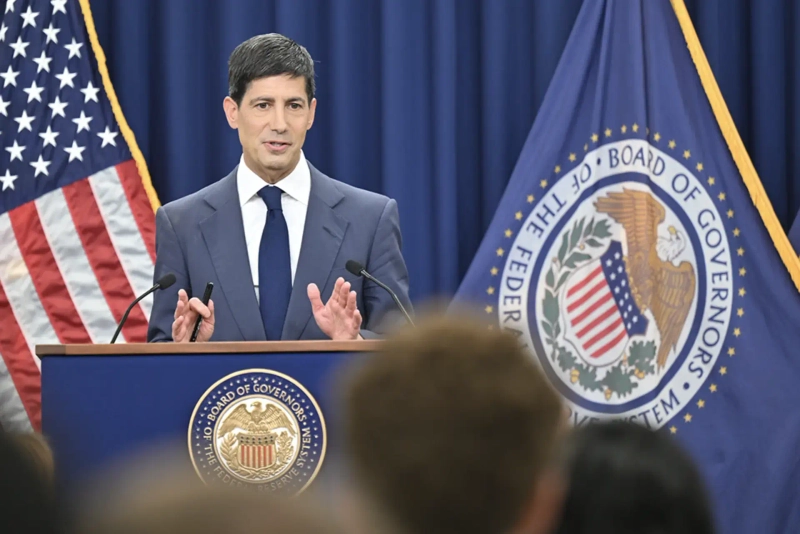
Warsh is scheduled to deliver the keynote address at 8 a.m. on Aug. 28 in Jackson Hole, Wyoming, or 11 p.m. in South Korea. It will be his first Jackson Hole speech since taking office in May. This year’s symposium is titled “Financial Innovation: Implications for Payments and Policy.” Stablecoins, tokenized assets and payments innovation are among the main agenda items.
Markets, however, are paying far closer attention to Warsh’s monetary-policy comments than to the symposium’s formal theme. The Fed left its benchmark rate unchanged at 3.50% to 3.75% last month. At that meeting, three Federal Open Market Committee members backed a quarter-point increase. US personal consumption expenditures inflation for July was also 3.7% from a year earlier, well above the Fed’s 2% target.
Interest-rate futures imply about a 35% chance of a September rate increase and better-than-70% odds of at least one more hike by year-end. A remark from Warsh that inflation has not slowed enough, or that the Fed remains prepared to act again if needed, could quickly push those odds higher.
Securities firms say Warsh probably won’t directly telegraph a September move. Since taking office, he has signaled that he wants to reduce reliance on the dot plot and forward guidance. The aim is to push markets to analyze economic data and asset prices directly rather than simply shadow comments from Fed officials.
That leaves investors watching less for an explicit reference to September than for the yardsticks Warsh uses to judge inflation, employment, the neutral rate and long-term yields. The key questions are what conditions he sets for disinflation and whether he treats the recent rise in long-term yields as tightening that partly substitutes for higher policy rates.
Surge in US Long-Term Yields Is the Biggest Variable
The biggest issue hanging over the speech is the jump in long-dated Treasury yields. The US 30-year Treasury yield recently climbed above 5.3% at one point, the highest level since 2007. The 10-year yield has been trading around 4.7%. Wider fiscal deficits, increased Treasury supply and persistent inflation concerns have all contributed.
The US Treasury said on Aug. 19 that it would raise the cap on long-term bond buybacks to at least $4 billion per operation. The move had only a limited effect on stabilizing yields. Market participants say buybacks alone are unlikely to ease structural supply pressures or concerns about fiscal credibility.
If Warsh says higher nominal and real yields across the curve mean financial conditions are already tight enough, markets would probably welcome that message. It would reinforce the view that rising long-term yields are already doing part of the Fed’s work and lessen expectations for a rush into further tightening.
The opposite would deal a double blow to risk assets. If Warsh describes elevated long-term yields as a normal market adjustment while also stressing the need for additional policy-rate increases to secure price stability, both short-term and long-term rates could move higher. That would lift the discount rate used to value equities.
“The most market-friendly outcome would be for him to reaffirm the commitment to price stability while acknowledging that long-term yields are already doing a meaningful amount of tightening,” a securities industry official said. Emphasizing both the need for further rate hikes and the case for higher long-term yields would make valuation adjustments hard to avoid, especially in growth stocks.
BOK Has Raised Rates Twice and Left the Door Open to More
Korean equities face a more complicated backdrop than US markets. The Bank of Korea’s Monetary Policy Board raised the benchmark rate by a quarter point to 3.00% from 2.75% on Aug. 27. It was the second straight increase after a move in July.
The BOK said the domestic economy has been growing more strongly than expected, led by semiconductor exports and capital spending. It also cited continued pressure from core inflation, housing prices in the Seoul metropolitan area and household debt. The central bank projected economic growth of 3.3% this year and 2.9% next year. It sees consumer inflation at 2.7% this year and core inflation at 2.5%.

BOK Governor Shin Hyun-song said the median expectation for the benchmark rate over the next four policy meetings is 3.25%. That leaves open the possibility of one additional increase from current levels. He said every meeting from here is “live,” but added that policymakers also need to assess the effect of two consecutive hikes on the economy and financial markets.
With South Korea’s benchmark rate at 3.00% and the upper end of the US target range at 3.75%, the rate gap stands at 0.75 percentage point. If the Fed raises rates by a quarter point in September, the gap would widen to 1 percentage point. The spread itself is not yet at a historically dangerous level. Even so, the view that both countries remain in tightening mode is a burden for Korean stocks.
A higher domestic discount rate, rising US long-term yields and a stronger dollar could combine to trigger foreign selling in Korean equities. If the won weakens again against the dollar, overseas investors may cut stock holdings out of concern over both falling share prices and currency losses.
For Kospi 7,000, Stable Rates Are the Key
Korean stocks are already showing sharp volatility ahead of Jackson Hole. The Kospi closed at 6,696.96 on Aug. 24 after tumbling 3.12%. It then rebounded to 6,912.37 on Aug. 27, only to finish at 6,788.88 on Aug. 28, down 1.79%. Foreign selling was concentrated in large-cap semiconductor and biotech names.
Brokerages say the bigger issue is not whether the Kospi briefly moves above 7,000, but whether it can hold that level while US long-term yields remain stable. Recent volatility in Korean stocks has been driven more by US yields and deleveraging by global investors than by corporate earnings.
If Warsh’s remarks are interpreted as more dovish than expected, US Treasury yields would likely fall and the dollar could weaken. That could set the stage for another run at 7,000 on the Kospi, supported by a firmer won and improved foreign flows. Semiconductor stocks such as Samsung Electronics and SK Hynix, along with growth sectors such as biotech and internet companies, could lead the rebound because they have been especially sensitive to rising US long-term yields.
If, instead, Warsh underscores the risk of persistent inflation and the possibility of additional tightening, the US 10-year yield could move above 4.75%. In that case, the Kospi may again test support around 6,800. The heaviest pressure would likely fall on richly valued growth stocks and Kosdaq names, including biotech, battery and internet companies whose valuations depend heavily on future earnings discounted back to the present.
Construction, real estate and some brokerage stocks may also be relatively vulnerable because they are directly exposed to two straight benchmark-rate hikes. Financing costs for real-estate project financing and household interest burdens could rise. Banks and insurers may benefit from gradually higher rates through improved net interest margins and reinvestment returns on bonds. But a sharp jump in long-term yields would also raise concerns over higher delinquencies and mark-to-market losses on bond holdings.
Semiconductor Earnings Could Cushion the Rate Shock
One supportive factor for Korean stocks is that this latest rate increase was not a defensive move aimed at supporting the currency during a downturn. The BOK sharply raised its growth outlook because semiconductor exports and capital spending have been stronger than expected. That means rates were increased during a period of solid growth and rising corporate profits.
Shares of Samsung Electronics and SK Hynix are also likely to be driven more by AI spending by US big tech companies, memory-chip prices and US long-term yields than by Korea’s policy rate alone. If US long-term yields stabilize and AI investment keeps expanding, improving earnings could offset some of the drag from higher domestic rates.
Investors should pay less attention to any single word in Warsh’s speech than to how markets react immediately afterward, market participants said. They point first to the US two-year yield for changes in expectations of a September hike, then to the 10-year and 30-year yields for clues on long-term inflation and fiscal concerns. The dollar, the offshore won-dollar exchange rate and the Philadelphia Semiconductor Index will also be key gauges for the next trading session in Korea.
Even if Warsh sounds tough on inflation, falling US long-term yields afterward would suggest markets took the message as a credible commitment to bringing inflation under control. If long-term yields rise even after dovish remarks, that would point to growing doubts about the Fed’s independence and resolve on inflation.
Shin also left for Jackson Hole on Aug. 27 to attend the symposium. The published official program did not include a separate speech or panel discussion by him. He is set to meet with fellow central bankers and academics to discuss financial innovation and communication around monetary policy.
“What matters more for Korean stocks than Warsh’s exact wording is the direction of US long-term yields and the won-dollar exchange rate,” the securities industry official said. “If US yields stabilize, the Kospi could move back above 7,000 on the back of semiconductor earnings. If yields surge again, concerns about another BOK hike would add to the pressure and volatility would increase, especially in highly valued growth shares.”
Jeon Ye-jin, Korea Economic Daily reporter, ace@hankyung.com

Korea Economic Daily
hankyung@bloomingbit.ioThe Korea Economic Daily Global is a digital media where latest news on Korean companies, industries, and financial markets.