US Must Issue Costlier Debt to Refinance Old Borrowing as Annual Interest Nears $1.5 Trillion
Forecast Trend Report by Period


America’s Debt Empire Loses Its Luster
US National Debt Tops $40 Trillion, Raising Risks Across Global Markets
Annual Interest Bill Exceeds Pentagon Budget
Costlier Treasury Issuance Fuels Rate Shock
Higher Borrowing Costs Threaten the AI Cycle
Economic Slowdown Risks Locking US Into a Debt Spiral
The US government now carries $40.098 trillion in debt, a staggering burden for the country at the center of the global financial system. The New York Post reported that a stack of $1 bills representing that amount would stretch beyond six round trips to the moon.
National debt rises when government spending exceeds tax revenue and the gap is financed by issuing Treasuries. Deficits have accumulated for decades, driven by the wars in Iraq and Afghanistan, sweeping tax cuts during President Donald Trump’s first term, and the helicopter money distributed after the Covid-19 pandemic. Mandatory spending, including Medicare, has also surged. The US has reached the point where even paying interest on existing debt with new borrowing is becoming burdensome. Interest expense in fiscal 2026 totaled $963 billion through July, exceeding the US defense budget.
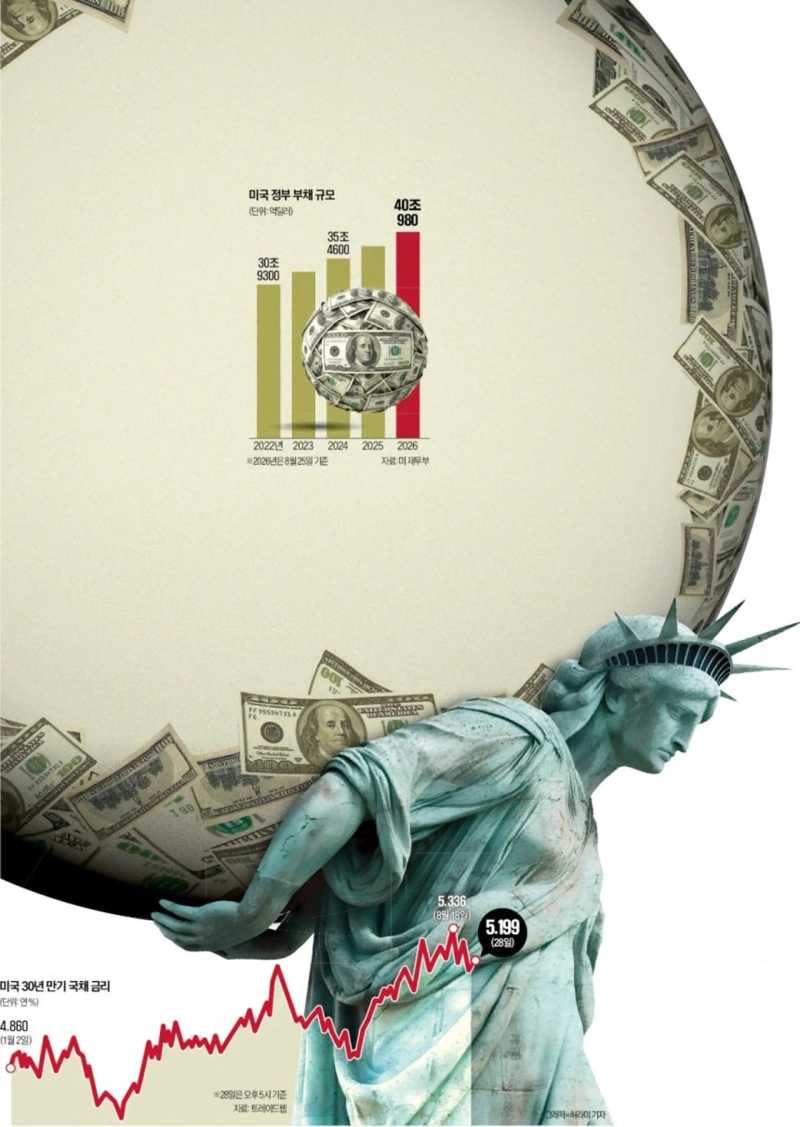
That debt load pushed the 30-year Treasury yield last week to 5.336%, the highest level since 2007. It was trading at 5.199% as of 5 p.m. on Aug. 28. Investors are increasingly pricing in the risk that the US government could face greater difficulty servicing its debt. Pressure is also building from another direction: AI hyperscalers have emerged as new rivals for long-term capital. Big Tech companies pouring money into data centers are issuing ultra-long corporate bonds at high yields. The result is an unprecedented fight for capital between the issuer of the world’s reserve currency and hyperscalers.
Treasury yields are the world’s benchmark borrowing rate. When US borrowing costs rise, financing costs for governments and companies around the world tend to climb as well. That weighs on global growth. If one or two AI companies tied to what the article describes as a circular financing system were to falter, the AI cycle could begin to unravel.
Debt that becomes difficult to control can also erode confidence in a currency. Central banks are gradually reducing their reliance on the dollar, while investors are turning to alternative stores of value such as gold and cryptocurrencies. The dollar is unlikely to lose its reserve-currency status anytime soon. Still, the shift is a warning that US monetary dominance may no longer be as strong as it once was.
What markets want is an end to the war in the Middle East. The longer the conflict lasts, the harder it will be for interest rates to decline, as inflation and fiscal concerns continue to build. The fundamental solution is fiscal consolidation. Treasury Secretary Scott Bessent has pledged to present a fiscal package aimed at cutting the budget deficit to 3% of gross domestic product from 6%. Markets remain skeptical. It will be difficult to curb already swollen mandatory spending or reverse the tax cuts promised by the Trump administration. America’s debt dilemma is casting a long shadow over the global economy.
US Debt Tops $40 Trillion as Dollar Dominance Wobbles
$8.5 Trillion of Low-Rate Treasuries Are Coming Due
The US is being forced to issue more expensive debt to repay maturing obligations. Large volumes of Treasuries sold at low rates before and around the Covid-19 outbreak are coming due, but the fiscal deficit has not narrowed. Investors buying new debt are demanding higher yields than before. With Treasuries no longer selling easily at low rates simply because they are viewed as safe assets, concern is growing that the era of unquestioned dollar dominance may be fading.
◇ Debt Rose $51 Billion in One Week
US federal debt stood at $40.098 trillion on Aug. 25, according to the Treasury Department. It first crossed $40 trillion on Aug. 18, when it reached $40.047 trillion. Just one week later, it had increased by another $51 billion. Debt that was below $20 trillion in 2017 has doubled in less than a decade.
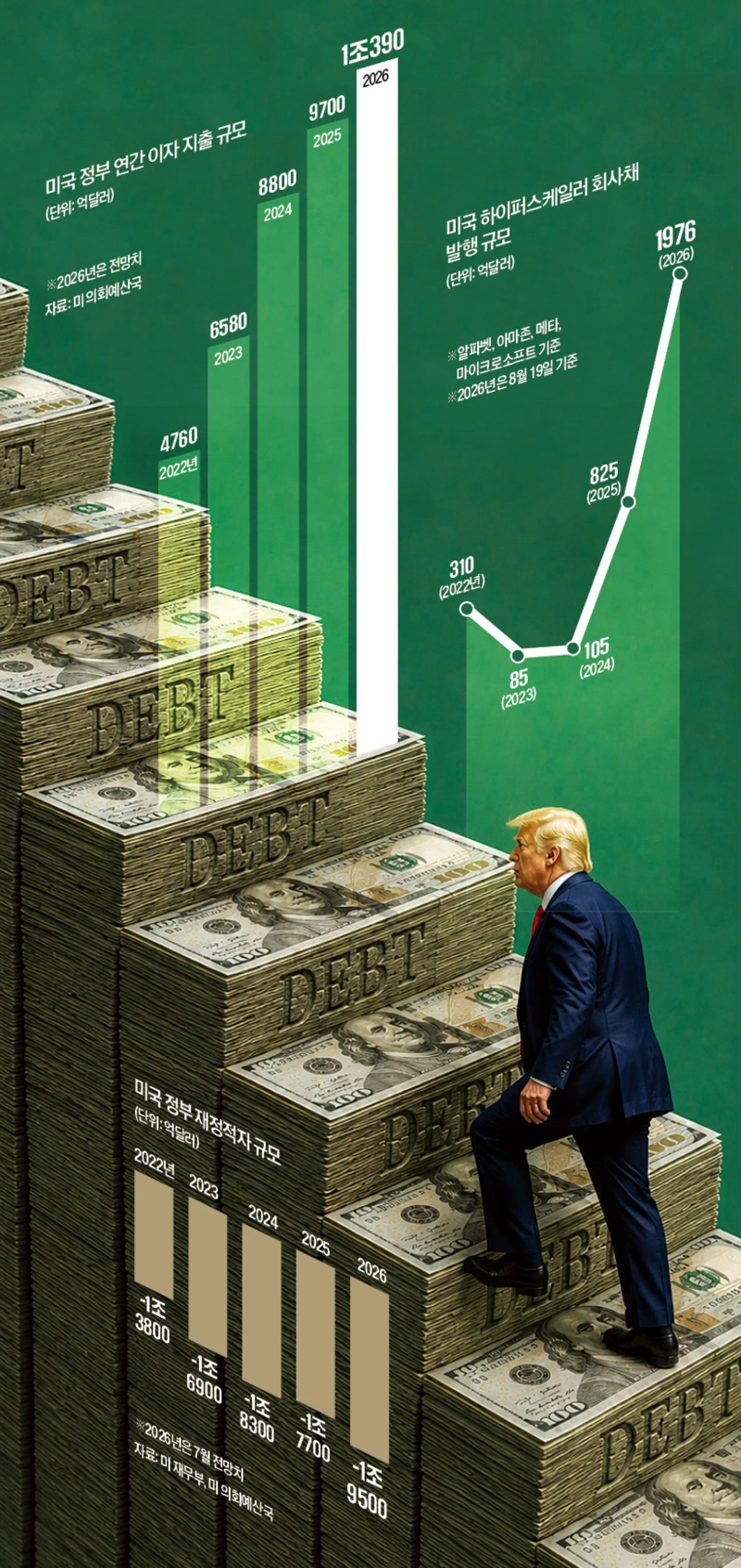
The bigger problem is that the interest burden is getting more expensive. The Treasury estimates that about $8.5 trillion of fixed-rate US government debt will mature between fiscal 2026 and 2028. If all of that is refinanced at rates 2 percentage points higher than before, the government’s interest burden would rise by about $170 billion by 2028, according to market estimates.
Refinancing at higher rates is eating into the federal budget. The Congressional Budget Office said interest payments in the first 10 months of fiscal 2026, from October 2025 through July 2026, totaled $963 billion, up 14% from a year earlier. That exceeded the defense budget for the current fiscal year. Interest consumed 21.5% of the $4.485 trillion in revenue collected during that period. The federal budget deficit reached $1.77 trillion last year and is projected to approach $2 trillion this year. Margaret Spellings, president of the Bipartisan Policy Center, said federal debt is pushing up living costs, crowding out other spending and investment, and threatening America’s long-term prosperity.
Bessent recently said there is “nothing magical” about the $40 trillion figure and argued that the US can grow its way out of debt. His point is that if the economy expands faster than interest costs rise, the debt ratio can come down. The broader view, however, is that growth alone will not be enough. Even the CBO’s forecasts already incorporate economic growth, and debt ratios will keep rising over the next decade unless taxes increase or spending on Social Security, health care and defense is cut.
That is the heart of the US dilemma. If Treasury yields are left entirely to the market, interest costs, mortgage rates and corporate borrowing costs all rise and weigh on growth. If the government and the Federal Reserve try to push rates down artificially, inflation concerns and questions about central-bank independence intensify. Investors could then demand even higher yields to reflect the risk of a weaker dollar.
Competition for long-term capital is also intensifying between the US government and private companies. Hyperscalers stepping up investment in artificial intelligence are flooding the market with corporate bonds. Yulia Alekseyeva, head of fixed income at MissionSquare Investments, said the wave of corporate issuance is competing with long-dated US Treasuries for investor demand and adding further upward pressure on long-term rates.
◇ Dollar Dominance Under Pressure
The Treasury’s answer has been buybacks. The US government said it will double the size of each buyback operation to $4 billion from $2 billion starting Sept. 9. Wall Street reacted negatively to the Treasury’s unusual intervention in pricing. Stanley Druckenmiller, the investor who mentored Bessent when he was a hedge fund trader, said artificially suppressing Treasury yields increases risks and called the move a mistake far larger than the $4 billion figure suggests.
The dollar’s dominance could also come under pressure. The greenback’s share of global foreign-exchange reserves held by major central banks has been falling, dropping to 57% in the first quarter from 71% in 1999. Gian Maria Milesi-Ferretti, a senior fellow at the Brookings Institution, said foreign central banks are unlikely to make a meaningful increase in their purchases of US Treasuries. As private investors make up a larger share of demand, US funding costs could become more sensitive to global risk appetite and geopolitical shifts.
The dollar is unlikely to lose its status as the world’s reserve currency anytime soon. But the privilege the US has long enjoyed from dollar dominance may shrink. Kenneth Rogoff, a Harvard University economics professor, said the dollar may no longer be as overwhelming as it once was, but it will remain the king of a smaller hill.
Seong-mi Shim, Hankyung reporter, smshim@hankyung.com
Ju-wan Kim, Hankyung reporter, kjwan@hankyung.com

Korea Economic Daily
hankyung@bloomingbit.ioThe Korea Economic Daily Global is a digital media where latest news on Korean companies, industries, and financial markets.