PiCK
Warsh Says Short-Term Rates Are Fed’s Main Tool, Sets Out Seven Principles at Jackson Hole
Summary
- Warsh said nontraditional policies should be avoided or used with caution.
- Warsh said short-term interest rates are the main policy tool for achieving the Fed’s dual mandate.
- Warsh said the money supply matters and that policymakers should also pay attention to money created through banks and the financial system.
Forecast Trend Report by Period


‘Nontraditional policies should be used sparingly’
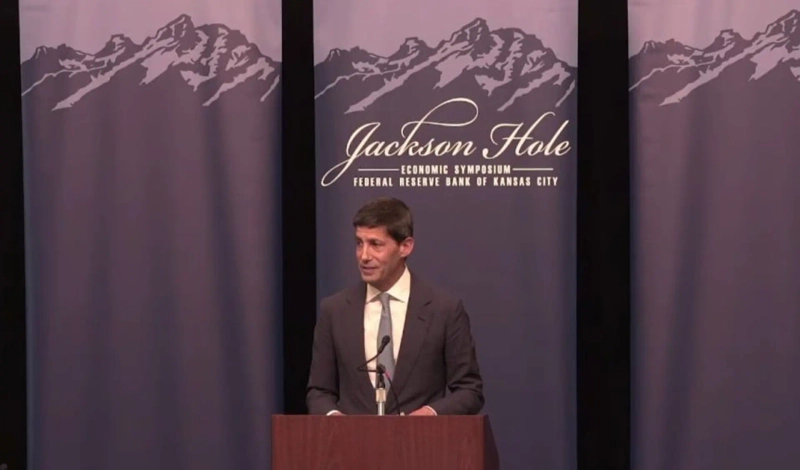
Federal Reserve Chair Kevin Warsh said on Aug. 28 at the annual Jackson Hole policy symposium in Wyoming that nontraditional policies used to spur economic activity should be avoided or deployed with caution.
Warsh used the speech to lay out seven principles he said should guide the Fed’s policy decisions.
First, policymakers should be careful not to make forward-looking decisions based on outdated or inaccurate data. “Trends matter,” he said.
Second, uncertainty is unavoidable when assessing the current and expected balance between aggregate supply and aggregate demand.
Third, delivering the Fed’s 2% inflation target, measured by the personal consumption expenditures price index, is the central bank’s responsibility. “There is no excuse” for falling short, he said.
His fourth principle was that the Fed is also responsible for achieving maximum employment and that the dual mandate of price stability and maximum employment is not in conflict. The reason, he said, is that high inflation itself is deeply damaging to economic prosperity.
Fifth, short-term interest rates are the primary policy tool for achieving the dual mandate. Warsh said nontraditional monetary policies may be appropriate in a genuine crisis, but outside such periods they should be avoided or used with caution.
His sixth principle was that “money matters.” While the topic may receive less attention these days, he said the money supply remains closely linked to monetary policy. Policymakers should pay attention not only to money supplied by the central bank, but also to money created through banks and the broader financial system.
Finally, Warsh said the Fed can achieve its goals more effectively if it communicates with greater care and a clearer sense of purpose. He cited Gen. Chuck Yeager’s remark that there is no need for excuses or for discussing results, only for accomplishing the mission. The key issue, he said, is not whether the Fed explains in detail where policy is headed, but whether it ultimately fulfills its dual mandate of controlling inflation and achieving maximum employment.
Hwang Jung-su, New York correspondent, hjs@hankyung.com
Lee Sang-eun, Washington correspondent, selee@hankyung.com

Korea Economic Daily
hankyung@bloomingbit.ioThe Korea Economic Daily Global is a digital media where latest news on Korean companies, industries, and financial markets.