Where Will $1.3 Trillion Go? Mapping the Companies Behind AI Data Centers
Forecast Trend Report by Period


Park Shin-young is the New York correspondent for Korea Economic Daily.
The third installment of “Park Shin-young’s Wall Street Anatomy” looks at the corporate map behind AI data centers.
In AI, securing GPUs is critical. But simply amassing GPUs is no longer enough. Companies also need space to install hundreds of thousands of them, networks to connect them, massive electricity supplies and cooling systems to handle the heat they generate.
The AI race is no longer just about securing chips. It is increasingly a contest over who can build larger, more powerful AI data centers the fastest.
Hyperscalers are set to spend $1.3 trillion in capital expenditures next year. A substantial share of that money will flow into data centers, benefiting the companies involved in building and equipping them.
This edition of “Wall Street Anatomy” examines why data centers have become so important in the AI era and which companies and industries are tied to that buildout.
How many data centers are there in the US?
Start with the scale of the US data-center market.
By this measure, the US has 3,408 data centers in total. Of those, 1,301 are operating and 2,059 are planned.
Operating data centers currently have about 61,000 megawatts of power capacity. Planned facilities account for about 378,000 megawatts.
To put that in perspective, 1 megawatt equals 1,000 kilowatts. In very simple terms, that is enough to supply electricity to about 1,000 US households, though actual consumption varies.
That means a single data center using several hundred megawatts can rival the electricity demand of a sizable city.
Planned facilities are now reaching the gigawatt scale.
The reason is AI.
Data centers before AI
Before AI, data centers worked differently.
When people shop online, search on Google, watch YouTube videos or check a bank account, a data center is working in the background.
Inside are thousands to tens of thousands of servers, each handling a different task.
Some servers handle search. Others process payments. Still others run databases or email.
Put simply, a traditional data center was a building packed with computers.
Its core functions were storage, computation and transmission.
AI is changing that structure in a major way.
AI is driving an explosion in computing demand
The biggest shift is in the amount of computation required.
CPUs are good at handling complex, varied tasks in sequence.
AI, by contrast, requires huge volumes of similar mathematical calculations repeated over and over.
GPUs can process those calculations in parallel and at scale. That point was explained in detail in the second “Wall Street Anatomy.”
That is why GPUs have become core hardware for AI training and inference.
As AI models grow larger, however, another problem has emerged.
One GPU is no longer enough.
One GPU isn’t enough
In traditional data centers, multiple CPU servers handled separate tasks.
In AI data centers, by contrast, thousands or tens of thousands of GPUs work together on a single AI model.
As models get larger, the number of GPUs required rises as well.
What matters now is not just the performance of a single GPU.
The key question is how many GPUs can be linked and operated as one system.
That is where networking becomes critical.
Communication between GPUs matters too
When GPUs work together on one AI model, they have to exchange data constantly.
The output from GPU 1 must be sent to GPU 2 and GPU 3. The next results then have to be shared again across the system.
No matter how fast the GPUs are, slow data transfer forces other chips to wait.
That means even expensive GPU clusters may not be fully utilized.
In AI data centers, performance depends not only on the GPUs themselves but also on how quickly they are connected to one another.
The data center as one giant computer
That is why the very concept of a data center is changing in the AI era.
If traditional data centers were buildings that housed many computers, AI data centers connect tens of thousands to hundreds of thousands of GPUs through ultra-fast networks.
Those GPUs then train and run inference on a single AI model together.
The result is that the entire data center operates like one giant AI computer.
So who will build these AI data centers?
Who will build the data centers?
Broadly, the players fall into four groups.
The first group is big tech and cloud companies such as AWS, Microsoft, Google, Meta and Oracle.
The second is AI companies such as OpenAI and xAI.
The third is AI infrastructure specialists such as CoreWeave and Nebius.
The fourth is dedicated data-center developers and operators such as QTS, Vantage and STACK.
The fourth group can be confusing.
Companies such as QTS and Vantage do not directly provide AI services. Instead, they build data-center facilities and power infrastructure and lease them to customers.
Those tenants may include hyperscalers such as Microsoft, AWS and Google. They may also include AI companies such as OpenAI and CoreWeave.
In other words, the company that builds the data center may be different from the company that uses the GPUs inside it.
Who will buy the GPUs?
That also means the company building the data center is not necessarily the one buying the GPUs.
Big tech companies such as AWS, Microsoft, Google and Meta can buy GPUs directly.
AI companies such as OpenAI and xAI, along with AI infrastructure firms such as CoreWeave, can also buy them directly.
By contrast, for companies such as QTS and Vantage that lease data-center space, the actual GPU buyer may be the tenant.
That means the data-center owner, the GPU buyer and the GPU user can all be different entities.
Nvidia is not just selling GPUs
It is no longer enough to think of Nvidia simply as a GPU vendor.
A group of GPUs becomes a server. A group of servers becomes a rack. Nvidia also sells server systems themselves.
And a server contains more than GPUs.
It also needs CPUs, memory, storage, networking, power supplies and cooling systems.
That means rising investment in AI data centers expands not only the GPU market but the entire data-center supply chain.
That is also why Nvidia works closely with memory companies.
HBM demand is surging
A jump in data-center demand ultimately means a jump in server demand.
As server demand rises, demand also increases for the other components that go into those systems, not just GPUs.
A leading example is high-bandwidth memory, or HBM.
For GPUs to compute at extremely high speed, they need memory that can feed them data quickly.
No matter how fast the GPU is, it still has to wait if memory cannot deliver data fast enough.
That is why HBM, which is much faster than conventional memory, has become critical for AI GPUs.
Major suppliers include SK Hynix, Samsung Electronics and Micron Technology.
As GPU volumes rise, HBM demand rises with them.
Storage demand is also rising fast
Storage matters too.
If HBM is like a desk where data can be laid out for immediate use, storage is more like a drawer or warehouse for keeping data longer term.
Training AI models requires storing huge amounts of data.
That data also has to be moved quickly to GPUs when needed.
That is driving demand for NAND and high-performance solid-state drives.
Samsung Electronics, SK Hynix, Kioxia and Micron are among the companies in that market.
SSD controller makers are also part of the chain.
Watch the network layer
Networking is particularly important in AI data centers.
That is because tens of thousands of GPUs are exchanging data at the same time.
As a result, switches, network interface cards, optical transceivers and optical fiber are all needed.
That ties AI data-center investment not only to networking companies such as Broadcom and Arista Networks, but also to optical communications firms such as Coherent and Lumentum and fiber makers such as Corning and Prysmian.
Power-supply equipment also matters
Next comes electricity.
As GPU performance increases, power consumption for each server and each rack is rising quickly.
Electricity coming in from outside has to be converted and delivered safely to servers. Backup power systems such as uninterruptible power supplies and generators are also required in case of outages.
Leading companies in that area include Vertiv, Eaton, Schneider Electric, Delta Electronics and Flex.
That is why AI investment is extending into traditional electrical-equipment makers.
The more electricity a system uses, the more heat it generates.
In the past, data centers mainly used air to cool servers.
But as the power density of AI GPUs rises, air cooling alone is becoming harder to manage.
That is increasing demand for new cooling systems, including liquid cooling.
Major companies include Vertiv, Modine, nVent, Schneider Electric and Johnson Controls.
Following the money through data-center servers
There are several ways server purchases are structured in the data-center market.
Dell Technologies or Super Micro Computer may buy GPUs from Nvidia, install them in servers, build finished systems and sell them to Microsoft.
In that case, the money flows from Microsoft to the server maker to Nvidia.
Alternatively, Microsoft may negotiate directly with Nvidia over GPU supply and outsource only assembly to ODMs such as Foxconn or Quanta.
That means the end user of the GPU is not necessarily the same as Nvidia’s direct customer for accounting purposes.
So where does data-center investment go, and in what proportions?
Assume $100 is invested in an AI data center.
According to Stifel, IT equipment accounts for about $65. That includes GPU servers, storage and networking.
The building accounts for about $14. Electrical systems account for another $14. Cooling systems make up about $7.
The actual mix can vary by data center.
How AI demand becomes data-center capex
Why is so much money flowing into data centers?
First, it helps to draw a simple distinction between cloud services and data centers.
A data center is the physical facility that houses servers and GPUs. It is where GPUs and servers are installed inside a building equipped with power and cooling infrastructure.
Cloud, by contrast, is the service of renting out those computing resources to customers over the internet.
For example, AWS and Microsoft Azure offer cloud services that rent AI computing to customers. But to provide that service, they ultimately need data centers filled with GPUs behind the scenes.
That means rising cloud demand requires more computing capacity, which in turn requires more data centers to be built.
Nvidia emphasized that point in its latest second-quarter earnings report.
Chief Financial Officer Colette Kress said the cloud industry’s backlog has exceeded $2 trillion.
Put simply, backlog refers to services cloud companies have already contracted to provide to customers in the future.
That means a large amount of computing capacity will still be needed.
As demand from AI customers rises, cloud providers are building larger backlogs of services they still have to deliver. To meet that demand, they need more computing resources.
That forces cloud companies to expand data-center capacity. As they do, large capital expenditures drive demand not only for GPUs and servers, but also for networking, power and cooling equipment.
Data-center power consumption is set to surge
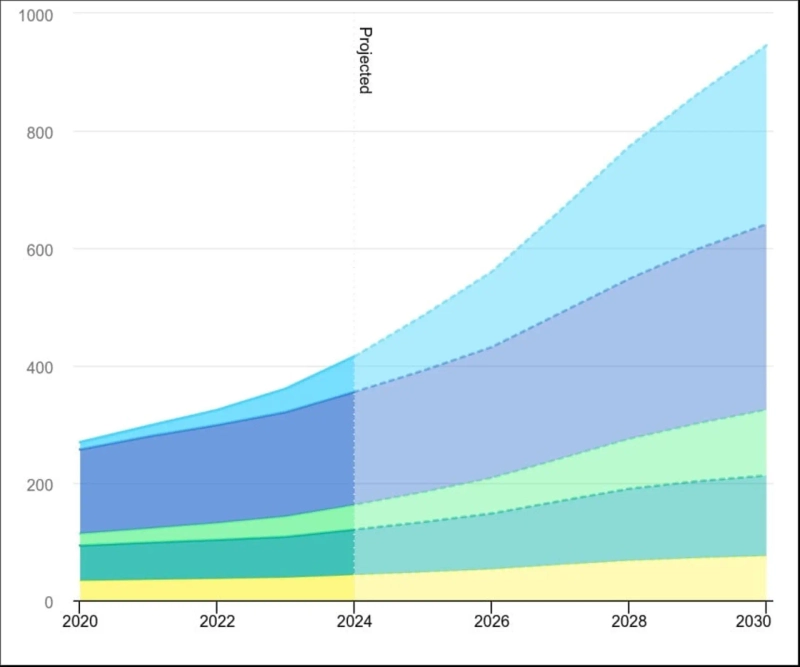
Now consider how much electricity data centers are likely to consume.
This chart is based on the International Energy Agency’s official outlook.
The colors break down data-center electricity use into four equipment categories.
The yellow band at the bottom represents other infrastructure needed to operate a data center, such as cooling and uninterruptible power supply systems.
The teal band above that covers non-server IT equipment such as storage and networking. The blue band represents conventional CPU-based servers.
The light-blue band at the top represents AI servers equipped with accelerators such as GPUs.
That top band is the key point. It expands sharply after 2024. The IEA projects power consumption from accelerated servers will grow about 30% a year on average through 2030, driven by the spread of AI.
By contrast, electricity consumption from conventional CPU-based servers is projected to rise about 9% a year on average.
The IEA estimates that nearly half of the increase in data-center power consumption between 2024 and 2030 will come from accelerated servers.
Looking at the full chart, global data-center electricity consumption is projected to more than double, rising from about 415 terawatt-hours in 2024 to about 945 terawatt-hours by 2030.
The US accounts for about 45% to 50% of that total.
Six bottlenecks slowing data-center construction
The first bottleneck is securing power and connecting to the grid.
A single AI data center can require several hundred megawatts to several gigawatts of electricity.
But generating electricity at a power plant and making that power available for use at a data center are two different things.
There has to be spare grid capacity, and substations are needed as well.
That is why companies can secure a building site and still wait years to get power.
The second bottleneck is shortages of transformers, switchgear and generators.
Data centers need transformers to step down high-voltage electricity from power plants, switchgear to distribute electricity safely, and generators and uninterruptible power supply systems for emergencies.
As data-center projects increase around the world at the same time, orders for that equipment are also piling up.
JLL says average lead times for US data-center-related equipment are about 42 weeks, 83% longer than in 2019.
Generators take about 51 weeks. Transformers and switchgear take about 43 weeks.
The third issue is the time required to build transmission infrastructure.
When a gigawatt-scale data center is added, existing transmission networks often cannot support it.
That means new transmission lines and substations have to be built.
The IEA says building new transmission lines in advanced economies can take four to eight years.
Securing large power transformers can also take as long as four years.
That is why the industry looks beyond simple construction schedules and focuses on time to power, or when a facility can actually receive electricity and start running GPUs.
The fourth bottleneck is permitting and local opposition.
Because data centers use large amounts of electricity and water, local residents may oppose them over power prices or environmental concerns. Developers also have to clear local government permitting hurdles.
The fifth bottleneck is the cooling and power-equipment supply chain.
As GPU power density rises, data centers need chillers, liquid cooling, coolant distribution units, rear-door heat exchangers and large-scale piping systems.
Even if a company secures GPUs, it still cannot operate them if the cooling system is not ready.
The sixth bottleneck is a shortage of skilled labor.
Data centers require electricians, substation specialists, cooling engineers, piping experts and construction workers with data-center experience.
But power plants and transmission-network projects need many of the same workers.
That means multiple projects end up competing for the same labor and equipment.
Delays are already showing up.
JLL says 57% of data-center projects in 2025 faced construction delays of more than three months.
The global average construction time for a standard 50-megawatt data center is about 18 months, and some critical equipment is ordered as much as 24 months in advance.
Six risks when data centers are delayed
Because of these bottlenecks, a data center completed later than planned faces more than a scheduling problem.
The first risk is delayed revenue generation.
A data center must be operational before it can run GPUs and sell AI training and inference services.
According to the Carnegie Endowment model, a 100-megawatt Blackwell data center operating normally could generate about $200 million in gross monthly revenue.
If the launch is delayed by several months, that revenue opportunity is pushed back as well.
The second risk is a decline in the data center’s economic value.
That means the present value of its future cash flow falls.
In the Carnegie model, a 100-megawatt US AI data center loses about $353 million in lifetime value if delayed by six months, about $543 million if delayed by a year and about $877 million if delayed by 18 months.
An 18-month delay amounts to about an 8.9% decline in value.
The third risk is the loss of the GPU’s economic life.
AI GPUs turn over very quickly from one generation to the next.
A company may order the latest GPU today, but if the data center is delayed by more than a year, a next-generation chip may be available by then.
The original GPU is not broken, but its relative performance and profitability may decline.
In other words, there is a risk that expensive GPUs are not fully used during the early period when they can generate the most money.
The fourth risk is rising construction and financing costs.
Even if work is delayed, labor, materials and management costs continue.
If the project was financed with debt, interest keeps accruing even though revenue has not started yet.
That means revenue is pushed back while costs keep rising.
The fifth risk is damage to customer contracts and trust.
This is especially important for neocloud providers such as CoreWeave and for companies that provide GPU computing to outside customers.
If they fail to deliver promised capacity on time, the problem can escalate quickly.
That can mean not only lost revenue but also contractual penalties, customer churn and reputational damage.
The sixth risk is weaker investment returns and heavier debt pressure.
Data centers require billions of dollars of upfront investment before cash flow is recovered later.
If the start of operations is delayed, cash inflows are postponed while interest expense and fixed costs continue.
That can reduce return on investment and add pressure to liquidity and credit quality.
New York — Park Shin-young, correspondent, Korea Economic Daily, nyusos@hankyung.com

Korea Economic Daily
hankyung@bloomingbit.ioThe Korea Economic Daily Global is a digital media where latest news on Korean companies, industries, and financial markets.