South Korea's Non-Middle East Crude Imports Jump 40%; Iraqi Oil at Zero for First Time in 20 Years
Summary
- Imports of crude from outside the Middle East rose 40% from a year earlier in August, while the share of Middle Eastern crude fell to 61.1% from 69.5%.
- Imports of Iraqi crude fell to zero for the first time in 20 years and two months, while purchases of US, Canadian and African crude increased sharply.
- Industry officials said reduced traffic through the Hormuz Strait and the blockade of the Bab el-Mandeb Strait mean crude import volumes could decline again in September and October.
Forecast Trend Report by Period


Impact of the Hormuz Strait blockade
Refiners diversify crude supply sources
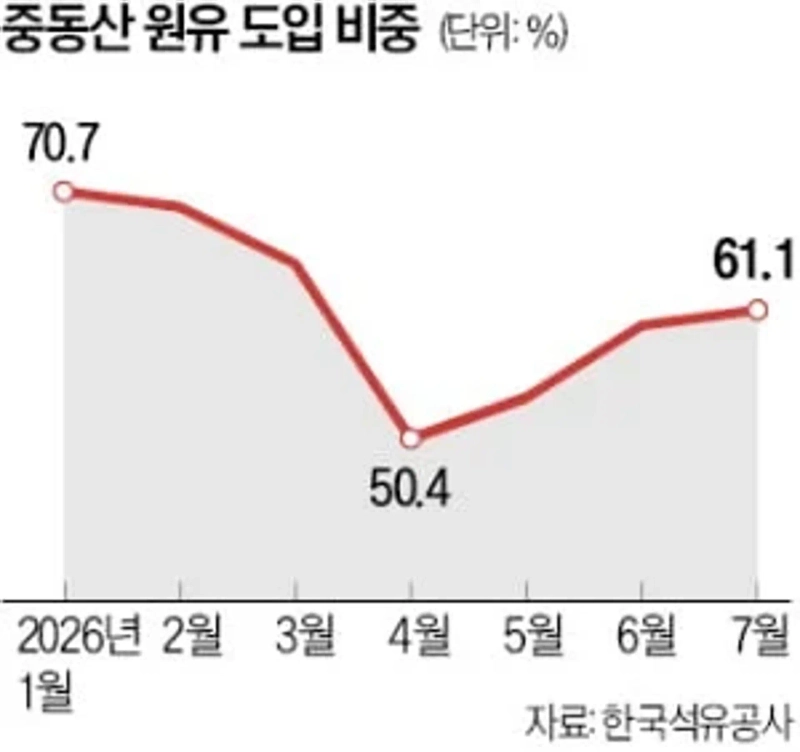
South Korea's crude imports from outside the Middle East rose 40% in August from a year earlier. Imports of Iraqi crude, the country's fourth-largest source last year, fell to zero for the first time in 20 years as the fallout from the Hormuz Strait blockade disrupted shipments. The shift points to a rapid diversification of supply sources by South Korean refiners.
Data from Korea National Oil Corp. showed crude imports from the Middle East, including Saudi Arabia, fell 3.5% from a year earlier to 56.9 million barrels in August. Middle Eastern crude accounted for 61.1% of total imports, down from 69.5% a year earlier. Imports from outside the region rose to 36.28 million barrels from 25.92 million barrels.
North American and African barrels filled much of the gap. Backed by government support for freight costs on non-Middle Eastern crude, imports from the US rose 28.5% from a year earlier to 17.3 million barrels, while Canadian shipments surged 112.1% to 2.32 million barrels. Imports from Africa climbed 49% to 5.71 million barrels.
Imports of Iraqi crude were recorded at zero in August. It was the first time since May 2006 that shipments from Iraq stopped, ending a stretch of 20 years and two months. Iraq's main export terminals are located inside the Hormuz Strait, suggesting the blockade cut off export routes. Imports from Kuwait also fell 39.5% from a year earlier to 4 million barrels.
Imports rose, however, from countries with alternative export routes that bypass the strait. Saudi crude imports increased 7.6% from a year earlier to 30.71 million barrels, while shipments from the United Arab Emirates rose 17.5% to 14.28 million barrels. Oman, which had no shipments in August 2025, supplied 5.04 million barrels in August. The share of those three countries in South Korea's Middle Eastern crude imports climbed to 87.9% from 69%. Fujairah in the UAE, Yanbu in Saudi Arabia and Oman's main loading ports are among the best-known terminals that can avoid the Hormuz Strait.
South Korea's refining system is geared toward processing heavier, sour crude from the Middle East. Because those barrels are difficult to replace quickly, refiners appear to have first raised purchases from Middle Eastern producers with alternative shipping routes.
Total crude imports rose 26.6% from July to 93.18 million barrels in August. That increase came after transit through the Hormuz Strait briefly resumed in late July, allowing cargoes aboard South Korea-bound tankers waiting inside the strait to arrive at once. An industry official said imports may fall again in September and October as traffic through the Hormuz Strait has tightened again and more tankers are detouring around the Cape of Good Hope after disruptions at the Bab el-Mandeb Strait.
Song Jun-young, Hankyung.com reporter ssong@hankyung.com

Korea Economic Daily
hankyung@bloomingbit.ioThe Korea Economic Daily Global is a digital media where latest news on Korean companies, industries, and financial markets.