South Korea’s Potentially Taxable Crypto Activity Reaches $10.9 Billion, Ranking 11th Globally Ahead of 2027 Tax
Forecast Trend Report by Period


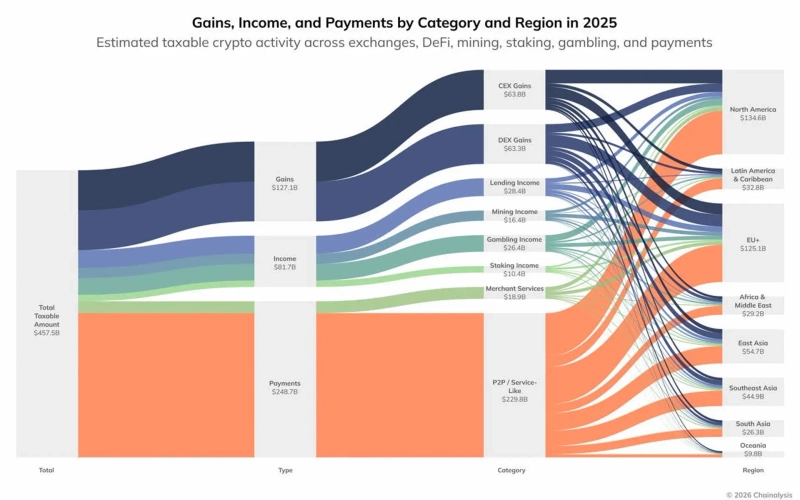
As South Korea prepares to begin taxing virtual assets in 2027, debate is continuing over tax standards and how to track transaction data. Against that backdrop, the country’s potentially taxable crypto activity is estimated to have reached about $10.9 billion in 2025.
Chainalysis said in its Crypto Tax Report released on Aug. 31 that South Korea’s potentially taxable on-chain activity in 2025 totaled $10.9 billion. That included $2 billion in income, $3.2 billion in trading gains and $5.6 billion in payments. The report analyzed on-chain data from six major blockchains: Bitcoin, Ethereum, Solana, Tron, BNB Smart Chain and Base. Among the countries studied, South Korea ranked 11th, behind the US at $112.6 billion, Germany at $24.1 billion and China at $21 billion.
The report said potentially taxable activity does not refer to actual tax assessments or projected tax revenue. Instead, it measures crypto-related gains, income and payment activity observed on blockchains without applying country-specific tax rates or individual exemptions. It also excludes trading within centralized exchanges and some activity that is difficult to verify directly on-chain, including staking and lending. As a result, the actual pool of potentially taxable activity could be larger than the report indicates.
In South Korea, potentially taxable crypto activity was equal to about 144.05% of the government’s fiscal deficit of $7.5 billion in the same year. That was the second-highest ratio among the countries analyzed, after Portugal. The comparison does not mean crypto taxes could generate revenue equivalent to the fiscal deficit. It compares the total volume of potentially taxable activity with the government’s budget shortfall.
Potentially taxable activity was also concentrated in a relatively small share of wallets. In South Korea, 28% of wallet addresses accounted for 87% of that activity. In Singapore, 20% of addresses made up 89% of activity, while in Brazil, 32% of addresses accounted for 87%. Japan showed a more even distribution, with 27% of addresses accounting for 57% of activity.
The global environment for crypto taxation is also shifting. As the Organization for Economic Cooperation and Development’s Crypto-Asset Reporting Framework, or CARF, is introduced, many countries are set to begin automatically exchanging crypto transaction information from 2027. Even so, the report found that only about 14% of global on-chain potentially taxable activity could be captured through CARF. The remaining 86% falls outside its practical scope, including decentralized exchange activity, peer-to-peer transfers, on-chain income and payments.
That underscores the importance of using both off-chain information provided by businesses such as exchanges and on-chain data that can be verified directly on blockchains. As trading activity becomes dispersed across self-custody wallets, decentralized exchanges and overseas platforms, exchange-reported data alone has limits in identifying a taxpayer’s full crypto activity. Combining information gathered through systems such as CARF with blockchain data would provide a broader picture of taxpayer activity, the report said.
Kwon Joon-hyuk, head of Chainalysis Korea, said the key issue ahead of the 2027 introduction of crypto taxation is not only setting tax standards but also how accurately authorities can identify taxable activity. Using taxpayer and transaction reporting data obtained through CARF together with on-chain data visible directly on blockchains would help close information blind spots and allow authorities to identify taxable activity more broadly and accurately, he added.

Minseung Kang
minriver@bloomingbit.ioBlockchain journalist | Writer of Trade Now & Altcoin Now, must-read content for investors.