Kospi Erases 3.6% Slide to Close Above 6,800 as Samsung, SK Hynix Buybacks Support Market
Summary
- The Kospi held above 6,800 on support from shareholder returns at Samsung Electronics and SK Hynix.
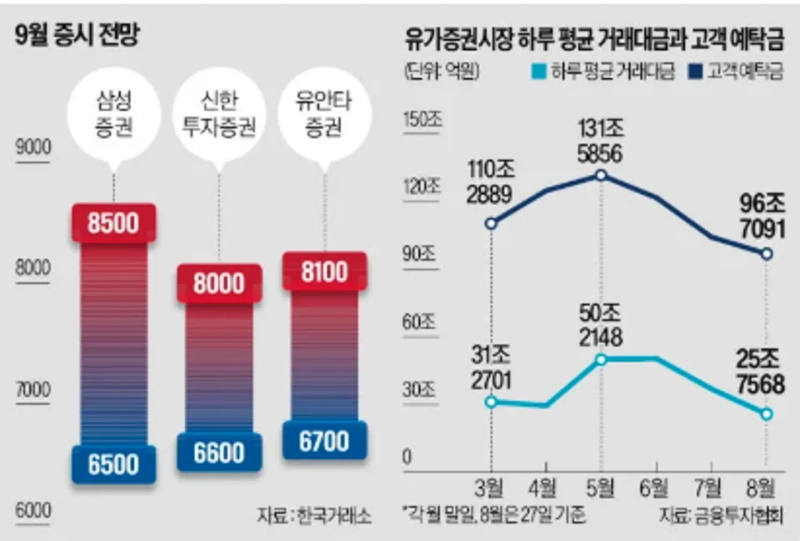
- Brokerages projected September Kospi bands of 6,700-8,100 and 6,600-8,000, with some seeing room for a move to 8,000.
- Analysts said the September FOMC, BOJ rate decision, a potential yen-carry unwind, and rate normalization will be key drivers of the market’s direction.
Forecast Trend Report by Period


Foreigners, institutions and retail investors all sold on a net basis; only other corporations were net buyers
Easing concern over additional U.S. rate hikes
helped the Kospi recover from an early plunge
Some brokerages see upside to 8,000 in September
with focus on FOMC and BOJ rate decisions
South Korea’s Kospi rose despite hawkish comments from Federal Reserve Chair Kevin Warsh. Retail investors, foreigners and institutions all sold stocks as external uncertainty mounted, but shareholder return programs at Samsung Electronics and SK Hynix helped the benchmark hold above 6,800. Brokerages are now watching whether the index can clear 7,000 in September and climb toward 8,000.
◇ Other corporations bought a net 1.5429 trillion won
The Kospi closed up 0.46% at 6,820.02 on Aug. 31. The benchmark opened lower and at one point fell as much as 3.55% to 6,547.76 before sharply trimming losses in the afternoon and ending in positive territory. The Kosdaq closed down 0.49% at 834.29.
Trading was driven by shifting interpretations of Warsh’s “inflation vigilance” remarks at the Jackson Hole economic symposium in Wyoming on Aug. 28. Stocks fell early as investors took the comments to mean the Fed could still raise rates because of inflation concerns. Sentiment later reversed as the market downplayed the significance of the remarks. Lee Eun-taek, a director at KB Securities, said Warsh’s comments were hawkish but mostly repeated a position he had already outlined. The decision appears set to depend on inflation data. Unless geopolitical risks intensify, consumer prices are unlikely to spike in the short term, Lee said.
Samsung Electronics and SK Hynix, which have been buying back treasury shares as part of shareholder return programs, also saw strong net buying. Other corporations purchased a net 1.5429 trillion won worth of stocks on the day. Individuals sold a net 235 billion won, institutions sold 869.4 billion won and foreigners sold 439.4 billion won. Samsung Electronics fell into the 240,000-won range during the session before closing up 1.17% at 260,000 won. SK Hynix, which had dropped into the 1.5 million-won range, ended 1.27% higher at 1,674,000 won.
◇ '8,000 is possible' vs. 'A rapid rally will be difficult'
The market’s rebound after a sharp early drop is also lifting expectations for September. Brokerages are considering two broad scenarios for the Kospi: that it remains in the 6,000 range or jumps toward 8,000.
Yuanta Securities forecast the Kospi at 6,700 to 8,100 in September. Kim Yong-gu, a researcher at Yuanta Securities, said the firm’s central projection for the month is 7,300. He added that the index could normalize in stages and move toward 8,200 in October. Shinhan Securities presented a September band of 6,600 to 8,000. Noh Dong-gil, a researcher at Shinhan Securities, said the Kospi could recover to 8,000 if a funding shock among artificial intelligence companies does not materialize.
Still, some expect any advance above 7,000 to be hard to sustain. In a September asset-allocation strategy report, Shin Young Securities said the Kospi is currently caught between profit-taking and bargain buying in the 6,000-7,000 range. Retail investors bought aggressively above 7,000 while foreigners sold, the firm said. That leaves many obstacles to a rapid climb.
Brokerages pointed to the macroeconomic backdrop as the biggest variable for September. Daishin Securities highlighted mid-September, when the Federal Open Market Committee and the Bank of Japan are due to announce rate decisions, as a potential turning point. Lee Kyung-min, a researcher at the firm, said a BOJ rate increase followed by a sharp rally in the yen could trigger an unwind of yen-carry trades and heighten volatility across global risk assets.
Kim of Yuanta said rate normalization would be a key driver for further gains. He said the undervaluation of South Korean equities reflects a surge in long-term U.S. yields driven by persistently high inflation, elevated rates and concerns over fiscal deficits. Stocks should stabilize as long-term yields settle with the Fed holding rates steady and the U.S. Treasury coordinating fiscal policy, he added.
Kang Jin-kyu, Lee Sun-a and Go Song-hee, Hankyung.com reporters josep@hankyung.com

Korea Economic Daily
hankyung@bloomingbit.ioThe Korea Economic Daily Global is a digital media where latest news on Korean companies, industries, and financial markets.