Bessent Urges G20 to Raise Barriers to Chinese Goods as Calls Grow for New Plaza Accord
Summary
- The U.S. Treasury Department said it will urge the G20 to join the trade fight through high tariffs on Chinese goods and import bans.
- It said discussion is growing over pressure for yuan appreciation and a second Plaza Accord in response to China’s $1.2 trillion trade surplus and undervalued yuan.
- It said participation by major trading partners including the EU and Latin America in Washington’s push for joint tariffs remains uncertain, making upcoming EU-China trade talks a key test.
Forecast Trend Report by Period


“We can’t hold out any longer against cheap Chinese goods”
Bessent pushes joint tariffs on China
Treasury chief to urge trade barriers at G20 finance meeting
U.S. Treasury: China’s trade surplus is $1.2 trillion
Blocking its exports depends on how other countries respond
Pressure on Beijing shifts to a multilateral framework
Calls also grow for a “second Plaza Accord”
aimed at pushing the yuan higher
Bessent Seeks to Widen Trade Fight
Scott Bessent, the U.S. Treasury secretary, told Reuters on Aug. 30, a day before a meeting of G20 finance ministers, that he plans to urge the group to review trade terms with China as a way to reduce global imbalances. The proposal would press other G20 countries to join the U.S. by imposing high tariffs on Chinese goods and banning imports of some items.
Bessent also argued that Beijing should be pushed to focus on domestic demand rather than exports. In his view, China is shipping excess output abroad at low prices because weak consumption at home is leaving goods unsold in the domestic market. That is hurting manufacturing in importing countries while worsening their trade deficits and debt burdens. Whether China can keep offsetting weak domestic demand through exports, he added, depends on how other countries respond.
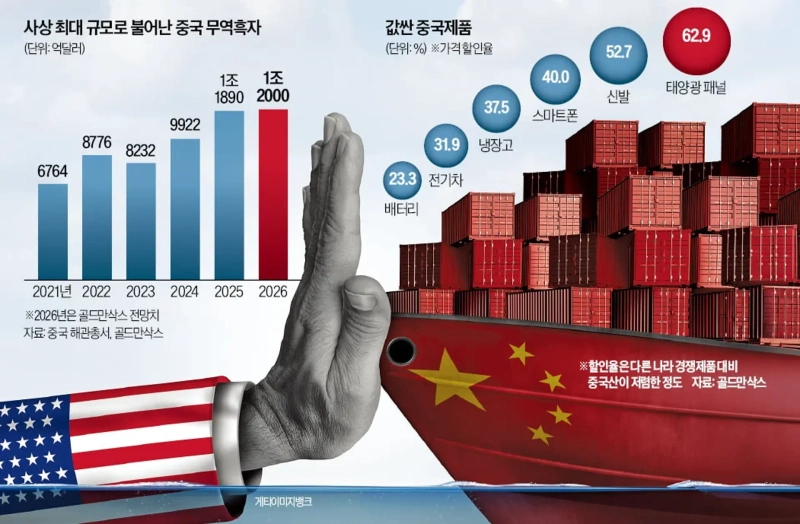
The push is aimed at recasting the trade war with China into a multilateral pressure campaign. China’s trade surplus has continued to expand despite U.S. efforts to contain it. Data from China’s General Administration of Customs and Goldman Sachs show the surplus rose to $1.189 trillion last year from $676.4 billion in 2021, and is projected to reach $1.2 trillion this year. The increase reflects a spillover effect in which Chinese goods shut out of the U.S. market are flowing instead to Europe and Latin America.
Pressure Builds for Yuan Revaluation
China’s trade surplus translates into deficits for its trading partners. Bessent warned that the global economy cannot keep absorbing annual Chinese surpluses of more than $1 trillion.
Concern over China is rising across the world. Some are calling for a new Plaza Accord with China, three decades after the original deal, to fend off what they describe as an export offensive from the country. The 1985 Plaza Accord was a coordinated currency policy agreement among the U.S., Japan, West Germany, the U.K. and France to weaken the dollar and drive up the yen. Its purpose was to narrow the rapidly expanding U.S. trade deficit.
The idea now differs from the 1985 framework. The focus is not on weakening an overvalued dollar, but on lifting the yuan, which the Council on Foreign Relations estimates is undervalued by as much as 35% relative to its fair value. A weaker yuan makes Chinese exports more price-competitive. Goldman Sachs estimates China’s production costs are lower than those of overseas rivals by about 32% for electric vehicles, 38% for refrigerators and 53% for shoes.
Some in U.S. business circles have proposed a system under which major economies would impose joint tariffs on Chinese goods and then lower those tariffs if China allows the yuan to appreciate. The Wall Street Journal said the goal should be to raise the value of an undervalued Chinese yuan rather than bring down an overvalued dollar.
Can a United Front Be Built?
The European Union, which ran a $412 billion trade deficit with China last year, is highly wary of Chinese products. Even so, it cannot ignore its heavy dependence on trade with China. Latin American countries including Brazil are also likely to be reluctant to support sweeping trade barriers against Beijing. That is why it remains unclear whether G20 countries will embrace Washington’s demands.
Trade talks scheduled for October between the EU and China will be a key test of whether multilateral pressure on Beijing can take shape. There is also a view that Washington will need to offer incentives if it wants to secure cooperation from G20 members.
Hwang Jung-soo, New York correspondent / Lee Hye-in, reporter hjs@hankyung.com

Korea Economic Daily
hankyung@bloomingbit.ioThe Korea Economic Daily Global is a digital media where latest news on Korean companies, industries, and financial markets.