Korea Retail Stock Buying Falls to a Tenth of June Level After July Rout
Summary
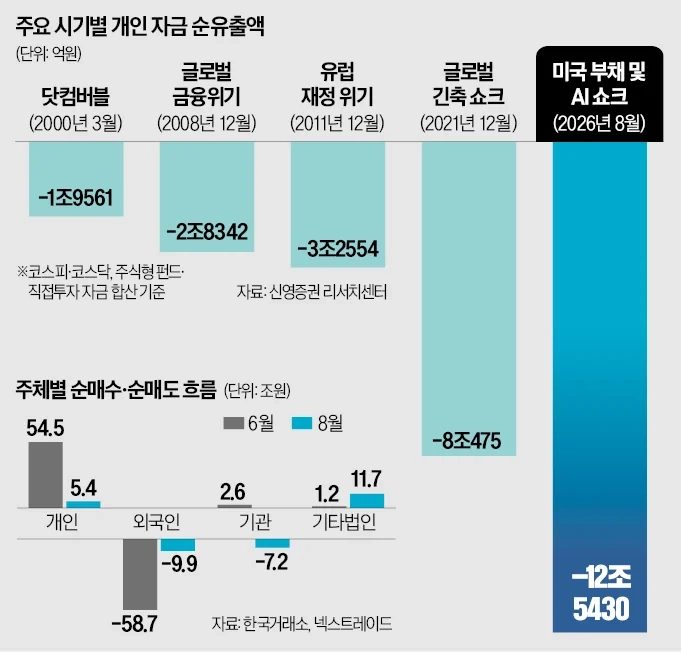
- A supply-and-demand vacuum in the stock market widened as 12 trillion won flowed out of retail funds in August, retail net buying plunged from 54.5 trillion won to 5.4 trillion won, and investor deposits fell below 100 trillion won.
- 11.7 trillion won in net buying by other corporations tied to share buybacks by Samsung Electronics and SK Hynix has served as a temporary backstop for the index, but could end as early as early to mid-October.
- Experts said easing foreign selling, expectations for a return to net foreign buying, and won strength will be the key variables for future stock-market flows.
Forecast Trend Report by Period


12 trillion won ($8.7 billion) of retail money left the market in August, more than during the financial crisis
Retail net buying plunged to 5.4 trillion won from 54.5 trillion won
Investor deposits fell below 100 trillion won
'Other corporations' backstop may last only another month
Stronger won raises hopes for foreign inflows
Retail investors were the main force behind the stock-market rally that gathered pace in November last year. Through July, foreign investors sold nearly 200 trillion won ($145 billion) of Kospi shares, while individuals snapped up a net 140 trillion won ($101.4 billion), helping power the advance. A shift of money out of time deposits and into stocks also emerged.
Those retail traders have struggled to return after the recent market correction. Individuals who bought at higher index levels have been quick to sell once prices recover enough to break even, capping gains. Foreign and institutional investors have also continued to sell, creating a supply-and-demand vacuum as all three major buyer groups step back.
Retail, Foreign and Institutional Investors Pull Back
Shinyoung Securities said net inflows from individual investors into the stock market were positive every month from January through July, pushing the cumulative total above 120 trillion won ($87 billion) this year. In just seven months, inflows topped the 75 trillion won ($54.4 billion) recorded in all of 2021, when the retail-driven Donghak Ant investing craze was at its peak.
The mood shifted last month. After the sharp selloff in late July, market funds swung to their first net outflow of the year. Kim Hak-kyun, head of research at Shinyoung Securities, said liquidity typically follows share-price moves. The Kospi's sharp drop from July triggered a large withdrawal of money in August.
The slide in sentiment is also evident in net-buying trends including margin purchases and deferred-payment trading. Data from the Korea Exchange and Nextrade showed retail investors' net purchases on the Kospi plunged 90% to 5.4 trillion won ($3.9 billion) last month from 54.5 trillion won ($39.5 billion) in June. Individuals bought more than 3 trillion won ($2.2 billion) on Sept. 2 as the Kospi tumbled almost 4%, but heavy net selling could resume. Kim Jun-young, an analyst at iM Securities, said the pattern has been repeated: investors buy when the index falls below 6,500, and selling pressure builds above 7,000. Unlike the first half, the push to recoup losses now outweighs expectations for a sustained rally. Investor deposits have also remained below 100 trillion won ($72.5 billion) for five straight trading days.
Retail investors are not alone. Foreign investors cut net selling to 9.9 trillion won ($7.2 billion) last month from 58.7 trillion won ($42.5 billion) in June, but they are still in selling mode. Institutions, meanwhile, switched from net buyers to net sellers. Han Ji-young, an analyst at Kiwoom Securities, said each group has its own reason for selling: retail investors are trying to avoid losses and exit at break-even levels, institutions are adjusting positions, and foreign investors are taking profits and hedging macro risks.
'Even the Backstop Could Be Gone in a Month'
The only group buying more Kospi shares than two months ago is other corporations. Net purchases by that category rose to 11.7 trillion won ($8.5 billion) last month from 1.2 trillion won ($870 million) in June, helped by share buybacks from Samsung Electronics and SK Hynix. As a result, all three main investor groups were net sellers on Aug. 31 and Sept. 1, yet the index still managed to edge higher on buying from other corporations alone.
That support is expected to prove temporary. Brokerages estimate the two chipmakers could complete their current buybacks as early as early to mid-October if they keep up the current pace. That would remove a key market backstop in little more than a month.
Market watchers say the next shift in flows now hinges on foreign investors. Kim said retail investors are unlikely to lead another bull run while cash reserves have thinned and the artificial-intelligence growth narrative remains under pressure despite strong semiconductor earnings. With foreign selling easing, a return to net foreign buying bears watching.
The won's recent strength is also a positive signal for foreign inflows. The won closed at 1,368.70 per dollar as of 3:30 p.m. on Sept. 2. That was 12.3% below its June peak of 1,561.50 per dollar.
Lee Sun-a, Hankyung.com reporter suna@hankyung.com

Korea Economic Daily
hankyung@bloomingbit.ioThe Korea Economic Daily Global is a digital media where latest news on Korean companies, industries, and financial markets.