Wall Street Banks Mount Joint Dollar Stablecoin Push to Challenge Tether, Circle
Summary
- Twenty-one global financial firms including Goldman Sachs said they will jointly issue a dollar stablecoin in the first half of 2027 to challenge USDT and USDC.
- The consortium said it will target the cross-border payments and digital-asset settlement markets, then expand issuance to stablecoins tied to G7 currencies including the euro.
- Citigroup said circulating stablecoin supply will grow to $1.9 trillion by 2030, creating risks for banks including deposit outflows, bypassing foreign-exchange and payment networks, and opportunities for interest income.
Forecast Trend Report by Period


Study-Abroad Tuition in Three Seconds: Wall Street’s ‘Dollar Coin’ Takes Shape
21-Firm Financial Alliance Includes Goldman Sachs
Launch Planned in First Half of 2027 to Counter Tether and Circle
A Wall Street-backed digital dollar that can move 24 hours a day across borders, outside the limits of banking hours, is moving toward launch. A consortium of 21 major global private financial firms, including Goldman Sachs, plans to jointly issue a dollar stablecoin in the first half of 2027. The project would create a new payments rail with institutional backing, allowing dollar-based trade settlement and overseas remittances that now take one to two days to be completed in seconds.
The consortium, which includes Goldman Sachs, Deutsche Bank and UBS, announced on Sept. 1 that it plans to bring a dollar stablecoin to market in the first half of 2027. A dollar stablecoin is a blockchain-based digital dollar designed to keep its value at one coin to one dollar. The group’s aim is to take on Tether’s USDT and Circle’s USDC, the dominant dollar stablecoins.
The consortium said the token is intended for wholesale, institutional and retail markets, including cross-border payments and digital-asset settlement. The move marks a more aggressive effort by banks to reclaim digital-dollar issuance and payments from crypto-native firms.
21 Global Financial Firms Unite Around a Dollar Coin, Challenging FX Settlement
Japanese, Middle Eastern and African Financial Institutions Join, Linking Clients, FX and Payment Networks
More than 80% of the stablecoin market is controlled by specialized nonbank issuers such as Tether and Circle. Large financial firms had previously focused less on issuing coins directly and more on tokenizing existing assets such as bank deposits, seeking to preserve profit models built around traditional money flows.
That stance shifted last year as the U.S. government moved to formalize rules for cryptocurrencies, making stablecoin adoption harder to ignore. Major financial institutions have now decided to issue stablecoins jointly, using the credibility they have built over time.
Issuance Plans Could Expand to the Euro
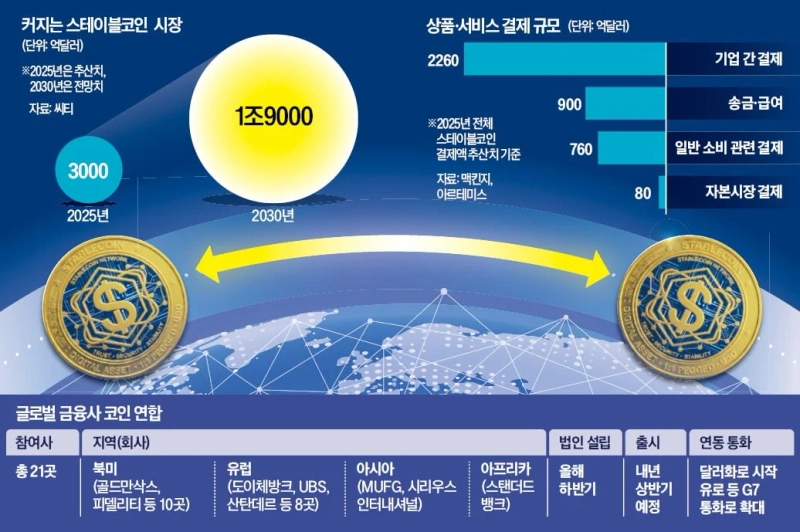
The 21 firms said on Sept. 1 that they plan to issue a dollar stablecoin in the first half of 2027. The consortium includes 10 North American firms such as Goldman Sachs and Bank of America, and eight European firms including UBS and Santander, along with leading financial institutions from Japan, the Middle East and Africa. The alliance has more than doubled in size from the 10 firms that formed it in October 2025. After starting with the dollar, the firms plan to expand issuance to stablecoins tied to G7 currencies including the euro.
South Korean financial firms are also considering joining. A senior executive at a major bank said the participant list has not been finalized and the bank is reviewing the consortium internally.
McKinsey estimates that annualized payment volume for stablecoins used in transactions stands at about $390 billion, or just 0.02% of the global market. Even so, the sector’s growth potential has been strong enough for the U.S. administration and Congress to push legislation to bring it into the regulated financial system. Citigroup projects circulating stablecoin supply will reach $1.9 trillion by 2030.
For banks, stablecoins represent a market they cannot afford to lose. If customers hold stablecoins instead of deposits, banks’ funding base could weaken. Stablecoins can also bypass parts of existing foreign-exchange remittance networks and card-payment systems. Issuers may also invest the dollars they receive in short-term Treasuries and earn interest income.
Competition to Issue Stablecoins Set to Heat Up
This alliance differs from OpenUSD, or OUSD, which includes Samsung Electronics, Shinhan Financial Group and Dunamu. While OUSD is focused on building a distribution ecosystem for payments and remittances by linking card companies, exchanges and big tech firms, this consortium is centered on global banks setting up a separate entity to issue stablecoins.
If traditional financial companies with established client bases, capital strength, and know-your-customer and anti-money-laundering systems enter the stablecoin issuer market, the dollar stablecoin sector led by Tether and Circle could change significantly.
With 21 financial firms participating together, the consortium could connect their corporate clients, asset-management clients, and foreign-exchange and payment networks in a single system. That would make it more than just another coin. It could become a shared settlement infrastructure for the global banking industry.
Another notable feature is the decision to use an open blockchain rather than remain on a closed network used only within the consortium. That would create a direct channel between traditional finance and the crypto ecosystem. An industry official said stablecoins depend less on technology than on distribution, trust and network effects, adding that a global alliance would be well placed to broaden adoption.
Competition for leadership in stablecoin issuance is set to intensify further. Kivalis, a Europe-focused alliance of 37 financial firms, plans to issue a euro-pegged stablecoin as early as the end of 2026. Central banks in China and elsewhere are also pushing ahead with digitizing their own currencies. That leaves private-sector financial stablecoins facing closer scrutiny. The European Central Bank has repeatedly raised concerns about the effect of wider private stablecoin adoption on monetary policy and financial stability.
Hwang Jung-su, New York correspondent / Cho Mi-hyun, reporter hjs@hankyung.com

Korea Economic Daily
hankyung@bloomingbit.ioThe Korea Economic Daily Global is a digital media where latest news on Korean companies, industries, and financial markets.