Oil Reclaims $90 as U.S.-Iran Fighting Escalates; Brent Jumps More Than 7% in Two Days
Summary
- The U.S. airstrikes on Iran helped lift Brent crude and WTI above $90 a barrel, capping a gain of more than 7% in two days.
- Rising oil prices fueled expectations for interest-rate increases, pushing up U.S. Treasury yields and the implied odds of an FOMC rate hike while sending global stock markets lower.
- A Strait of Hormuz blockade and higher energy prices pushed euro-area consumer inflation to a three-year high, adding to concern over an ECB rate hike and slower economic growth.
Forecast Trend Report by Period


Middle East tensions intensify; Brent surges more than 7% in two days
IRGC vows retaliation after U.S. strikes
Risk of prolonged disruption in Hormuz shipping
Rate fears weigh on stocks
Euro-area inflation hits three-year high

International oil prices jumped more than 7% over two days, pushing back above $90 a barrel after the U.S. intensified attacks on Iran. The surge in crude also boosted expectations for higher interest rates and sent global stocks lower. Rising energy costs are fueling concern about broader economic damage, with euro-area consumer inflation climbing to its highest level in three years.
Oil rises above $90
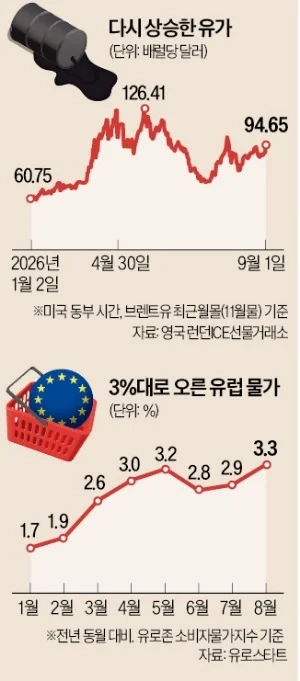
Brent crude futures settled at $94.65 a barrel on Sept. 1, up 4.6% from the previous session on ICE Futures Europe in London. On the New York Mercantile Exchange, October West Texas Intermediate crude rose 5.20% to settle at $90.22 a barrel. Brent reached its highest level since July 24, while WTI hit its highest since July 23. Crude had been up about 2% earlier in the day before extending gains after news that the U.S. had launched another airstrike on Iran, its second in two days.
U.S. Central Command said it began airstrikes at noon Eastern time on Sept. 1 against targets linked to Iran's Islamic Revolutionary Guard Corps, or IRGC. The U.S. military said the operation was a response to IRGC attempts to attack civilian vessels in the Strait of Hormuz and American troops deployed in the Middle East.
Iran signaled it would retaliate. In a statement on Sept. 1, the IRGC described the U.S. strikes on Iran's southern coast as an act of desperation and said it would take strong retaliatory measures.
The exchange has intensified concern that disruption to shipping through the Strait of Hormuz, a critical route for global oil flows, could be prolonged.
Ole Hansen, an analyst at Saxo Bank, said fears of sustained disruption to energy shipments through the Strait of Hormuz have grown. That has also strengthened expectations that Brent could top $100 a barrel within days.
The oil shock spilled into broader financial markets. The Dow Jones Industrial Average fell 419.02 points, or 0.79%, to 52,766.88 on Sept. 1. In Asia on Sept. 2, Japan's Nikkei 225 closed down 2.85% and Taiwan's Taiex lost 1.67%.
Investors are also focused on the risk that higher oil prices could reinforce the Federal Reserve's tightening stance. The yield on the 10-year U.S. Treasury rose as high as 4.796% on Sept. 1. The probability of a 25-basis-point increase at this month's Federal Open Market Committee meeting climbed to 68.2% on CME FedWatch, up from 39.6% a week earlier.
Ross Mayfield, an investment strategy analyst at Baird, said recent hawkish remarks from Fed Chair Kevin Warsh were followed by airstrikes in Iran and another jump in oil prices. With stocks near record highs, he said, a shift into safer assets was becoming unavoidable.
Europe is the weak link
The latest oil shock is set to hit Europe especially hard. Euro-area consumer inflation in August rose 3.3%, the highest since September 2023, when it was 4.3%. Energy prices led the increase, jumping 14.3%. The rise reflects a blockade of the Strait of Hormuz that has lasted more than six months, along with worsening energy supply strains tied to the war in Ukraine.
The European Central Bank is poised to raise its benchmark rate by 25 basis points from 2.25% at its Sept. 10 policy meeting as it tries to contain inflation. The European Commission, the European Union's executive arm, projects euro-area growth of 0.9% this year, down from 1.4% last year. If the ECB raises rates again next month under pressure from higher energy prices, domestic demand and investment could weaken further.
Europe's fiscal position is also deteriorating, making it harder for governments to cushion the shock with large subsidies. ECB projections show the euro area's fiscal deficit as a share of gross domestic product widening from 2.9% last year to 3.6% this year and 3.7% next year. If governments sharply expand energy subsidies again, sovereign debt issuance could increase, driving long-term yields higher and offsetting the ECB's tightening. If fiscal support is restrained instead, household real incomes and corporate profits may fall further, raising the risk of recession.
Kim Ju-wan, Hankyung.com reporter, kjwan@hankyung.com

Korea Economic Daily
hankyung@bloomingbit.ioThe Korea Economic Daily Global is a digital media where latest news on Korean companies, industries, and financial markets.