Dell Shares Surge 233% This Year as Record AI Server Orders Lift Results
Summary
- Dell Technologies said second-quarter AI servers orders hit a record, while traditional server revenue rose 122% from a year earlier, driving a sharp improvement in results.
- Dell raised its full-year revenue forecast to $192 billion and said AI server revenue will triple from a year earlier to reach $74 billion this year.
- Wall Street analysts assign Dell buy and hold ratings, with an average price target of $527.38, implying about 24.09% upside from the current share price.
Forecast Trend Report by Period


Hot Pick! Overseas Stocks
Dell's Shift to AI Infrastructure Gains Traction
Second-Quarter AI Server Orders Hit a Record
Traditional Server Revenue Also Rose 122% From a Year Earlier
Wall Street's Average Price Target Stands at $527
Easing Shortages of DRAM and Other Components Remains Key
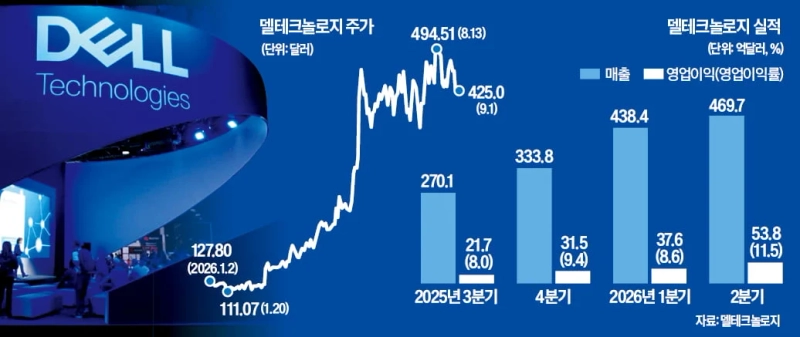
Dell Technologies, long known as a U.S. PC maker, is being reappraised as an artificial intelligence infrastructure company. Record AI server orders, along with growth in traditional servers and storage, are driving a sharp improvement in results. Dell shares had climbed 232.6% this year through Sept. 1. The stock fell 6.8% in regular trading that day, but rose about 10% in after-hours trading after the company released second-quarter earnings.
AI Servers and Replacement Demand Fuel Growth
Dell's stock has soared this year as the company beat market expectations each quarter. The shares jumped 21.9% the day after its February earnings report and 32.8% after its May results. On Sept. 1, Dell again posted second-quarter results that topped Wall Street estimates.
The company said revenue for the second quarter, which covered May through July 2026, totaled $46.97 billion, while operating profit reached $5.38 billion. That was up 7.1% and 43.1%, respectively, from the previous quarter. Adjusted earnings per share came in at $7.04, well above Wall Street's $4.91 estimate.
AI servers were the main driver of the improvement. Dell built its name in PCs, but it now also sells enterprise servers, storage systems and networking equipment. Demand for those products has risen rapidly as investment in AI data centers accelerates. Second-quarter AI server orders reached a record $60.9 billion. Backlog that has yet to be delivered and therefore not yet booked as revenue stood at $95 billion.
Jeff Clarke, Dell's vice chairman and chief operating officer, told analysts on a conference call that AI demand is rising sharply. Over the past 12 months, Dell converted $131.7 billion into orders, and its order pipeline still grew from the previous quarter.
Demand for traditional servers also remained strong. Revenue from conventional servers rose 122% from a year earlier, reflecting continued replacement demand as companies upgrade aging data-center equipment. Most of that increase came from existing enterprise customers, Clarke said, adding that demand exceeds what Dell can supply.
Storage demand is also increasing. As AI systems process more data, more equipment is needed to store and protect it. Dell's second-quarter storage revenue rose 26% from a year earlier.
David Kennedy, Dell's chief financial officer, said AI server revenue will triple from a year earlier and reach $74 billion this year. Dell also raised its full-year revenue forecast by $2.5 billion to $192 billion.
Wall Street Sees 24% More Upside, but Component Shortages Remain a Risk
Wall Street's view is broadly positive. TipRanks data showed that 10 of the 14 analysts covering Dell rate the stock a buy, while four recommend holding it. Their average 12-month price target is $527.38. That implies upside of about 24.09% from the Sept. 1 close.
Component shortages could still limit earnings growth. Even with strong AI server orders, Dell cannot increase output enough if it fails to secure key parts such as memory and central processing units. Production would not stop entirely, but it could become harder to make enough products and deliver them on time to meet customer demand.
Supply issues also emerged on the conference call. Asked by a Citi analyst whether Dell could secure enough parts to meet strong demand through next year, Clarke said supplies were insufficient to fill all orders. DRAM and NAND are in shortest supply, while CPUs, disk drives and optical components are also tight.
Park Ju-yeon, Hankyung.com reporter grumpy_cat@hankyung.com

Korea Economic Daily
hankyung@bloomingbit.ioThe Korea Economic Daily Global is a digital media where latest news on Korean companies, industries, and financial markets.