Dollar Hedging Falls to Lowest Since 2015, Leaving Institutions Facing Big FX Losses
Summary
- Global institutional investors' dollar hedge ratios have fallen to the lowest level since 2015, heightening concern over currency losses.
- If institutions in six countries raise the hedge ratio on dollar assets by just 5 percentage points, it could trigger $230 billion in futures selling, raising fears of a vicious cycle that pushes the dollar lower.
- Korean insurers and the National Pension Service have also reduced dollar hedging, increasing the risk of weaker returns and adding to calls for greater diversification of foreign-currency assets.
Forecast Trend Report by Period


Rising hedge demand risks fueling a vicious cycle of dollar weakness
Even a 5-percentage-point increase in hedge ratios by major investors
Could unleash $230 billion of dollar-futures selling
Korea’s low hedge ratios threaten investment returns
"Foreign-currency assets should be diversified beyond the dollar"
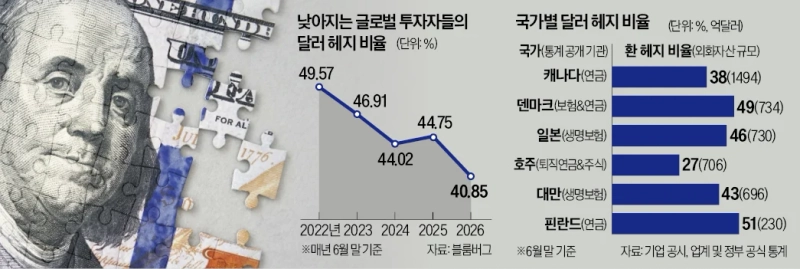
Major institutional investors' dollar hedge ratios have fallen to their lowest level since 2015. A stronger dollar through the first half of the year drove up hedging costs, while leaving positions unhedged helped returns. Now, with the dollar weakening, concern is growing that currency losses will mount. That could prompt selling of dollar assets and add to upward pressure on US Treasury yields.
Global institutions face an uncomfortable shift
Bloomberg reported on Sept. 3 that a survey of pension funds and insurers in six countries — Japan, Canada, Taiwan, Australia, Denmark and Finland — showed they had hedged only 41% of their foreign-currency assets as of the end of June. That was down sharply from 56% in 2020. Australia had the lowest ratio at 27%, followed by Canada at 38%, Taiwan at 43%, Japan at 46%, Denmark at 49% and Finland at 51%. Bloomberg said the figures showed overseas institutional investors with large dollar holdings remain significantly exposed to exchange-rate swings.
That strategy has helped lift returns in recent years. Investors benefited both from rising asset prices and from dollar strength. But the dollar's recent turn lower is increasing the need for hedging. The Bloomberg Dollar Spot Index, which tracks the US currency against major peers, fell 2.1% to 99.29 on Sept. 3 from 101.39 on July 1. The Wall Street Journal Dollar Index has also dropped 1.9% so far in the third quarter.
If institutional investors move belatedly to hedge their dollar exposure, that could deepen the currency's decline. The hedging process involves large derivatives trades selling dollar futures. Bloomberg estimated that if investors in those six countries raised the hedge ratio on their dollar assets by just 5 percentage points, it would require $230 billion of futures-selling contracts. There is also concern over a vicious cycle in which investors sell dollar-denominated assets or stop making new purchases, amplifying the dollar's decline.
Shoki Omori, chief strategist at Deutsche Bank, said hedge ratios were similarly low in 2013, but the macroeconomic backdrop is now the reverse of that period. Additional rate hikes by the Bank of Japan, a weaker dollar and insurers' reduced tolerance for exchange-rate volatility are combining to create conditions for a sharp increase in hedging. Eric Nelson, a foreign-exchange strategist at Wells Fargo, said heavier hedging could accelerate the dollar's decline in the short term, though monetary policy will probably determine its longer-term direction.
Korea also risks weaker investment returns
Years of dollar strength have also led Korean institutional investors to reduce dollar hedging. South Korea's insurance industry previously fully hedged overseas bond holdings and other foreign investments, but this year the ratio has reportedly fallen to 80% at large insurers and below 50% at small and midsize firms. The decline reflects the higher cost of hedging during the dollar's rally.
The National Pension Service decided in April to raise the hedge ratio on overseas investments to 15% from 10%. Even so, more than 85% remains exposed to currency moves.
That has a direct impact on returns from overseas investments. According to investment information platform Epic AI, the three-month return on the TIGER US S&P500 exchange-traded fund was minus 7.44% for the currency-exposed version and positive 1.23% for the currency-hedged version. That left a gap of 8.67 percentage points depending on whether the product was hedged. With a 15% hedge ratio, even if dollar-denominated asset prices are unchanged, a 10% appreciation of the won would reduce won-based returns by about 8.5 percentage points.
Calls are also growing for investors to diversify foreign-currency assets rather than relying solely on the dollar as geopolitical uncertainty rises. Stuart Simmons, head of multi-asset solutions at Australian asset manager QIC, said investors should reassess whether holding 70% of foreign-currency assets in dollars will remain an effective risk-management strategy.
Oh Se-seong, Hankyung.com reporter sesung@hankyung.com

Korea Economic Daily
hankyung@bloomingbit.ioThe Korea Economic Daily Global is a digital media where latest news on Korean companies, industries, and financial markets.