PiCK
Wall Street Sees Rate Surge as Different From 2022, Flags Mid-October Buying Window
Summary
- Wall Street said this latest rise in rates differs from 2022, citing high interest rates, the bond market fear gauge, and the level of the MOVE Index.
- Societe Generale said stocks remain more attractive than bonds, pointing to growth in S&P 500 corporate earnings.
- JPMorgan Market Intelligence and Citadel Securities described September as a period of tactical caution and pointed to mid-October as a better buying opportunity.
Forecast Trend Report by Period


"Bear-market fears are back as rates rise, but this is not 2022"
Wall Street says rate moves remain within a normal range
Bond market fear gauge stays below its long-term average
U.S. corporate earnings remain solid even as yields climb
Inflation expectations are also stable
"Stay cautious in September, buy in mid-October"
The Kospi fell 25% in 2022, while the S&P 500 dropped 19%. As surging inflation forced the Federal Reserve into a belated tightening campaign, the benchmark rate was lifted within a year to 4.25%-4.5% from 0%-0.25%. Fears of stagflation swept through markets. Earnings forecasts deteriorated, investor sentiment froze and global stocks suffered their worst year in 14 years since the financial crisis.
The nightmare of high rates is again looming over equity markets. The yield on the U.S. 10-year Treasury has been hovering above 4.8% for the first time in more than three years, while Japan's long-term yield has climbed to its highest level in 30 years. Markets are on edge as investors price in the possibility that the U.S. and Japan could both raise rates this month for the first time in 37 years. Some fear a repeat of the 2022 bear market, but Wall Street says the comparison is overdone.
Yields are rising, but there is no tantrum
On Sept. 3, the Kospi closed 0.26% higher at 6,579.48. The gain tracked an overnight rebound on Wall Street, where stocks rose for the first time in three sessions as the surge in yields cooled and oil prices fell.
One key difference from 2022, strategists say, is volatility in the U.S. Treasury market. Stocks are hurt not just by the level of yields, but by how quickly and sharply they move. Every major equity selloff since 2020 -- from the Covid-19 shock and the 2022 tightening shock to this year's U.S.-Iran war -- has been accompanied by a jump in bond volatility.
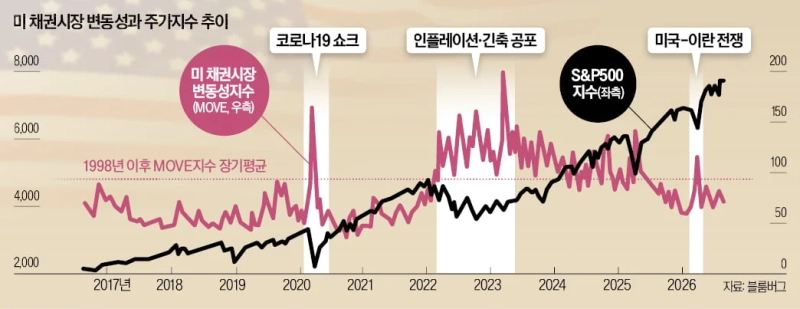
The MOVE Index, often called the bond market's fear gauge, rarely fell below 100 in 2022 and 2023. As of Sept. 3, it stood at 79, still below its long-term average of 85 to 90. The cumulative increase in global government bond yields over the past 20 trading days was also only about one-third of the rise seen in late 2022. HSBC said stocks would eventually react if yields spiked suddenly and disorderly, but for now the increase has been relatively gradual.
The nature of the rise in yields is also different. John Williams, president of the Federal Reserve Bank of New York, said on Sept. 2 that the recent surge in yields reflected a strong economy supported by investment in artificial intelligence, not a problem with market functioning. The move higher is being driven by growth and investment demand rather than an inflation shock. Kevin Flanagan, head of fixed-income strategy at WisdomTree, said a 4%-5% U.S. 10-year yield looks high compared with the low-growth era after the global financial crisis, but remains within a normal range compared with periods of normal economic expansion.
Growth-driven yields can be absorbed by corporate earnings. S&P 500 earnings are expected to rise 27% this year, putting companies on track for record results. That stands in sharp contrast with 2022, when earnings excluding the energy sector turned negative. Societe Generale said stocks still look more attractive than bonds when earnings forecasts and economic growth are taken into account. It also said the current equity bull cycle would require a far bigger rate shock to end, with the U.S. 10-year yield needing to rise by roughly another 2 percentage points.
"Even so, September calls for caution"
Unlike in 2022, long-term inflation expectations have remained stable at around 2.3%. The consensus view is that even if the Fed raises rates once or twice more, it is unlikely to deliver the kind of abrupt tightening that would trigger a bear market.
Even so, caution dominates the near-term outlook for stocks in September. Since 2000, the average September return for the S&P 500 and the Kospi has been minus 1.3% and minus 0.7%, respectively, making it the weakest month of the year for both indexes. In even-numbered years with a U.S. election such as this year, the average returns were even worse at minus 1.8% and minus 1.9%. JPMorgan Market Intelligence and Citadel Securities, both of which have been among the more accurate forecasters of this year's market outlook, identified September as a period of "tactical caution." Citadel Securities said better buying opportunities would emerge after mid-October.
Bin Nan-sae, Hankyung.com reporter binthere@hankyung.com

Korea Economic Daily
hankyung@bloomingbit.ioThe Korea Economic Daily Global is a digital media where latest news on Korean companies, industries, and financial markets.