Hyundai’s Chung Says Louisiana-Made Steel Should Be Used in Atlas, Eyes SpaceX Supply
Forecast Trend Report by Period


Groundbreaking Ceremony for Hyundai Steel’s HPLS Electric Arc Furnace Mill
“We Didn’t Build the Steel Mill Because of Tariffs”
Chung Rules Out Additional U.S. Investment
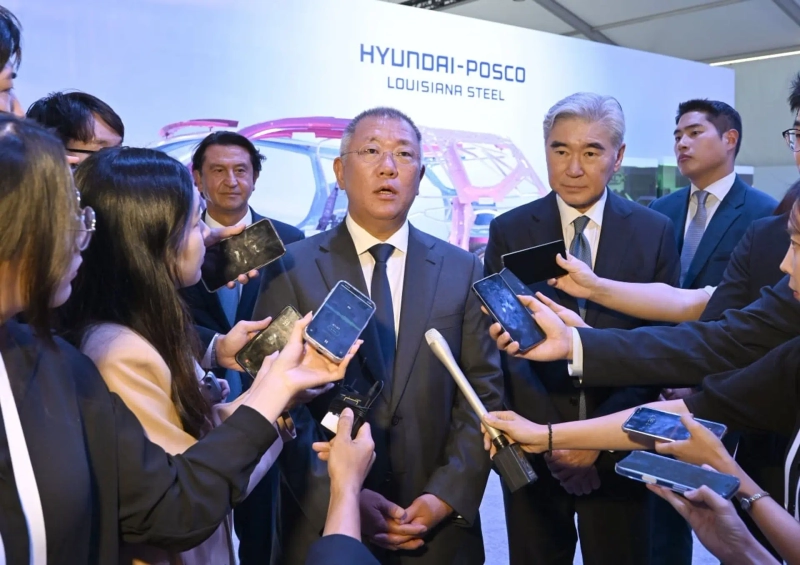
Euisun Chung, executive chair of Hyundai Motor Group, said steel produced at Hyundai Steel’s electric arc furnace mill in the U.S. should be used in products including Boston Dynamics’ Atlas robot.
Chung made the remarks to reporters at the Hyundai Steel-Posco Louisiana Electric Arc Furnace Steel Mill, or HPLS, groundbreaking ceremony in Donaldsonville, Louisiana, on Sept. 4. Asked whether U.S.-made steel would be used for Atlas, he replied, “I think of course it should be.”
He added that he hopes the company will eventually be able to supply the steel to rocket companies including SpaceX.
On the significance of the U.S. mill project, Chung said the U.S. currently imports about 20 million tons of steel, and producing high-value, low-carbon specialty steel there would benefit the country. Hyundai Motor and Kia also need low-carbon steel to improve the quality of vehicles produced there, he said, adding that the project should create benefits for both sides and generate synergies. He also stressed that responding to U.S. tariffs was not the goal.
Asked about any savings from lower tariff costs through local production, Chung said it was difficult to quantify because tariffs keep changing. He emphasized that the focus is not on tariffs but on making better products in the U.S. and improving vehicle quality. In March last year, the U.S. imposed a 25% tariff on imported steel products under Section 232 of the Trade Expansion Act to protect the domestic steel industry. It raised the tariff again to 50% in May of the same year.
The HPLS electric arc furnace mill is the first U.S. steel plant dedicated to automotive steel sheet based on electric arc furnace technology. Construction is scheduled to begin in the fourth quarter of 2026, with mass production targeted for 2029. Total investment stands at $5.8 billion. Hyundai Steel will hold 50%, Hyundai Motor and Kia 30% combined, with 15% each, and Posco 20%.
The plant will have an integrated production system capable of handling everything from raw materials to finished products at a single site. Its key feature is the ability to produce high-value strategic products while reducing carbon emissions compared with a blast furnace.
The project is the first initiative under Hyundai Motor Group’s previously announced $26 billion U.S. investment plan. Chung ruled out the possibility of additional U.S. investment, saying it would proceed within the scale of the plan announced earlier.
On partnering with Posco, Chung said the company is one of the world’s top steelmakers. The two sides have held in-depth discussions on future steel technologies and next-generation batteries, he said. He added that the project is also a good opportunity for Posco to expand into the U.S. market. Joint research could lead to higher-quality, more advanced materials and create a win-win outcome, he said.
Chung also said the HPLS mill can reduce carbon emissions by about 70% compared with a conventional blast furnace. Direct reduced iron, or DRI, is in effect a new technology, he said, and if that challenge succeeds, it could be applied elsewhere as well. He added that if hydrogen is later used in reduced iron production, the strengths of electric arc furnaces could potentially be combined with AI in other areas.
Asked whether Atlas could eventually be deployed at the U.S. mill, Chung said the company would first conduct extensive seasonal testing and move ahead if the results support it. Robots are intended for work that is difficult or excessive for people, he said, and the aim is to use them in ways that protect worker safety.
Shin Jeong-eun, Hankyung.com reporter newyearis@hankyung.com

Korea Economic Daily
hankyung@bloomingbit.ioThe Korea Economic Daily Global is a digital media where latest news on Korean companies, industries, and financial markets.