Iran Warns in Korean of 'Consequences' if South Korea Joins Hormuz Military Operations
Summary
- Iran's Foreign Ministry warned that if South Korea joins military operations in the Strait of Hormuz, Tehran would regard it as direct support for US attacks on Iran and said it would bring serious consequences.
- The South Korean government said it is still weighing participation in the Freedom of Navigation Initiative in the Strait of Hormuz and whether to deploy troops, while considering its energy and diplomatic interests, and has not reached a final decision.
- A domestic poll showed split views over sending South Korean troops, providing defensive weapons, and staying out of military support, while more respondents said the government was mishandling its more than six-month delay in deciding whether to deploy troops.
Forecast Trend Report by Period


Iran Foreign Ministry issues Korean-language warning over Hormuz deployment
Says military participation would be seen as direct support for US attacks
Seoul reviews whether to send troops, saying the decision is difficult
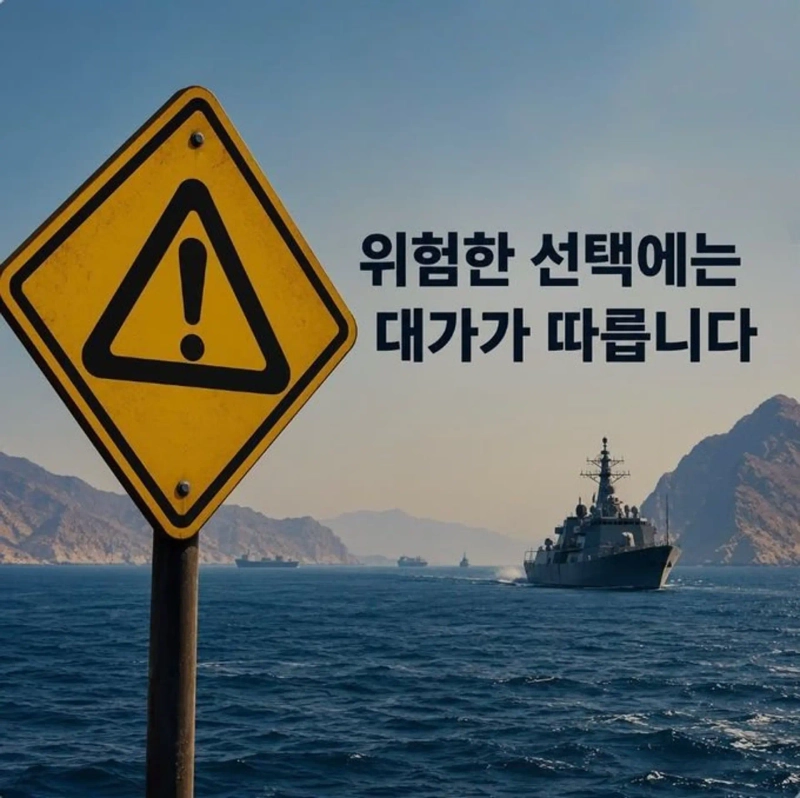
Iran has publicly warned South Korea over the possibility of joining military operations in the Strait of Hormuz. In a Korean-language message, an Iranian Foreign Ministry spokesman said any participation in military operations there would be regarded as direct support for US attacks on Iran.
Esmail Baghaei, spokesman for Iran's Foreign Ministry, wrote on X on Sept. 7 that Iran and South Korea have maintained diplomatic relations for more than 64 years. “Relations between Iran and the Republic of Korea span more than 64 years, and ties have consistently developed on the basis of mutual respect,” he wrote. “Iran places great importance on its friendly relations with the Republic of Korea.”
“Military participation is direct backing for aggression”
After emphasizing those ties, Baghaei took a hard line on military activity in the Strait of Hormuz. “The military presence or operational participation of other countries in the Persian Gulf and the Strait of Hormuz can only be regarded as direct support for the party committing aggression,” he wrote, adding that it would bring “serious consequences.”
The post also included an image bearing the Korean phrase: “Dangerous choices come with consequences.” Tasnim News Agency, a semi-official outlet affiliated with Iran's Islamic Revolutionary Guard Corps, said Iran had warned South Korea over any military role in the Strait of Hormuz.
Baghaei also reiterated Tehran's position that it is responding to US attacks. He wrote that Iranians are acting in self-defense against what he described as US aggression and responding firmly to what he called US war crimes against women and children.
He added that no sovereign and responsible state should yield to US pressure and threats and join what he described as aggression and terrible crimes against the Iranian people. The message made clear that Tehran does not want South Korea to join military action at Washington's request.
Iran steps up warnings as government faces decision
This is not the first time Iran has publicly objected to the prospect of a South Korean deployment to the Strait of Hormuz. On Sept. 4, a senior Iranian political and security official told Lebanon's pro-Iran Al Mayadeen that Tehran would view any South Korean troop dispatch as direct participation in military attacks on Iran.
At the time, the official said South Korea should not bow to pressure from Washington to cooperate in what he described as illegal US military operations. Three days later, the Foreign Ministry spokesman issued a warning directly in Korean, signaling that Iran is intensifying pressure ahead of Seoul's final decision.
US President Donald Trump has repeatedly asked South Korea, Japan and European countries to send troops after Iran blockaded the Strait of Hormuz in response to US and Israeli attacks that began in late February. The strait is a key shipping route for Middle Eastern crude, and Washington has pressed allies to participate under the banner of protecting freedom of navigation.
The South Korean government has been reviewing whether to join the Freedom of Navigation Initiative in the Strait of Hormuz, a multilateral consultative framework led by the UK and France and involving more than 40 countries. At the same time, it has continued communications with Iran and has yet to reach a final decision on the form of participation, including whether to send troops.
Tasnim also reported that South Korea is considering various ways to contribute to freedom of navigation in the Strait of Hormuz but has not made a final decision. That suggests Tehran is closely watching Seoul's internal deliberations.
Under Trump pressure, President Lee says issue is hard to ignore
Trump also referred directly to South Korea's response to Iran when he ordered a sharp reduction in joint US-South Korea military drills on Aug. 16. He wrote on Truth Social: “This may be somewhat unrelated (?), but I recently asked the president of South Korea whether they would be willing to join Iran's denuclearization, and they said ‘No thanks.’”
Seoul is weighing its response between US requests and repeated warnings from Iran. The government must consider not only whether to participate militarily, but also navigational safety in the Strait of Hormuz and South Korea's energy and diplomatic interests.
President Lee Jae-myung said at a meeting with civil society representatives on Sept. 4 that the Hormuz deployment issue was “not something we can simply ignore because there are interests at stake.” He also said the matter was militarily sensitive and that the government was giving it deep thought.
Domestic opinion is divided over how South Korea should respond in the Strait of Hormuz. In a survey of 1,017 adults nationwide conducted by Gaehyeok Institute on Sept. 6, 34.9% supported sending South Korean troops, while 31.8% backed providing defensive weapons without deploying forces. Another 27.6% said South Korea should not take part in military support.
On the government's failure to decide for more than six months since a US request in March, 50.9% said it was handling the matter poorly, compared with 42.2% who said it was doing well. The poll had a margin of error of plus or minus 3.1 percentage points at a 95% confidence level.
Hong Min-seong, Hankyung.com reporter mshong@hankyung.com

Korea Economic Daily
hankyung@bloomingbit.ioThe Korea Economic Daily Global is a digital media where latest news on Korean companies, industries, and financial markets.