Did the US Counter-Blockade in Hormuz Work? Gulf Oil Exports Recover to 50% of Prewar Levels
Summary
- The report said 7.5 million barrels of crude a day are now leaving the Strait of Hormuz and nearby routes, recovering to 50% of prewar levels.
- It said Iranian crude exports have been sharply constrained since the MOU expired, while the US has gained the upper hand in the blockade with tanker escort operations and a multilayered air defense network over the strait.
- As the US-Iran standoff continues, concern is growing over a prolonged war, while Washington is pressing for South Korea to commit resources to the Middle East region.
Forecast Trend Report by Period


US tanker escort mission shows results as Iranian transit is effectively blocked
US blocks routes to Iranian ports
Builds air defenses over the strait for a long war
Presses South Korea, saying it is still waiting for support
Iran warns against aiding the aggressor
US military tanker escort operations in the Strait of Hormuz appear to be producing results. Iran, by contrast, is facing growing difficulty exporting crude because of the US blockade. That has fueled concern that Washington, with the upper hand in the blockade campaign, is preparing for a prolonged conflict and could seek additional support from allies including South Korea.
◇ Oil export volumes recover
Maritime data firm TankerTrackers.com said an average of 5 million barrels of crude a day exited the Strait of Hormuz over the 28 days after military clashes between the US and Iran resumed. That was below the 6.1 million barrels a day averaged over the two months from mid-June, when a ceasefire took hold under a memorandum of understanding. But it was nearly double the 2.3 million barrels a day recorded in the first month after the war broke out.
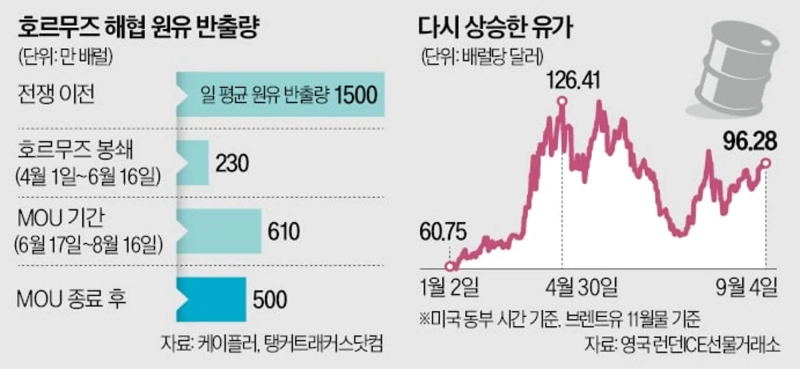
Crude shipments rerouted through ports on the Gulf of Oman, including Fujairah in the United Arab Emirates, also increased. Those flows averaged 2.5 million barrels a day. Combined with Hormuz traffic, total crude exports from the Gulf region reached 7.5 million barrels a day. That marks a recovery to half of the 15 million barrels a day shipped before the war began.
TankerTrackers.com estimated that Iranian crude has barely been able to leave via the Strait of Hormuz since the MOU expired. “Iran’s blockade has more gaps than the US blockade,” said Samir Madani, the company’s co-founder. “Iran does not have the ability to shut down all traffic.”
Analysts also say US attacks on Iran’s detection, identification and strike networks around the strait have been effective. The Financial Times reported that US forces, using Navy SEALs, uncrewed surface vessels and submersibles, carried out high-risk mine-clearing operations mainly at night. About 80 mines were believed to have been laid near key shipping lanes. The military did not remove all of them, but it appears to have secured narrow corridors that commercial vessels can use repeatedly.
The US has also built a multilayered defense network around the strait. Guided-missile destroyers and carrier strike groups were deployed to monitor Iranian anti-ship missiles and drones and shield commercial vessels. At the same time, ships bound for Iranian ports are being blocked effectively.
◇ US and Iran clash over South Korea’s role
That does not mean the US military has full control of the strait. Traffic has fallen sharply again after the US and Iran recently attacked each other’s tankers. Global shipping analytics firm Kpler said an average of 10 transport vessels a day passed through the Strait of Hormuz in the 10 days through Sept. 6, the lowest level since May. Mohsen Rezaei, secretary of Iran’s Supreme National Security Council, said on Sept. 6 that Tehran would formally announce a control zone on the outer edge of the Strait of Hormuz within days, signaling a further escalation.
That also helps explain why Washington is asking allies such as South Korea to share the burden. A White House official, commenting on the South Korean government’s review of possible military contributions related to the Strait of Hormuz, said South Korea is one of the main importers of Middle Eastern crude. The official added, “We are still waiting for South Korea to commit resources to the region.”
Iran pushed back. Esmaeil Baghaei, spokesman for Iran’s Foreign Ministry, wrote on X that relations between Iran and South Korea span more than 64 years and have steadily developed on the basis of mutual respect. Iran values its friendly ties with South Korea, he wrote. He added that any country that stations troops in the Persian Gulf and the Strait of Hormuz or takes part in military operations would be regarded as directly supporting the aggressor, and that such a move would have serious consequences.
As the standoff continues, predictions of a prolonged war are gaining force. Leon Panetta, a former US defense secretary, said the conflict would last more than six months. He told the Guardian on Sept. 6 that the US and Iran were clearly stuck in a terrible stalemate with few options to end the war. He added that the conflict risked becoming another failed war in the Middle East and could turn into a war without an end.
Kim Joo-wan / Kim Dong-hyun / Kang Hyun-woo, Hankyung.com reporters kjwan@hankyung.com

Korea Economic Daily
hankyung@bloomingbit.ioThe Korea Economic Daily Global is a digital media where latest news on Korean companies, industries, and financial markets.