Samsung, SK Hynix Dollar Sales, US Investment and Rates Emerge as Three Key Drivers of Won-Dollar Outlook
Summary
- The won-dollar exchange rate fell into the 1,330 won range on large-scale dollar conversions by Samsung Electronics and SK Hynix and a current-account surplus, fueling projections that it could move into the 1,200 won range.
- Still, some analysts say the exchange rate could rebound into the 1,300 won to 1,400 won range in the fourth quarter as additional demand for dollar conversions weakens, US investment gathers pace, and the possibility of a Fed rate increase rises.
- A view is spreading that foreign-exchange authorities regard the low- to mid-1,300 won range as the de facto fair exchange rate, and with the National Pension Service confirmed to have halted FX hedging, that range may become the main trading benchmark for companies and investors.
Forecast Trend Report by Period


1,200 won or 1,400 won: Where is the won-dollar rate headed?
Additional exporter conversions are the key variable
Full-scale US investment could drive the rate higher
A wider Korea-US rate gap could also fuel dollar strength
Authorities are seen viewing the low- to mid-1,300 won range as appropriate
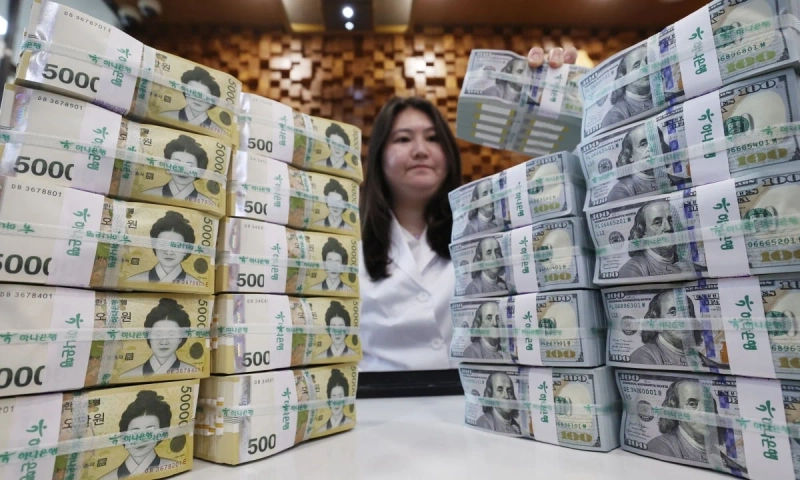
The won-dollar exchange rate has dropped sharply to the 1,330 won range after surging to near 1,600 won per dollar, drawing attention to whether it has further room to fall. Market views are divided. Some expect Samsung Electronics Co. and SK Hynix Inc. to continue converting hundreds of billions of dollars into won, pushing the exchange rate into the 1,200 won range. Others argue it could climb back into the 1,400 won range if South Korea's investment in the US accelerates and the likelihood of a Federal Reserve rate increase grows. At the same time, a perception is spreading in the market that foreign-exchange authorities regard the low- to mid-1,300 won range as an appropriate level.
Samsung and SK Hynix lead dollar selling
In Seoul trading, the won-dollar exchange rate stood at 1,337.1 won per dollar as of 3:30 p.m. on Sept. 9, down 9.5 won from the previous session. That marked its lowest level since Oct. 4, 2024, when it closed at 1,333.7 won per dollar. The rate had climbed as high as 1,559.2 won intraday on July 1 amid Middle East tensions and broad dollar strength. It has since fallen by more than 220 won in a little over two months. The won's strength has been driven by large-scale dollar conversions from exporters such as Samsung Electronics and SK Hynix. South Korea posted a current-account surplus of $240.1 billion in the first half, nearly double last year's record annual surplus of $123.1 billion.
As the won turned sharply stronger, exporters sold dollar holdings and expanded currency hedges, putting additional downward pressure on the exchange rate. Hanwha Ocean Co., which had maintained a foreign-currency strategy that left it fully exposed to exchange-rate swings, raised its hedge ratio against order backlog to the 70% range recently from 17% at the end of June. That has fueled forecasts that the won-dollar rate could fall into the 1,200 won range.
Cha Young-hoo, an analyst at Eugene Investment & Securities, estimated annual won conversion demand tied to shareholder returns and mega projects at Samsung Electronics and SK Hynix at $210 billion. He said pressure for won strength would likely remain dominant through next year, with the won-dollar rate finding a lower bound of 1,250 won to 1,300 won.
National Pension Service halts FX hedging after sharp drop in rate
Some analysts say the impact of recent dollar conversions by Samsung Electronics and SK Hynix has already been largely exhausted. Most of the proceeds from SK Hynix's American depositary receipt sale in July have also reportedly been converted. As of June, Samsung Electronics held 44.8 trillion won in cash, cash equivalents and short-term financial instruments on a standalone basis, while SK Hynix held 36.5 trillion won. That has led to assessments that both companies already have enough won liquidity for immediate use, limiting the scale of additional dollar conversions.
With the won-dollar rate having fallen into the 1,300 won range, expectations for further declines have weakened, reducing the incentive for exporters to rush to sell more dollars. Kim Yu-mi, head of investment strategy at Kiwoom Securities, said the effect of additional dollar conversions by Samsung Electronics and SK Hynix would gradually fade. She projected the won-dollar rate would rebound into the low 1,400 won range in the fourth quarter.
South Korea's investment drive in the US is another factor that could lift the exchange rate. The government plans to announce an investment agreement in mid-September covering a $22 billion gas combined-cycle power plant project in Encinal, Texas, and a $120 billion project to build eight nuclear reactors in the US. The government has said those investments will be funded through returns on foreign-exchange reserve management, limiting direct disruption to the currency market. Even so, they could affect market sentiment. Choi Kyu-ho, an analyst at Hanwha Investment & Securities, said a full-scale push into US investment could become a factor lifting the exchange rate. He expects the won-dollar rate to trade between 1,300 won and 1,400 won at year-end.
The possibility of a Fed rate increase is another variable that could reinforce dollar strength and push the won-dollar exchange rate higher.
Foreign-exchange authorities are understood to view the low- to mid-1,300 won range as the de facto appropriate level for the currency, based on the won's fundamentals and market supply-demand conditions. In the market, that view is increasingly seen as a trading reference point for exporters, importers and investors, making it likely the exchange rate will fluctuate around that range for the time being.
One foreign-exchange market official said the National Pension Service appeared to have halted FX hedging after the won-dollar rate fell into the low- to mid-1,300 won range, normalizing measures it had adopted in response to a weak won. That suggests authorities also see the range as appropriate, the person added.
Kim Ik-hwan and Ko Song-hee, reporters at The Korea Economic Daily, lovepen@hankyung.com

Korea Economic Daily
hankyung@bloomingbit.ioThe Korea Economic Daily Global is a digital media where latest news on Korean companies, industries, and financial markets.