AI Optimism Revives as Kospi Reclaims 7,000 After 48 Days
Summary
- The Kospi regained the 7,000 level, with foreign investors concentrating purchases in Korean chip stocks, semiconductor materials, parts and equipment shares, and power infrastructure stocks.
- After OpenAI unveiled Astra, the AI rally broadened, lifting expectations for demand across the AI value chain, including CPUs, memory, storage and networks.
- With retail investors making heavy purchases in the 7,500-8,500 range and foreigners buying in the 6,500-7,500 band, break-even selling and profit-taking above the 7,500 level could form strong resistance.
Forecast Trend Report by Period


Foreign Investors Pile Into Chip Stocks
Semiconductor Suppliers, Power Shares Lead Gains
Astra-Fueled AI Rally Continues
Retail Supply Has Built Up Above 7,000
Break-Even Selling Could Limit Further Gains
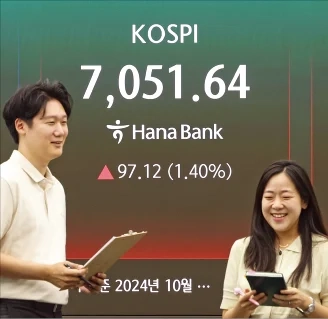
South Korea’s Kospi index reclaimed the 7,000 mark for the first time in a month and a half on Sept. 9, shaking off Middle East tensions and inflation worries. Market participants say the global debate over an artificial-intelligence bubble has swung back toward confidence in AI after OpenAI unveiled its next-generation model, GPT-6 Astra. Optimism has also grown as foreign investors, who had been steady net sellers, recently started buying Korean chip stocks again.
AI Rally in South Korea and the US
The Kospi rose 1.40% to close at 7,051.64 on Sept. 9. It was the first close above 7,000 since July 23, ending a 48-day, or 33-trading-session, stretch below that level.
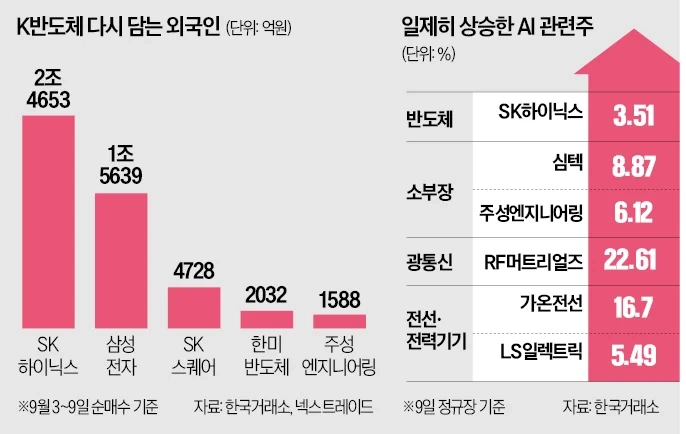
As of the previous session, the index had slipped at the 7,000 threshold as retail investors sold to break even. On Sept. 9, however, it cleared that level even with Samsung Electronics, the largest stock by market capitalization, ending flat. SK Hynix rose 3.51%, while semiconductor materials, parts and equipment names such as Simmtech and Jusung Engineering gained 8.87% and 6.12%, respectively. Power infrastructure stocks also climbed, with Gaon Cable up 16.7% and LS Electric rising 5.49%. Optical communication shares advanced broadly as well, with RF Materials, Woorinet and Taihan Fiberoptics gaining 22.61%, 12.81% and 9.20%, respectively.
The AI rally had started a day earlier in the US. All three major New York stock indexes fell as heightened Middle East tensions pushed up oil prices, but major semiconductor stocks still posted gains. Intel rose 9.05%, AMD added 5.9% and Qualcomm climbed 3.17%.
News that Intel plans to raise prices for PC central processing units by about 10% in October helped lift sentiment. Investors took that as a sign the company’s pricing power is strengthening as the expansion of AI data centers drives a surge in server CPU demand. Additional support came from a $60 billion AI chip development alliance between Qualcomm and Amazon Web Services, as well as AMD’s decision at the Citi Global Conference to raise its 2030 server CPU market forecast to nearly four times its previous estimate.
A more fundamental driver is Astra, which OpenAI recently unveiled. Unlike chatbot-style AI that simply answers questions, Astra is an agentic AI system that can find data on its own, send emails and execute programs. That has boosted the broader AI value chain because it sharply increases usage not only of graphics processing units, but also of CPUs, memory, storage and networks.
Astra is also advancing toward human-like capability, passing all 48 stages of a CAPTCHA-style game used to distinguish humans from robots. Tibo Sotio, OpenAI’s head of product, wrote on X on Sept. 9 that demand for Astra is unprecedented and that the company may temporarily suspend new Pro subscription applications to maintain service quality.
'7,500 Could Become Resistance'
As the AI growth narrative regains momentum, foreign investors who had been net sellers are buying shares on South Korea’s main board again. Korea Exchange and alternative trading platform Nextrade data show foreigners bought more than 4 trillion won ($2.9 billion) worth of Samsung Electronics and SK Hynix from Sept. 3 through Sept. 9. Semiconductor supplier names such as Hanmi Semiconductor and Jusung Engineering were also among the top net purchases. The amount is not yet large, but the buying is meaningful because foreigners, who play a key role in market flows, are once again accumulating market heavyweights.
Still, the Kospi may need to absorb heavy retail supply above 7,000 if it is to keep climbing toward this year’s high. According to KB Securities, retail investors were net buyers of 36 trillion won ($26.1 billion) during the early phase of the correction, when the index traded in the 7,500-to-8,500 range. Foreign investors concentrated 10 trillion won ($7.2 billion) of buying in the lower 6,500-to-7,500 band.
That could turn 7,500 into a strong resistance level. Above that point, break-even selling from retail investors who were trapped early in the correction could emerge at the same time as profit-taking by foreign investors who bought near the lows.
Lee Sun-a / Bin Nan-sae, Korea Economic Daily reporters suna@hankyung.com

Korea Economic Daily
hankyung@bloomingbit.ioThe Korea Economic Daily Global is a digital media where latest news on Korean companies, industries, and financial markets.