Samsung Securities Wins Issuing-Note License, Setting Up Battle for Wealth Clients’ Idle Cash
Summary
- Samsung Securities has won approval to enter the issuing-note business, a move that is set to reshape competition in the about $40.6 billion issuing-note market.
- Short-term idle cash has been flowing into issuing notes because issuing-note yields in the upper 3% to mid-4% range are higher than bank time-deposit rates.
- Samsung Securities could draw idle cash from its about $473 billion in retail assets and 572,000 high-net-worth clients into issuing notes, potentially competing with bank deposits and existing issuing-note providers.
Forecast Trend Report by Period


FSC approves license at regular meeting
Competitive landscape shifts in issuing-note market

Samsung Securities has won approval to enter South Korea’s issuing-note business, nine years after first applying. The license had long been a key goal for the firm after it was designated a large investment bank in 2017, but legal risks tied to its controlling shareholder and sanctions over internal controls repeatedly stood in the way. Samsung Securities’ entry is set to reshape competition in the issuing-note market, which has grown to about $40.6 billion, as the firm brings roughly $472 billion in retail client assets.
South Korea’s Financial Services Commission approved Samsung Securities’ short-term financing license at a regular meeting on Sept. 9. The decision raises the number of domestic issuing-note operators to eight, joining Korea Investment & Securities, Mirae Asset Securities, NH Investment & Securities, KB Securities, Kiwoom Securities, Hana Securities and Shinhan Investment Corp.
Issuing notes are financial products with maturities of less than one year that large investment banks with at least about $2.9 billion in equity capital can sell on the strength of their own credit. Securities firms can invest money raised from clients in corporate finance, bonds, loans and other assets.
The business is considered a core operation for large investment banks because it provides a stable funding base. The structure is similar to banks taking deposits and making loans. Securities firms can raise funds equal to as much as 200% of their equity capital, giving larger firms more room to use the model. The market is currently led by major firms including Korea Investment, KB, Mirae Asset and NH, which rank first through fourth by outstanding balances.
Samsung Securities first applied for an issuing-note license in 2017, but its entry was blocked by questions over the eligibility of its controlling shareholder. It tried again last year, only to be delayed by the possibility of sanctions over improper sales practices at wealth-management hub branches. The final obstacle was removed in July, when the FSC determined the penalty would be an institutional warning, which did not disqualify the firm from receiving the license.
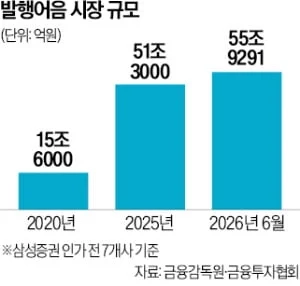
The market has expanded rapidly in the meantime. Financial Supervisory Service data show outstanding issuing notes rose to about $39.4 billion at the end of March from about $11.3 billion at the end of 2020, a 3.5-fold increase in five years. Data compiled by the Korea Financial Investment Association showed the balance had reached about $40.5 billion at the end of June.
Funds have flowed into the products because yields are relatively high. Major securities firms offer annual rates in the upper 3% range on one-year contracted issuing notes, while some special offerings pay in the mid-4% range. Demand for short-term cash management has remained steady because investors can earn more than on bank time deposits without meeting complicated preferential conditions, even though the products are not protected by deposit insurance.
Samsung Securities’ biggest strength is its wealth-management franchise among affluent clients. Its retail assets stood at about $473 billion at the end of the second quarter, and the number of high-net-worth clients with at least about $72,600 in assets reached 572,000. How much of that client cash the firm can channel into issuing notes will help determine its early performance. Special offerings aimed at new and corporate clients could also put it in competition with bank deposits as well as existing issuing-note providers.
Samsung Securities set up a dedicated issuing-notes division in November last year and prepared its systems and product development. The company said it would offer clients a wider range of choices and help support the supply of venture capital in South Korea.
Bin Nan-sae, Hankyung.com reporter binthere@hankyung.com

Korea Economic Daily
hankyung@bloomingbit.ioThe Korea Economic Daily Global is a digital media where latest news on Korean companies, industries, and financial markets.