Why the US Treasury Isn’t Buying Bonds Blindly: The Real Purpose of Buybacks
Summary
- The US Treasury said the main purpose of its Treasury buybacks is to improve trading in older bonds and make cash management more efficient.
- The article said high US Treasury yields can weigh on growth stocks and heavily indebted companies by affecting the present value of future earnings and interest costs.
- The article said Korean investors should watch US interest rates, Treasury yields and the won-dollar exchange rate together, weighing both price risk and currency risk.
Forecast Trend Report by Period


This article was published on Hankyung Premium 9, the Korea Economic Daily’s paid investment platform. Subscribers to Hankyung Premium 9 can access more stock-investment stories at www.hankyung.com/premium9.
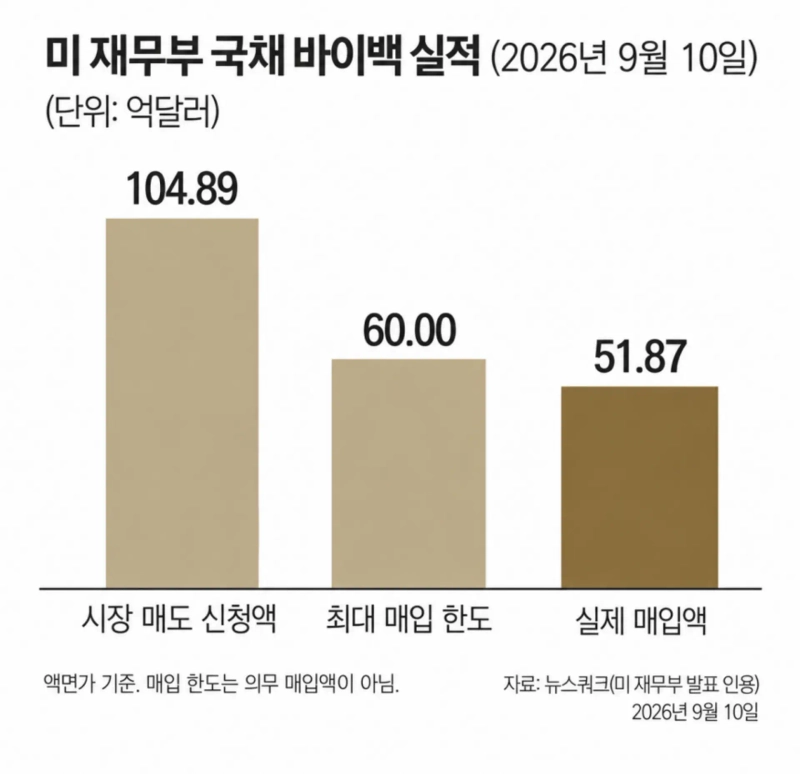
The US Treasury recently received offers to sell back $10.489 billion of Treasuries, but purchased only $5.187 billion. It could have bought as much as $6 billion, but did not use the full limit. The amount offered for sale was nearly double the cap.
That reflects how the Treasury’s buyback program works. It evaluates submitted bonds based on market prices and relative value at the time of the operation. Even when sale offers exceed the cap, the Treasury does not have to fill the full amount.
That has underscored that Treasury buybacks are not a policy of indiscriminately purchasing bonds to drive yields lower. The program is meant to support market functioning, but the Treasury can decline to buy securities it views as too expensive. Even so, markets had widely expected that a larger buyback program would lift Treasury prices and push yields down.
Actual Buyback Volume Was 86%
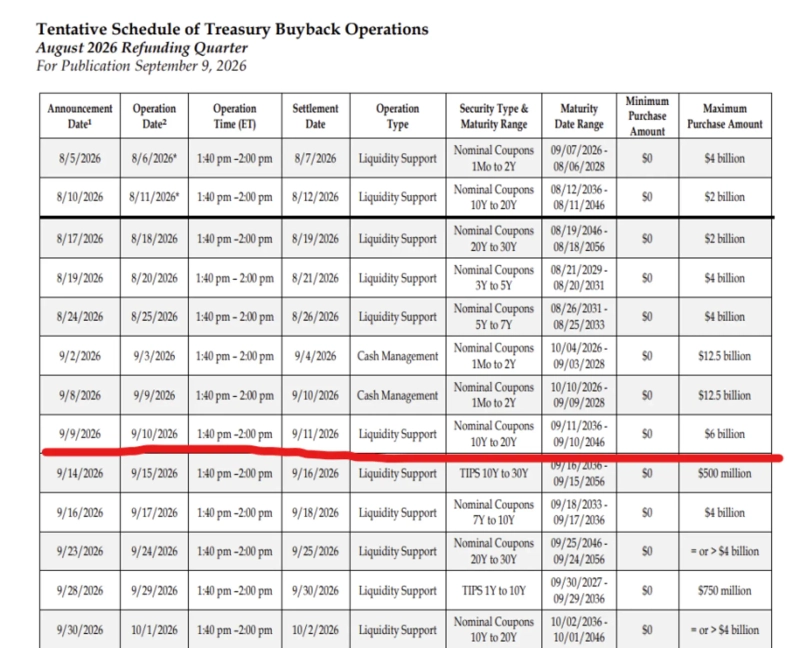
According to TreasuryDirect, the Treasury’s debt-information website, the Sept. 10 buyback targeted nominal Treasuries with 10 to 20 years remaining to maturity. The Treasury said it would buy up to $6 billion and ultimately purchased 86.45% of that amount. The $6 billion figure, however, was based on par value. Because par value refers to principal repaid at maturity, it does not necessarily match the amount of cash the Treasury actually paid that day.
The Treasury screens submitted sell orders based on market price and relative value. It is not required to accept all bonds offered at elevated prices. Even when bids exceed the cap, the government has no obligation to take every price level. That is why a purchase amount below the cap does not by itself mean the operation failed.
Nellie Liang, then the Treasury’s under secretary for domestic finance, said in 2023, when the framework was being designed, that “the objective is not to buy a particular quantity of securities.” The mechanics make it easier to understand why the Treasury buys selectively. Newly issued Treasuries tend to attract the most trading. Older securities, by contrast, can be relatively harder to buy and sell even though they carry the same US government backing. By regularly purchasing those older bonds, the Treasury gives investors a channel to convert them into cash.
That reduces the need for investors to slash prices when they need to sell quickly. Financial firms that intermediate bond trading can also sell Treasury holdings to the government and redeploy the proceeds into other transactions. If Treasuries become easier to trade, investors may demand a smaller liquidity premium for the risk that the bonds will be harder to sell later.
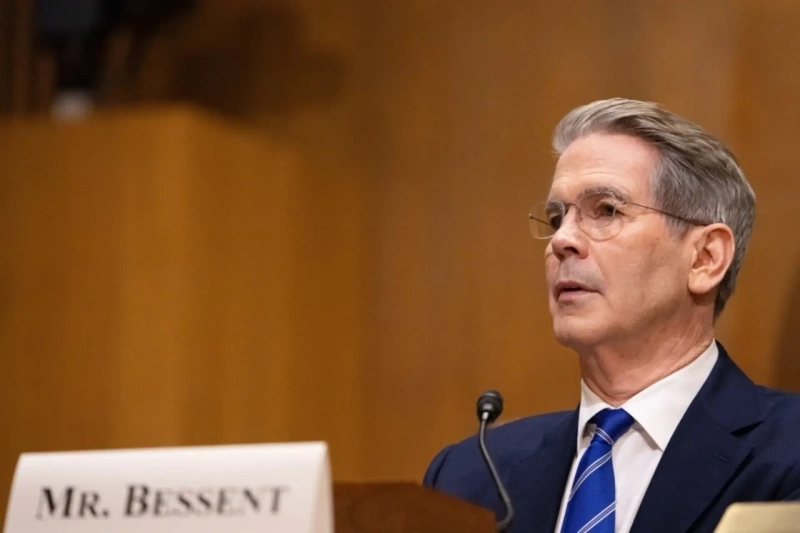
The Treasury itself does not appear to believe this round of buybacks can dictate market yields. Treasury Secretary Scott Bessent recently said the government “cannot change the equilibrium price.” Jim Barnes, a fixed-income director at Bryn Mawr Trust, told Reuters that the $6 billion cap “is not a large amount.”
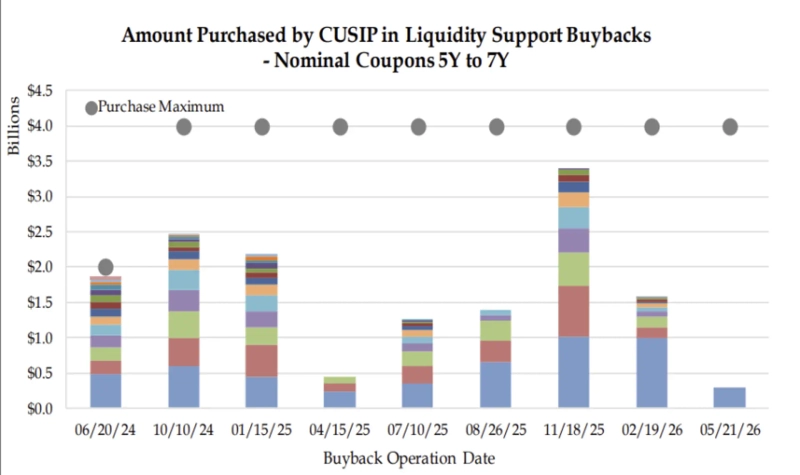
This purchase was the first case in which the Treasury applied its previously announced expansion of buybacks. Last month, it said the per-operation cap for purchases of Treasuries with 10 to 20 years and 20 to 30 years remaining to maturity would rise from $2 billion to at least $4 billion. The expanded limits apply from Sept. 9 through Nov. 4, when the Treasury is scheduled to announce its next quarterly borrowing plan. In the Sept. 10 operation, the cap rose to $6 billion.
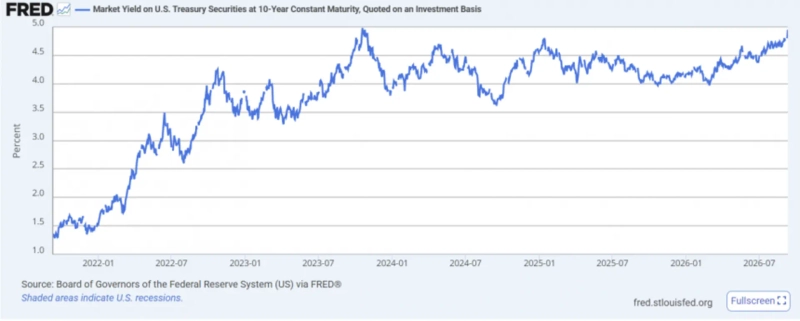
But the larger buyback did not immediately pull long-term yields lower. Data from FRED, the database maintained by the Federal Reserve Bank of St. Louis, show the 10-year Treasury yield rose to 4.95% on Sept. 10 from 4.78% on Sept. 4. The 30-year yield climbed to 5.37% from 5.24% over the same period, increases of 0.17 percentage point and 0.13 percentage point, respectively.
Did the Buyback Have an Effect?
That does not necessarily mean the buyback had no effect. Reuters reported that the 10-year Treasury yield climbed as high as 4.979% intraday on Sept. 11 before easing back to about 4.93%. A few days of rising yields are not enough on their own to label the buyback a failure. By the same token, a modest pullback afterward cannot automatically be attributed entirely to the program.
When the government buys back bonds, it does not create new money or reduce the fiscal deficit by the same amount. The Treasury either uses cash on hand or raises money by issuing new debt. The bonds it repurchases disappear in the settlement process, but if the government sells other securities to fund that cash outlay, the overall debt burden has not truly fallen. That makes the structure different from quantitative easing, in which the Federal Reserve creates new reserves to buy Treasuries.
ING said in a report last month that the Treasury could finance buybacks by issuing Treasury bills if needed. Whether it uses existing cash or sells more short-term debt can affect money markets. But in either case, the government still has to obtain the necessary funds elsewhere.
Some also argue that buying long-dated Treasuries while financing the operation with bill issuance merely shifts where the risk sits. A smaller stock of long-term bonds in the market could reduce some long-end duration risk. But the government would then need to issue more short-term debt and refinance more frequently. If short-term rates remain high, the interest burden could rise later.
The government’s large borrowing needs are already evident. On Sept. 3, the Treasury projected net privately held marketable borrowing of $739 billion for the third quarter of this year. That was $68 billion more than its May estimate, largely because expected net cash inflows declined. The figure represents projected net borrowing for the entire quarter.
George Cole, Goldman Sachs’ head of European rates strategy, said in a webinar reported by Business Insider that “fiscal concerns are not going away.” If markets remain worried about future US borrowing and bond supply, investors may still demand greater compensation for tying up money over long periods, regardless of measures meant to improve trading in older Treasuries.

Inflation is another factor. The Bureau of Labor Statistics said on Sept. 11 that the August consumer price index rose 0.4% from a month earlier on a seasonally adjusted basis and 3.4% from a year earlier on an unadjusted basis. Energy prices rose 2.1% over the month, while gasoline increased 3.9%. Gasoline accounted for more than one-third of the monthly rise in consumer prices. Treasury buybacks do not directly change energy supply or prices at the pump.
Jim Reid, a strategist at Deutsche Bank, told Reuters that “geopolitical concerns are driving everything.” Michael Metcalfe, head of macro strategy at State Street, said “the fundamentals haven’t changed.”
That said, some argue it would be wrong to conclude the buyback had no effect at all. Their view is that the program’s purpose is less about lowering yields outright and more about improving market functioning.
ING said in last month’s report that 30-year swap spreads narrowed by 4 basis points after the Treasury announced a larger long-bond buyback program, and then narrowed by another 3 basis points. That suggests long-term Treasuries improved in relative value against interest-rate derivatives. Even if yields rise across the broader market, the trading conditions and relative pricing of the bonds the Treasury is buying can still improve.
This is not the first time the US government has bought back its own debt. The rationale, however, was different in the past. Treasury records show it conducted 45 buyback operations between March 2000 and April 2002, purchasing a total of $67.5 billion of securities. At the time, the federal government was running budget surpluses and issuing less new debt. The main goal was to prevent trading in benchmark Treasuries from drying up and to put excess government cash to use. That was very different from the current environment, in which the government needs to borrow heavily.
A comparable case is the Federal Reserve’s 2011 Operation Twist. At the time, the Fed said it would buy $400 billion of Treasuries with 6 to 30 years remaining to maturity and sell an equal amount of securities with maturities of three years or less. The purpose was explicit: to increase demand for long-term bonds, lower long-term yields and ease financial conditions.
The similarity is that both programs involve buying longer-dated Treasuries. But the recent Treasury buybacks are different in nature. Their main purpose is to improve trading in older bonds and manage Treasury cash more efficiently. If investors interpret the program like the Fed’s Operation Twist — as a policy tool aimed at lowering long-term yields — they may overstate both its impact and its durability.
How High Treasury Yields Matter
The first way high US Treasury yields affect the stock market is through corporate valuation. Stock prices reflect the present value of future earnings. When the discount rate rises, the present value of those profits falls. Companies whose valuations depend heavily on growth far in the future may be hit harder. Even so, if earnings expectations improve faster than rates rise, stocks can absorb that pressure. Higher Treasury yields do not automatically mean technology shares must fall.
The second channel is companies’ actual interest costs. Businesses with large cash reserves are affected differently from those that need to borrow to invest. Companies that locked in long-term funding at low fixed rates in the past may not see their interest burden rise sharply right away even if market rates move higher.
The opposite is true for companies facing large debt maturities and needing to refinance. Those firms must bear higher rates more directly. That is why investors need to look not only at total debt, but also at when that debt comes due and how much is fixed-rate versus floating-rate.
For Korean investors, the exchange rate also matters. If they hold unhedged US stocks or bonds, an asset’s dollar price may be unchanged while returns translated into won fall if the Korean currency strengthens. If the won weakens, the won value of dollar-denominated assets rises. Higher US rates do not always mean a stronger dollar. Anyone investing in US bonds needs to weigh both price risk from yield moves and foreign-exchange risk in the won-dollar rate.
It is useful to consider several possible paths ahead. One is that inflation remains high and the US government continues to borrow heavily. In that case, long-term yields may not fall easily even if the Treasury expands buybacks and improves trading conditions.
Another is that energy prices and core inflation both stabilize while the government’s funding burden also eases. If long-term yields decline in that environment, it would more likely signal that borrowing costs across the US economy are coming down.
There is also a scenario in which yields fall but the investment environment worsens. If recession fears intensify, money may flow into safe-haven Treasuries and push yields lower. At the same time, earnings expectations could weaken and corporate bond yields could rise. In that case, a decline in Treasury yields should not automatically be read as a positive signal for equities.
Kim Ju-wan, Korea Economic Daily reporter, kjwan@hankyung.com

Korea Economic Daily
hankyung@bloomingbit.ioThe Korea Economic Daily Global is a digital media where latest news on Korean companies, industries, and financial markets.