Kakao Says Spinoff Will Help It Be Valued as an AI Company
Summary
- Kakao said it aims to raise shareholder value by explaining the rationale for pursuing an equity spinoff into KakaoAI and KakaoX, while clarifying each business's growth strategy and resource allocation.
- Kim Do-young, the incoming chief executive, said Kakao will strengthen its identity as an AI company so it can be valued as an AI company, helping lift corporate value that had been depressed by the conglomerate discount.
- Kakao said it will allocate 30% of investment gains from Dunamu, SK Telecom and Kadokawa to special dividends and share buybacks and cancellations, while KakaoAI will devote 40% of free cash flow (FCF) to shareholder returns. It also said it has no plans for a rights offering or a holding company conversion.
Forecast Trend Report by Period


Kakao Holds Online Meeting to Win Over Retail Shareholders
Opposition Voices Grow Among Individual Investors
Management Explains Background and Process
"No Plans for a Rights Offering or Holding Company Conversion
We Will Share All Investment Gains With Shareholders"
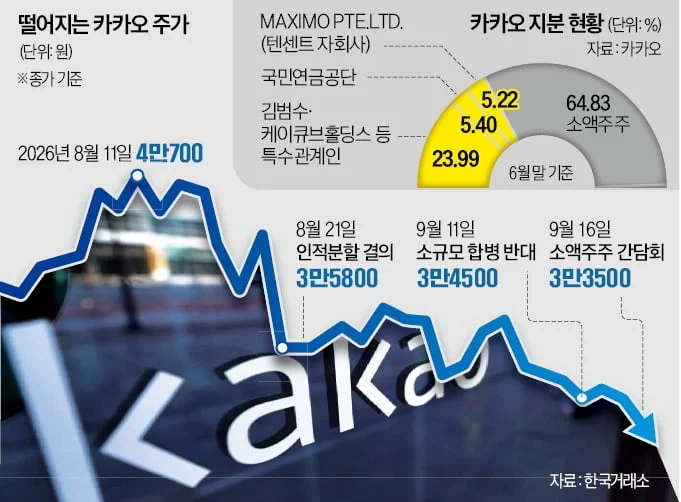
Kakao held a meeting for retail shareholders ahead of its planned December spinoff. The company moved to explain the plan as opposition emerged among individual investors, who own 64.83% of the stock. Under South Korea's Commercial Act, a corporate split requires a special shareholder resolution, meaning approval from at least one-third of outstanding shares. Management sought to win support by outlining an expanded shareholder return policy.
Kim Do-young: We Will Clarify the Growth Strategy
Kakao held a Zoom meeting on Sept. 16 titled "Retail Shareholder Meeting on Governance Restructuring" to explain the rationale for the planned spinoff, the steps ahead and measures to boost shareholder value. Kim Do-young, the incoming head of KakaoX and current chief executive of Kakao Investment, said the split would clarify the growth strategy and resource allocation for KakaoX and KakaoAI. The ultimate goal, he said, is to raise shareholder value.
The meeting was arranged as concerns and opposition over the spinoff intensified among retail investors. Kakao's board approved the plan on Aug. 21 to split the company into KakaoAI and KakaoX. The new KakaoAI entity will house platform businesses including KakaoTalk, advertising and commerce. The surviving KakaoX entity will hold the remaining affiliates, including KakaoBank and Kakao Pay. Kakao will hold an extraordinary shareholders' meeting on Dec. 17 to put the spinoff to a vote.
Retail investors have reacted coolly. Shareholder platform Act conducted a vote on Kakao's spinoff from Aug. 22 to Aug. 27, and 99.9% of responses called for opposing the split and taking active steps against it. Many said there was no compelling reason to divide one listed company into two. Others argued the conglomerate discount would not disappear after the split and could instead shift to KakaoX.
Kim said Kakao plans to sharpen its identity as an AI company and lay the groundwork to be valued as one. That, he said, should also lift a corporate valuation that had been weighed down by the conglomerate discount.
Winning Over Retail Shareholders Is Key
Kakao also unveiled a broad shareholder return plan. Kim said KakaoX would use 30% of gains from the sale of its Dunamu stake, as well as gains on its investments in SK Telecom and Kadokawa, after taxes and capital costs, for special dividends and share buybacks and cancellations. The company will share every realized investment gain with shareholders. KakaoAI will allocate 40% of its standalone free cash flow, or FCF, to shareholder returns, he added.
Management also pushed back on criticism that the benefits of splitting the listed company in two were unclear. Kim said there would be no change in founder Kim Beom-su's stake. The company also has no plans for a rights offering or a conversion into a holding company structure.
Some investors also said the company had not presented enough of a vision for how the split would lift corporate value. One retail shareholder said Kakao's competitiveness had weakened and its stock had swung sharply as the company continued to pursue separate listings for affiliates. Kakao now needs to prove it can persuade the market by presenting a concrete growth strategy, the shareholder said.
Kakao fell 2.9% to close at 33,500 won in Seoul trading on Sept. 16. That was down 13.43% from 38,700 won on Aug. 20, the last trading day before the company disclosed the spinoff plan. Yang Jun-seok, a business professor at the Catholic University of Korea, said Kakao needs to show in concrete terms that it has businesses beyond platforms and AI that can deliver additional growth and profit.
Jeong Ji-eun/Yoo Ji-hee reporters jeong@hankyung.com

Korea Economic Daily
hankyung@bloomingbit.ioThe Korea Economic Daily Global is a digital media where latest news on Korean companies, industries, and financial markets.