Warsh Vows to Curb Inflation as Trump Urges Fed to Cut Rates Below 1%
Summary
- The US Federal Reserve (Fed) raised its benchmark interest rate by 0.25 percentage point to 3.75% to 4.0% and signaled the possibility of an additional increase this year.
- Chair Kevin Warsh said consumer prices, inflation, and financial conditions justified pursuing "a timelier return" to the 2% inflation target, while leaving open the possibility of further rate increases.
- Wall Street and investors interpreted the Fed's decision as a stronger-than-expected tightening drive, hawkish, and part of a broader tightening cycle, and now see additional benchmark-rate increases this year and next.
Forecast Trend Report by Period


US Returns to the 4% Interest-Rate Era for the First Time in Three Years
Mortgage Shock in South Korea
Fed Raises Benchmark Rate by 0.25 Percentage Point
Warsh Tightens Four Months Into His Term
'Inflation Has Stayed Too High for Too Long'
Odds of Another Increase This Year Rise
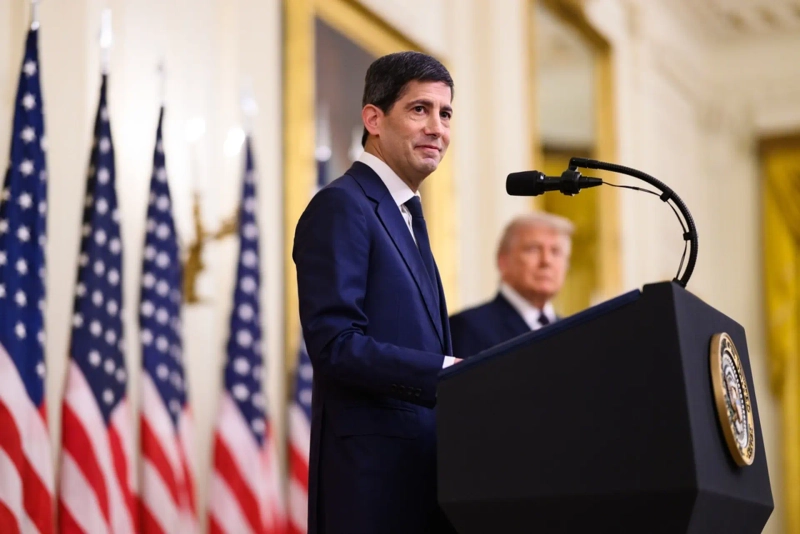
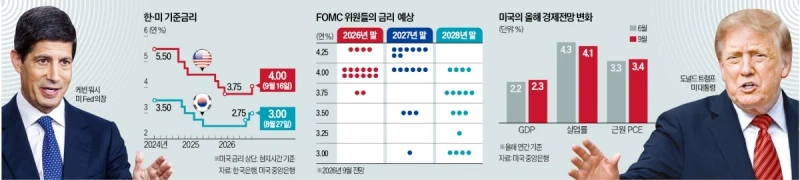
The Federal Reserve has moved to rein in inflation that has remained above its 2% target for more than five years. On September 16, the Fed raised its benchmark interest rate by 0.25 percentage point for the first time in three years and two months. Chair Kevin Warsh and other Federal Open Market Committee members also signaled that another increase this year remains possible.
The Fed said policymakers unanimously decided at the September 15-16 FOMC meeting to raise rates by a quarter point. That lifted the federal funds target range to 3.75% to 4.0%.
The central bank cited inflation stuck in the 3% range and geopolitical uncertainty, including the war in the Middle East, as reasons for the move. It described consumer spending as resilient and productivity growth as strong. Investment remains solid, while employment gains have kept pace with the size of the labor market. The message was that the economy can withstand higher borrowing costs.
In the dot plot released the same day, the median year-end rate forecast from 18 officials, excluding Warsh, rose to 4.1%. That was 0.3 percentage point higher than in June. After the FOMC meeting, Warsh told reporters inflation had stayed too high for too long and financial conditions were not yet restrictive. He left the door open to another rate increase. On Wall Street, more firms began predicting an additional move this year, calling the tightening push stronger than expected.
Markets were surprised by the Fed's hawkish turn, but there was no broad disruption. The Dow Jones Industrial Average fell 1.2%, while the S&P 500 and Nasdaq Composite posted only modest declines. Yields on 10-year and 30-year Treasuries were little changed. South Korea's Kospi fell 2.56 points, or 0.04%, on September 17. Short-term government bond yields in both South Korea and the US, which are more sensitive to monetary policy, rose sharply.
All FOMC Members Back Tighter Policy as Strong Growth Fuels Inflation
Wall Street Calls Fed More Hawkish Than Expected, Sees Tightening Bias Extending Into Next Year
"The economy is doing well, but inflation is not under control."
That was the thrust of Federal Reserve Chair Kevin Warsh's remarks at his FOMC press conference on September 16. With employment stable, the Fed now has room to focus more squarely on inflation, the other half of its dual mandate. Warsh also described the rate increase as an important step toward price stability, reinforcing expectations that further hikes could follow.
Push for a Faster Return to Low Inflation
Before the FOMC meeting, some had expected one or two officials to oppose a rate increase. The result was different. All committee members supported the 0.25 percentage-point move.
The Fed's main reason for raising rates was inflation that has not slowed enough. Warsh used phrases such as "a timelier return" to the 2% inflation target, underscoring his resolve as an inflation fighter. Inflation has remained too high for too long, he said. Financial conditions are not restrictive, and other FOMC members share that view.
Officials focused in particular on price gauges that have stayed in the 3% range, including August personal consumption expenditures inflation of 3.6%. Warsh said inflation readings over the summer had not improved meaningfully. He added that the latest rate increase removed part of the accommodative policy stance and marked an important step. Goldman Sachs and Nomura interpreted those comments as a clear signal that additional rate increases may follow.
Strong Economy Adds to Price Pressure
According to the Summary of Economic Projections, the Fed raised its forecast for this year's gross domestic product growth to 2.3% from 2.2%, while lowering its unemployment-rate outlook to 4.1% from 4.3%. For next year, it lifted the GDP forecast to 2.4% from 2.2% and also revised the unemployment-rate projection down to 4.1% from 4.3%.
At the same time, the Fed raised its medium-term inflation outlook. It increased this year's core PCE forecast to 3.4% from 3.3%, and its 2028 projection to 2.2% from 2.1%. Warsh said strong economic growth and job gains were adding to inflation pressure.
Warsh also cast the recent rise in US 10-year Treasury yields, a major focus in global markets, in a positive light. One reason long-term yields have risen is that the economy is strengthening, he said. Markets are moving to reflect the future, and he wants to let that process continue.
A stronger economy also helps explain why markets were less rattled by rate increases than they were three years ago. In 2022, the Fed delivered steep hikes after the pandemic, when concerns about the recovery still lingered and June consumer price inflation climbed as high as 9.1%. This time, even if another increase comes, markets do not expect a repeat of the 2022 "big step" of a 0.5 percentage-point hike.
How Long Will Rate Increases Continue?
Markets took the FOMC outcome and Warsh's remarks as more hawkish than expected. Financial stocks including JPMorgan and Bank of America fell more sharply than the broader market, reflecting concern over a prolonged tightening cycle.
The FOMC will meet twice more this year, on October 27-28 and December 8-9. On Wall Street, another rate increase this year is increasingly being treated as a base-case outcome. The dot plot showed a median year-end policy-rate forecast of 4.1% from 18 of the FOMC's 19 members, excluding Warsh. Only two officials projected no further change. Morgan Stanley said the Fed had signaled the possibility of another increase sooner rather than later. JPMorgan expects one additional rate hike in December.
The chances of more increases next year are also substantial. Once the Fed starts raising rates, the cycle has often continued for an extended period. The Wall Street Journal said expectations that the latest move might prove one-off had weakened.
Hwang Jung-soo, Korea Economic Daily correspondent in New York / Lee Sang-eun, Korea Economic Daily correspondent in Washington hjs@hankyung.com

Korea Economic Daily
hankyung@bloomingbit.ioThe Korea Economic Daily Global is a digital media where latest news on Korean companies, industries, and financial markets.