Korea-US Rate Gap Returns to 1 Percentage Point as Fed Tightening Clouds BOK’s October Pause
Summary
- The report said the US benchmark interest rate increase widened the Korea-US rate gap to 1 percentage point, adding to pressure on the exchange rate and inflation.
- It said growing odds of additional Fed tightening by year-end were fueling concern over higher government bond yields and greater volatility in the domestic stock market, including the Kospi.
- It said the BOK’s policy calculus has become more complicated over whether to hold in October and deliver an additional hike in November, and over the timing of reaching a benchmark rate of 3.25%.
Forecast Trend Report by Period


Sixteen of 18 dot-plot members project another rate increase
BOK faces mounting pressure on the won and inflation as the rate gap widens to 1 percentage point
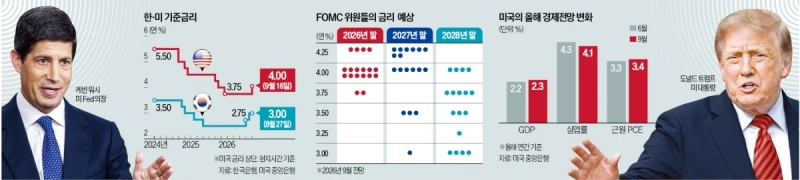
The Federal Reserve’s latest rate increase has widened the policy-rate gap with South Korea back to 1 percentage point. Analysts say that if the wider gap and high oil prices persist, pressure could build further on the won and on inflation. That is complicating the Bank of Korea’s policy calculus as it had been weighing an October pause after back-to-back increases in July and August.
Fed seen leaning toward more tightening by year-end
The Fed raised its benchmark rate by 25 basis points to 3.75% to 4.00% at its Federal Open Market Committee meeting on Sept. 16. It was the first tightening move in three years and two months since July 2023. Markets widely expect the central bank to follow with additional tightening.
The Fed’s dot plot reinforced that view. Of the FOMC’s 18 participants, 12 projected the policy rate at 4.00% to 4.25% by year-end, while four saw 4.25% to 4.50%. Only two expected rates to remain at the current 3.75% to 4.00% range.
That outlook could also keep upward pressure on long-term yields. Stocks are priced by discounting future earnings into present value, so a higher discount rate lowers that value. If long-term yields remain elevated, equities become relatively less attractive. The yield on the 10-year Treasury had already approached 5% before the FOMC meeting amid concern over a hawkish rate path, and it remained at 5.023% after the decision.
As the uptrend in rates becomes more pronounced, the Kospi could return to a more volatile trading pattern after a recent lull. Sidecar curbs were triggered 49 times this year through last month, but not once so far in September. July recorded the most with 15, while January and September are the only months with no sidecar activation so far.
Brokerages are also bracing for wider swings in Korean stocks as higher US rates ripple through markets. Han Ji-young, an analyst at Kiwoom Securities, said the local market would likely remain volatile as it absorbs the aftershocks of the September FOMC meeting. Each time concerns over rate increases resurfaced, stock volatility widened because of the burden of already-high rates and the market’s memory of the 2022 tightening shock, he added.
In 2022, the Fed raised rates by 525 basis points over 17 months. During that period, the S&P 500 fell as much as 25% from its peak, while the Kospi dropped as much as 35%. That episode of rapid tightening may be one reason markets are now more sensitive to rates.
Kim Ho-jung, an analyst at Yuanta Securities, said the two-year Treasury yield would likely remain in a 4.65% to 4.75% range for the time being, while the 10-year yield would likely hover near 5.0%. Rate volatility is unlikely to ease in earnest until an October pause is confirmed, he said. As long as the possibility of additional tightening remains, a near-term decline in volatility will be difficult.
Stronger Fed tightening signal complicates BOK’s next move
The Fed’s signal that more tightening may come this year has also raised the possibility of another BOK increase before year-end. The gap between the top end of the US policy-rate range and South Korea’s benchmark rate of 3.00% has widened back to 1 percentage point. Combined with high oil prices, that has heightened concern over a weaker won and stronger inflation pressure.
For the BOK, the outlook has become more complicated. The central bank had been leaning toward a pause in October to assess the impact of its consecutive increases in July and August. But exchange-rate and inflation conditions argue for another hike, while already-elevated market rates and heavier interest burdens for households and companies argue for a slower pace. The key question is whether the BOK sticks with an October hold followed by a November increase, or brings the next move forward.
Most analysts say the wider Korea-US rate gap has strengthened the need for the BOK to examine exchange-rate and financial conditions at its next rate decision on Oct. 22. Some also say that if the won’s strength, which had helped cushion the oil shock, is checked, the timing of a move to a 3.25% benchmark rate could be brought forward.
The BOK raised its benchmark rate twice in a row in July and August, by a combined 50 basis points, and signaled a gradual path for further increases. At last month’s Monetary Policy Board meeting, the median six-month conditional outlook was 3.25%, 25 basis points above the current level. Governor Shin Hyun-song said at the time that expectations for gradual increases reflected the need to assess the impact of the two straight hikes. That left room for the central bank to keep the door open to further tightening while still pausing once in October.
If the Fed’s tightening signal leads to renewed won weakness and stronger domestic inflation pressure, however, the BOK may have less room to pause. Changes in market expectations for the rate path after the Fed’s move, the won’s reaction and the degree of tightening in financial conditions are emerging as key variables for the next decision.
Kang Kyung-ju, Hankyung.com reporter qurasoha@hankyung.com

Korea Economic Daily
hankyung@bloomingbit.ioThe Korea Economic Daily Global is a digital media where latest news on Korean companies, industries, and financial markets.