PiCK
Bitcoin Can Keep Climbing Even if the Clarity Act Stalls, With Rates and ETF Flows the Key
Summary
- Analysts said the odds of the Clarity Act passing this year have fallen, but Bitcoin has still climbed about 38%, showing that the infrastructure for institutional investment is already in place.
- Market participants said interest rates, spot ETF inflows and the monetary policy backdrop are the main drivers of Bitcoin's price, with actual fund flows mattering more than regulatory changes.
- On-chain data showed U.S. spot Bitcoin ETFs recently posted about $334 million in net outflows, while stalled stablecoin supply growth and flat corporate Bitcoin purchases pointed to a lack of new demand as a factor behind the decline.
Forecast Trend Report by Period


Bitcoin up 38% despite legislative setback
Bitwise revises view that downturn would drag on
Bitcoin already has ETFs, futures and other investment rails
Rates and institutional fund flows are the key variables

A setback in the U.S. Senate for the Clarity Act, a digital-asset market structure bill, has put expectations for a Bitcoin rebound to the test. But some analysts say passage of the measure should not be viewed as the decisive condition for further gains. Bitcoin already has the infrastructure for institutional investment, and its price is more sensitive to interest rates and actual capital flows than to regulatory change.
Even analysts who had worried about legislative delays are revising their views. In an investor memo on Sept. 16, Matt Hougan, chief investment officer at Bitwise, backed away from his earlier call that failure of the Clarity Act would prolong the crypto market downturn. He pointed to Bitcoin's gains and continued expansion by financial firms into the market even as the odds of passage this year declined.
Bitcoin rises as legislative hopes fade, shifting Wall Street's view
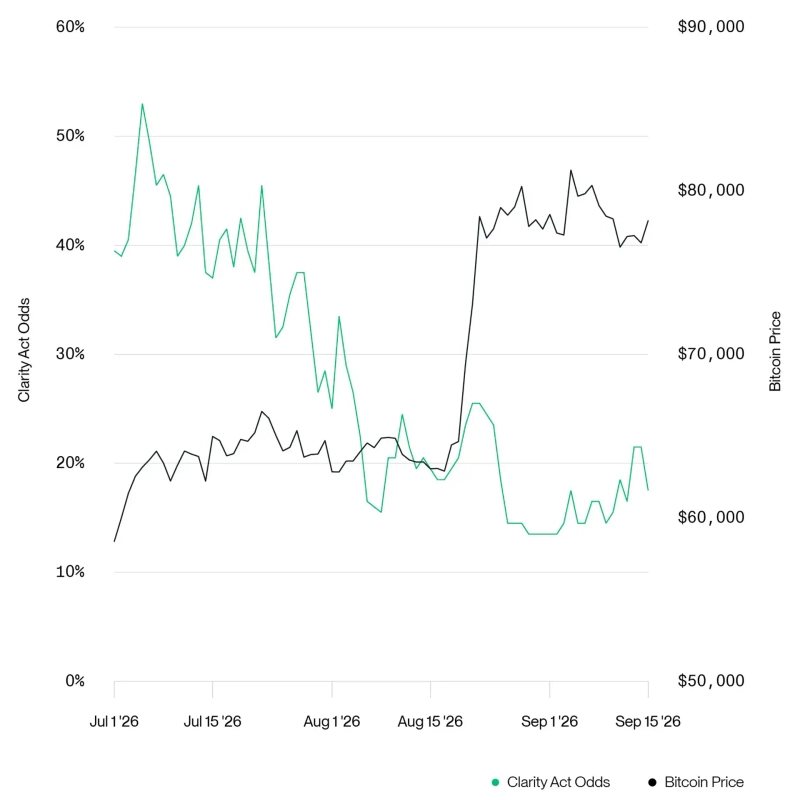
The Clarity Act failed to pass a procedural vote in the U.S. Senate on Sept. 15 that would have advanced debate. The measure won 49 votes, short of the 60 required, dimming prospects for passage this year.
Financial institutions had warned that delays in legislation could slow institutional inflows and weigh on prices. Citigroup in March cut its 12-month Bitcoin price target to $112,000 from $143,000, citing delays in U.S. crypto legislation among other factors. At the time, Citi strategist Alex Saunders said regulatory changes would encourage broader market participation and capital inflows, but the chances of U.S. legislation passing this year were shrinking.
More recently, however, the view has emerged that Bitcoin's rally can continue even if the bill is delayed. Hougan had written in January that failure of the measure could extend crypto winter by another six weeks. In his latest memo, he wrote that he no longer views that as the most likely scenario.
The turning point was price action. Bitcoin rose from about $57,950 on July 1 to more than $80,000 on Sept. 4. Over the same period, Polymarket odds that the Clarity Act would become law this year fell to 18% from 39%. Bitcoin still climbed about 38% as expectations for legislation faded. Had the rally depended on passage of the bill, the price should have fallen alongside those odds. Instead, the opposite happened, Hougan wrote.
He saw the same pattern in Wall Street's moves. Hougan cited Robinhood's launch of its own blockchain, Morgan Stanley's launch of a Solana ETF and the Depository Trust & Clearing Corp.'s settlement of tokenized stock trades. Major financial firms are expanding their crypto businesses without waiting for Congress to act.
He also pointed to rulemaking by the Securities and Exchange Commission and the Commodity Futures Trading Commission as support for that trend. Even if the bill is delayed, follow-up action by regulators could improve business conditions. Hougan maintained that passage would still be more positive for investor sentiment and prices. But he stepped back from treating legislation as a prerequisite for a bull market.
'Already embedded in mainstream finance' as Bitcoin's legal status differs from altcoins
That view reflects a broader recognition that Bitcoin faces a different regulatory backdrop from other digital assets. The Clarity Act would establish standards for classifying digital assets, define the supervisory boundaries of the SEC and CFTC, and set operating rules for exchanges and brokerages. The bill is aimed at reducing uncertainty in how assets are issued and traded.
Bitcoin, however, is already treated as a commodity in the U.S. In January 2024, the SEC approved the listing and trading of spot Bitcoin exchange-traded products. That gave institutional investors a route to buy Bitcoin through securities accounts before any action on the bill.
James Seyffart, a Bloomberg ETF analyst, said for that reason the Clarity Act is likely to have only a limited direct effect on Bitcoin prices. Bitcoin already has commodity status, a regulated futures market, spot ETFs and institutional custody infrastructure. Passage of the bill is not what makes institutional investment in Bitcoin possible, he said.
Rates and spot ETF inflows are the real drivers

Analysts point to interest rates and spot ETF flows as the key conditions for a Bitcoin rebound.
Rachel Lucas, an analyst at BTC Markets, said the market is being driven more by rates than by policy expectations. Investors should watch the path of rates and whether ETF inflows recover. Justin d'Anethan, head of research at Artic Digital, also stressed the importance of rates and the broader monetary backdrop, saying Bitcoin has reached record highs without the Clarity Act.
The monetary policy backdrop is already proving a headwind. The Federal Reserve raised its benchmark interest rate by 0.25 percentage point on Sept. 16, bringing it to 3.75% to 4.00%. The Federal Open Market Committee said inflation remained elevated and that the increase was intended to accelerate the return to target.
Fresh buying has also slowed. A report published by on-chain analytics firm Glassnode on Sept. 16 showed that U.S. spot Bitcoin ETFs drew about $1 billion earlier this month, but swung to net outflows of about $334 million from Sept. 8 to Sept. 14. That suggests fund flows had already weakened before the Senate vote. Glassnode said stablecoin supply growth and corporate Bitcoin purchases had also stalled. The lack of new demand contributed to Bitcoin's decline, it said.
A delay in legislation does not mean regulatory development comes to a standstill. JPMorgan said in a report that the market's focus will now shift to rulemaking by the SEC and CFTC. Still, administrative rules are less durable than legislation because they can be changed by the next administration or constrained by court rulings. JPMorgan added that the Clarity Act could reduce long-term regulatory uncertainty, but sustained gains in Bitcoin will also require improved conditions for investors to put real money to work.

Doohyun Hwang
cow5361@bloomingbit.ioKEEP CALM AND HODL🍀