Kospi Nears 7,000 in Stunning Reversal After Fed, BOJ Rate Hikes
Summary
- The report said the Kospi index was nearing a return to 7,000, led by semiconductor shares even after benchmark rate hikes in the U.S. and Japan.
- Brokerages said the Fed's tightening pace should be more limited than in past cycles, while earnings growth could remain intact, with consensus for 990 trillion won in operating profit on the main board.
- It added that investors should watch whether the rally can continue, as volatility could rise because of oil prices, yen weakness, U.S. Treasury yields, and the roughly $2 trillion options expiry (triple witching).
Forecast Trend Report by Period


Fears of a yen-carry unwind ease as stocks mount a relief rally
Kospi nears 7,000 despite U.S. and Japan rate hikes
'Different from the 2022 rout'
This article appeared on Hankyung Premium9, the Korea Economic Daily's paid investment platform. Subscribers to Hankyung Premium9 can access more stock-investment stories.
Global tightening gathered pace after the Federal Reserve and the Bank of Japan both raised interest rates. Even so, South Korea's Kospi surged, putting the benchmark within striking distance of 7,000 as sentiment toward semiconductor shares improved.
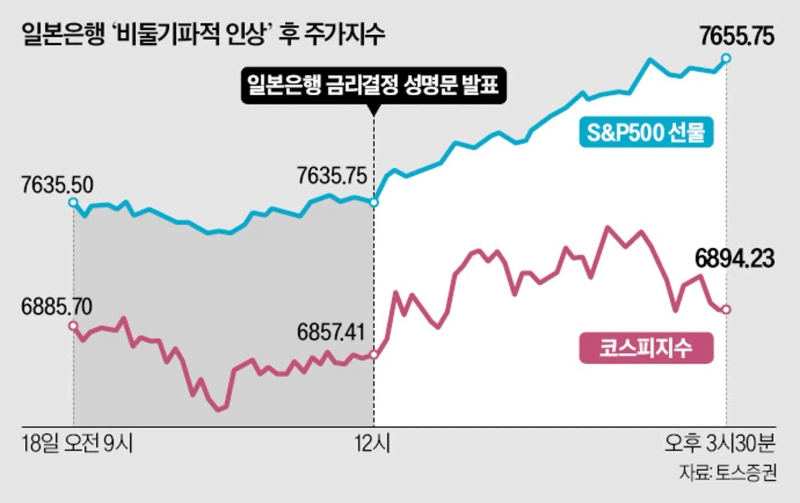
The Kospi closed 2.66% higher at 6,894.23 on Sept. 18. The index briefly rose above 6,900 during the session. The Fed on Sept. 16 raised its benchmark rate by 25 basis points to 3.75%-4.0%, launching a tightening cycle for the first time in three years and two months. The BOJ then lifted its policy rate to 1.25% from 1.0%. Despite the worsening macro backdrop, chip stocks led the advance. Samsung Electronics gained 3.73% and SK Hynix jumped 6.42%. Sentiment toward semiconductor shares had already improved from Wall Street after Nvidia Chief Executive Officer Jensen Huang said next year's chip sales would double from this year.
Brokerages say a repeat of the 2022 crash, when the Kospi fell 35% from its peak, is unlikely even if the global rate-hike cycle continues. At that time, the Fed started raising rates from 0%-0.25% and lifted them rapidly to 5.25%-5.50% in a year and a half. This time, the starting point is already higher at 3.50%-3.75%, leaving limited room for both the pace and scale of additional increases. Han Ji-young, an analyst at Kiwoom Securities, said the Fed has entered six rate-hike cycles since 1994 and the Kospi rose an average of 9.1% during those periods.
Corporate profit fundamentals on South Korea's main board also appear firmer. Unlike 2022, when earnings weakened alongside a downcycle in memory chips, this year's consensus for operating profit on the benchmark stock market stands at 990 trillion won, suggesting earnings growth could hold up.
The yen weakened further on Sept. 18, trading in the 157-per-dollar range. The move came despite the BOJ rate increase, as investors judged Japan's tightening would remain less forceful than that of the U.S.
Market Sees BOJ as Less Hawkish Than Expected; Oil Eases on Hopes for End to Middle East War
Optimism Prevails Despite Tightening, With Sept. 18 U.S. Options Expiry a Key Variable
The U.S. and Japanese central banks raised rates two days apart, but risk assets around the world rallied. The Kospi's 2.7% gain on Sept. 18 was the biggest in about a month since Aug. 20, excluding a single session driven by enthusiasm over OpenAI's Astra. Japan's Nikkei 225 closed 1.4% higher despite the BOJ move, while Bitcoin rose 1.4% to recover the $77,700 level as of 4 p.m. Seoul time. U.S. stock-index futures, which had already advanced after all three major benchmarks rose the previous day, added to their gains.
◇ Fears of a Yen-Carry Unwind Recede
A series of favorable developments helped revive risk appetite. Oil prices, which had surged, eased after reports that China had warned Iran to restrain the Houthi rebels and concern over disruptions to Saudi crude supply subsided. The yield on the 10-year U.S. Treasury retreated to the 4.93% range.
The BOJ's dovish hike also eased fears of aggressive tightening and a drain on global liquidity. The Kospi began rebounding sharply around noon, when the BOJ announced its rate decision. Foreign investors also returned as net buyers for the first time in seven trading days. Funds that had stayed on the sidelines ahead of the BOJ meeting joined a relief rally on the view that the worst-case scenario had been avoided.
The BOJ raised its policy rate to 1.25% from 1.0% on Sept. 18, the highest level in 31 years. The increase itself was expected. What surprised markets was the absence of any minority view calling for a larger hike. Morgan Stanley said some investors had expected the two most hawkish board members to push for a 50-basis-point move, but instead the only dissent came from two votes in favor of holding rates unchanged. That made the outcome more dovish than the market had anticipated.
The result helped ease fears over an unwinding of yen-carry trades, which had unsettled markets. Investors have remained highly sensitive to moves in the yen after the summer of 2024, when BOJ tightening and a sharp rise in the Japanese currency triggered a global equity selloff. A sudden strengthening of the yen can force investors to unwind yen-carry trades, in which cheaply borrowed yen is used to buy overseas stocks and other assets, amplifying stress across global markets.
BOJ Governor Kazuo Ueda said the phase of policy management had changed, but added that the central bank also needed to avoid raising rates too quickly and abruptly tightening financial conditions. Citi interpreted that as a message that rates are still heading higher, but not at the pace the market had feared.
◇ Focus Shifts Back to Corporate Earnings
Strategists remain optimistic on equities even as major central banks continue to raise rates. The key support is strong economic growth driven by AI investment and resilient corporate earnings. Mislav Matejka, JPMorgan's head of global equity strategy, said stocks can withstand higher rates if tightening remains gradual, inflation stays under control and earnings remain solid.
That also marks a contrast with 2024, when the yen-carry shock hit. At the time, fears of an unwind were intensified by a U.S. jobs shock and recession concerns. The Kospi plunged 9% in a single day. The backdrop is now the reverse. Kim Yong-gu, an analyst at Yuanta Securities, said oil prices and interest rates are stabilizing, while actual demand data are countering concerns about AI. The Fed also left open the possibility of further hikes, but did not signal uninterrupted tightening through next year. In that environment, the market's focus is likely to shift back to earnings and orders.
Still, it may be too early to say the relief rally is fully entrenched. Oil remains the biggest obstacle. Another concern is that a renewed sharp slide in the yen could reignite the rise in U.S. Treasury yields. Nick Twidale, a strategist at AT Global Markets, said volatility could easily pick up again as central-bank policy continues to drive markets and geopolitical risks remain elevated. Another variable is the triple witching on Sept. 18 in the U.S., when more than $2 trillion in options by notional value are set to expire. Pepperstone Group added that the key near-term question is whether the rally can extend beyond options expiry.
Kang Jin-kyu, Korea Economic Daily reporter josep@hankyung.com
Choi Man-su, Tokyo correspondent, Korea Economic Daily bebop@hankyung.com
Bin Nan-sae, Korea Economic Daily reporter binthere@hankyung.com

Korea Economic Daily
hankyung@bloomingbit.ioThe Korea Economic Daily Global is a digital media where latest news on Korean companies, industries, and financial markets.