AI Is Propping Up Global Trade. If Big Tech Spending Falters, South Korea Could Shake Too
Summary
- A large share of the increase in global trade is coming from AI-related goods, semiconductors, power equipment, and minerals.
- A slowdown in AI capital spending by US Big Tech could trigger a chain reaction across Asian trade in semiconductors, foundries, power equipment, and copper.
- South Korea's reliance on the AI supply chain is deepening, with about 79% of its export growth coming from semiconductors, increasing concentration risk.
Forecast Trend Report by Period


Growth in global merchandise trade is becoming increasingly concentrated in artificial intelligence-related products. Trade in AI-related goods rose 42% in dollar terms in the first quarter from a year earlier, while the rest of global goods trade increased just 7%.
That leaves a growing vulnerability. AI investment helped the global economy withstand tariffs and an energy shock from the Middle East. If US Big Tech pulls back on capital spending, semiconductors, power equipment, minerals and Asian exports could all slow.
AI Trade Up 42%, Non-AI Goods Up 7%
The World Trade Organization said on September 19 that AI-related goods accounted for about 19% of global merchandise trade in the first quarter. The category includes not only semiconductors, but also servers, telecommunications equipment, some industrial machinery and related parts.
Total trade volume rose 3.2% in the quarter from a year earlier, while the value of trade increased 11% in dollar terms. The gap across products was wide. Trade in office and telecommunications equipment jumped 44%, and AI-related technology goods rose 42%. By contrast, chemicals fell 6%, steel dropped 5% and fuel declined 3%.
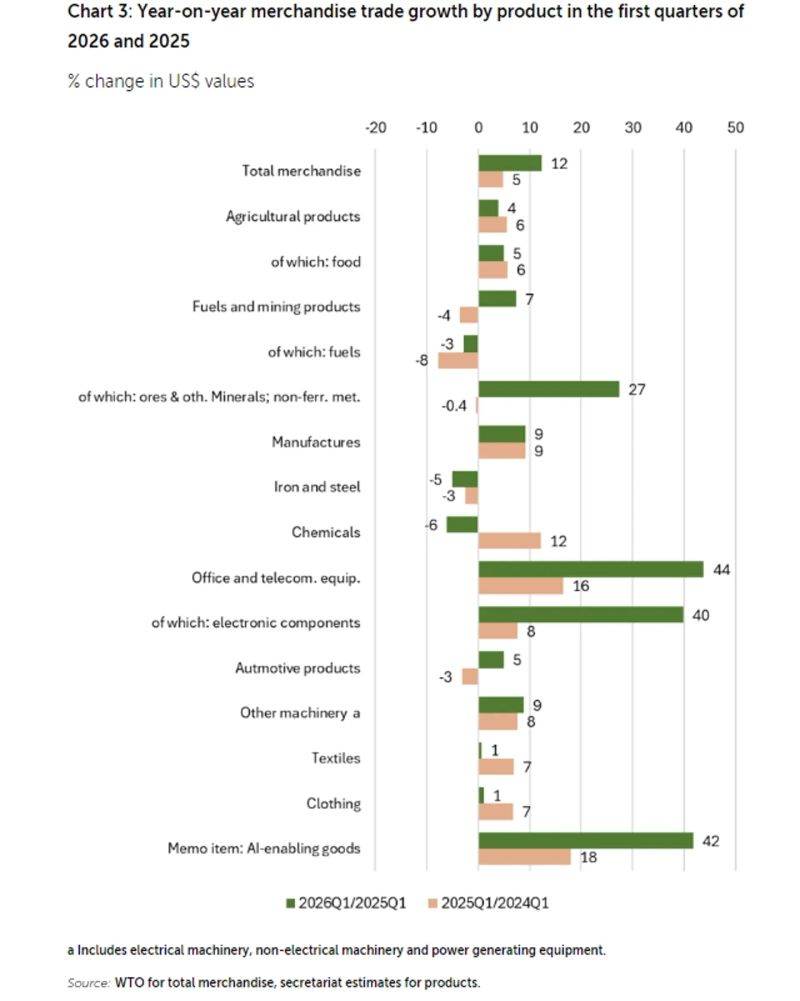
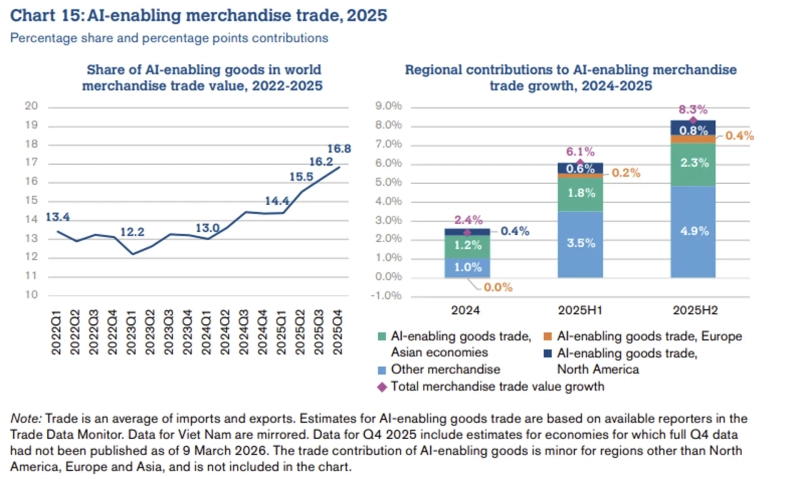
WTO Director-General Ngozi Okonjo-Iweala said AI trade is masking the effects of tariffs and other disruptions around global commerce, the Financial Times reported. Global merchandise trade volume rose 4.6% last year, and the WTO estimates that 42% of that increase came from AI-related goods. That suggests the AI investment boom was not just a one-quarter phenomenon.
More recent leading indicators point the same way. The WTO's goods trade barometer, released on September 9, stood at 102.0, above its long-term trend level of 100. The index for electronic components was 104.9 and export orders came in at 103.5, while container shipping remained at 99.6. The message is that global trade is not recovering evenly. Electronic components and AI equipment are doing much of the lifting.
Asia Produces, North America Funds
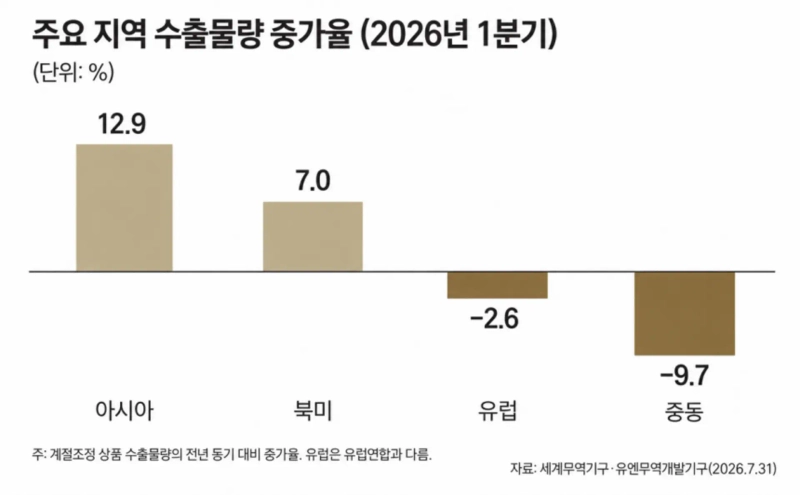
The regional concentration of AI trade is also becoming clearer. Asia's merchandise export volume rose 12.9% in the first quarter from a year earlier, while imports increased 14.6%. The gain reflects rising intra-Asian trade in AI-related components moving among China, South Korea, Taiwan, Singapore and Thailand. Europe's export volume, by contrast, fell 2.6% in the same period. Part of that decline, however, reflects a high base after gold and pharmaceutical shipments were front-loaded last year.
Asia handled more than 60% of global trade in AI-related goods last year, according to the Financial Times. North America, by contrast, attracted 76% of venture capital investment in AI. That points to a sharper division of labor: the US provides design, capital and end demand for cloud services, while Asia, led by South Korea and Taiwan, supplies semiconductors and electronic components.
Okonjo-Iweala described a semiconductor supply chain in which chips are designed in one country, manufactured and packaged in another, and then assembled into servers somewhere else. "Without trade, there is no computing," she said. Singapore Digital Development and Information Minister Josephine Teo said AI must become an opportunity for many, not a privilege for a few. AI is both a growth engine and a source of concentration in production and capital.
The trade rules supporting AI supply chains are older than the technology itself. The WTO's Information Technology Agreement lowers tariffs on many pieces of AI equipment, while agreements on services, technical standards and intellectual property support the movement of data and technology. But those rules were written before large language models and AI accelerators emerged. If semiconductor export controls and local production requirements expand, trade values may rise even as duplicate supply-chain investment and costs increase.
South Korea sits at the center of that global supply-chain structure. WTO data showed the country's nominal exports rose 38.4% in the first quarter from a year earlier, the fastest pace among the world's five largest exporting economies. AI investment that begins with US capital spending is creating a circular flow that runs through Korean memory chips, Taiwanese foundries, Asian assembly and logistics, and back to US data centers.
Big Tech Capital Spending at $730 Billion
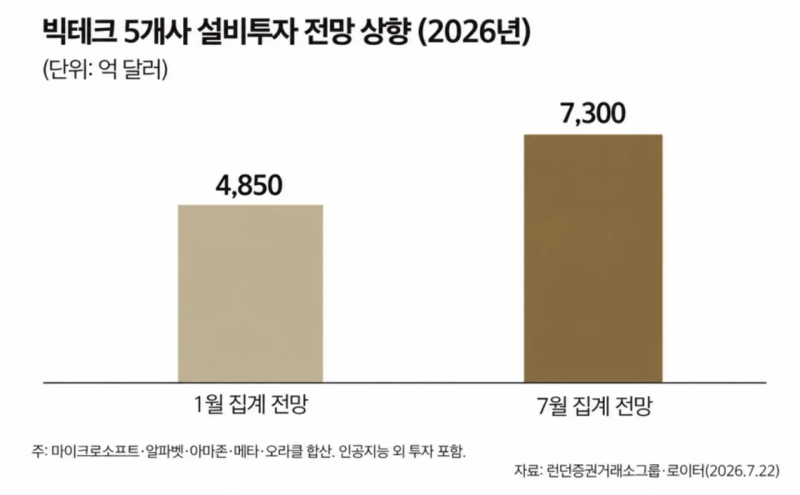
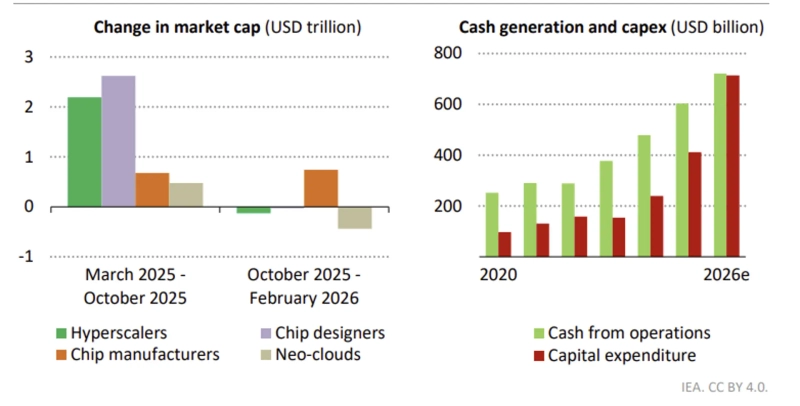
The money supporting global trade is coming from US Big Tech capital spending. LSEG data show projected capital expenditure this year for Microsoft, Alphabet, Amazon, Meta and Oracle rose to $730 billion in July from $485 billion in January. The companies do not separately disclose AI investment, so the figure reflects total capital spending. Even so, much of the outlay on data centers, servers and networks is tied to AI demand.
The pace of spending has outstripped cash generation. Under LSEG's projections, those five companies will spend more on capital expenditure than they generate in free cash flow by 2027. From 2025 through 2027, every additional $1 of operating cash flow would be matched by a $1.57 increase in capital spending. David Russell, global head of market strategy at TradeStation, said companies exist to make money, not to spend it.
There is still no definitive evidence that demand has rolled over. Amazon raised its capital spending plan for this year by 10% to $220 billion. Amazon Web Services posted $42.2 billion in second-quarter revenue, up 37%, while its backlog rose to $496 billion from $364 billion in the previous quarter. Chief Executive Officer Andy Jassy said AWS is growing at an explosive pace and that even $220 billion would not be enough to meet all of this year's demand.
Alphabet also raised its capital spending outlook to $195 billion to $205 billion this year. Google Cloud revenue rose 82% to $24.8 billion in the second quarter. Chief Financial Officer Anat Ashkenazi said demand continues to outpace investment.
The strain is already showing up in cash flow. Amazon's free cash flow over the past 12 months swung to a $7.6 billion deficit from an $18.2 billion surplus a year earlier. Alphabet also posted negative free cash flow of $5.9 billion in the second quarter. Thomas Monteiro, an analyst at Investing.com, said capital has a real cost again and the margin for error is shrinking each quarter.
Bridgewater estimates Alphabet, Amazon, Meta and Microsoft will spend $650 billion on AI infrastructure this year, 59% more than last year's $410 billion. That measure differs from LSEG's estimate because it covers AI infrastructure rather than the five companies' total capital spending. Greg Jensen, Bridgewater's co-chief investment officer, said the competition in AI investment has entered a more dangerous stage. If expected returns fall while dependence on external capital rises, both investment and financial markets could wobble.
Power and Minerals Are on the Same Cycle
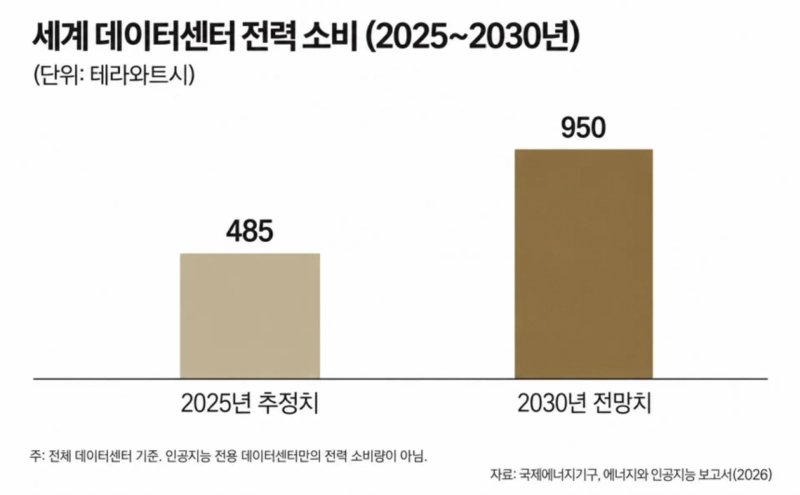
AI trade does not end with semiconductors. The International Energy Agency projects global data-center electricity consumption will almost double to 950 terawatt-hours by 2030 from 485 terawatt-hours last year. Consumption by AI-specific data centers is projected to triple over the same period. By 2030, data centers will account for about 3% of global electricity demand.
The power used by servers is also climbing rapidly. According to the IEA, the power density of AI servers rose elevenfold between 2020 and 2025 and is projected to increase another fourfold by 2027. By 2027, a single server rack in an advanced data center could require as much electricity at peak load as 65 households. That is why transformers, power semiconductors, cables, batteries and transmission grids are becoming part of the AI supply chain.
IEA Executive Director Fatih Birol said electricity demand is rising three times faster than total energy demand, and that 61% of global energy investment this year has gone to the power sector. He added that grid shortages and high electricity prices could slow the pace of data-center expansion.
Mineral demand is also tied to the cycle. Trade in ores and minerals rose 27% in the first quarter, while prices for metals and minerals excluding gold and silver climbed 32%. Not all of that can be attributed to AI demand. Gold and copper prices, along with supply shocks tied to the Middle East, also played a role. Still, the link is clear: investment in servers, transmission grids and cooling systems is pushing up trade in copper and electrical equipment.
If Investment Slows, Asia Would Be Hit First
The WTO expects global merchandise trade volume to grow 1.9% this year under its baseline scenario. If AI investment remains strong, that growth rate could be 0.5 percentage point higher. If the war in the Middle East keeps energy prices elevated, it could be 0.5 percentage point lower. In the WTO's outlook, the positive effect of AI investment is roughly the same size as the drag from an energy shock.
If AI capital spending slows, the effects would move through several stages. A cut in data-center budgets by Big Tech would first hit orders for AI accelerators and high-bandwidth memory. That would then reduce foundry, packaging and server assembly activity, along with intra-Asian component trade. The impact would spread further to air cargo, power equipment, copper orders and data-center financing. In other words, the same channels through which AI lifted global trade would begin to work in reverse.
Okonjo-Iweala said it would be difficult to sustain the current pace of trade growth if AI investment proves to be a bubble. The IEA also said data-center investment has grown too large to be supported by corporate balance sheets alone, and that future construction will become increasingly sensitive to capital-market sentiment and expected investment returns.
At the same time, there is not enough evidence to make a sharp downturn the base case yet. The Semiconductor Industry Association said global semiconductor sales reached $146.8 billion in July, up 135.1% from a year earlier. SIA President and Chief Executive Officer John Neuffer said the industry surpassed its previous annual global sales record in just seven months. Monthly sales have now risen for 17 straight months.
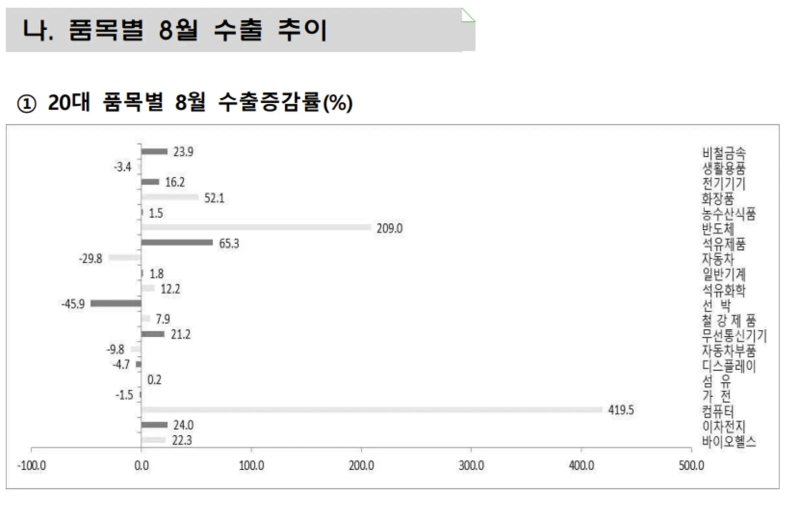
For South Korea, the opportunity is rising alongside concentration risk. The Ministry of Trade, Industry and Energy said exports in August climbed 68.7% from a year earlier to $98.25 billion. Semiconductor exports surged 209% to $46.65 billion. That meant a single product accounted for 47.5% of the country's total exports.
Exports excluding semiconductors also rose about 20%. Even so, roughly 79% of the increase in total exports came from semiconductors. The base of export growth has broadened, but dependence on chips has deepened as well.
Kim Ju-wan, Hankyung.com reporter, kjwan@hankyung.com

Korea Economic Daily
hankyung@bloomingbit.ioThe Korea Economic Daily Global is a digital media where latest news on Korean companies, industries, and financial markets.