Samsung’s Unusual AI Bet: It Invests in Euclid in Search of a Future Beyond HBM
Summary
- Samsung Electronics said it co-led a Series A investment of more than 200 million euros in Dutch AI semiconductor startup Euclid, betting on an architecture centered on AI inference and memory.
- Euclid said it is developing Craftwork, an AI inference chip featuring processor-memory co-design, 1 terabyte of UBM, and as much as 8,000 terabytes per second of memory bandwidth.
- Samsung Electronics said it is expanding investments beyond HBM into companies focused on integrating AI computing and memory architectures, including AI semiconductors, GPU design IP, and AI accelerators.
Forecast Trend Report by Period


Why Samsung Really Invested in Euclid
GPUs Alone Aren’t Enough; Memory Will Determine Inference Performance
Push to Integrate Computing, Memory and Packaging Beyond HBM

Samsung Electronics Co.’s investment in Dutch AI chip startup Euclid is drawing attention across the semiconductor industry. The move is being viewed as a bet that competition in AI chips may shift from the raw performance of graphics processing units to how efficiently compute processors and memory are combined. As AI inference grows in importance, Samsung is also seeking an edge in memory bandwidth, data movement and power efficiency.
What Kind of Company Is Dutch AI Chip Startup Euclid?
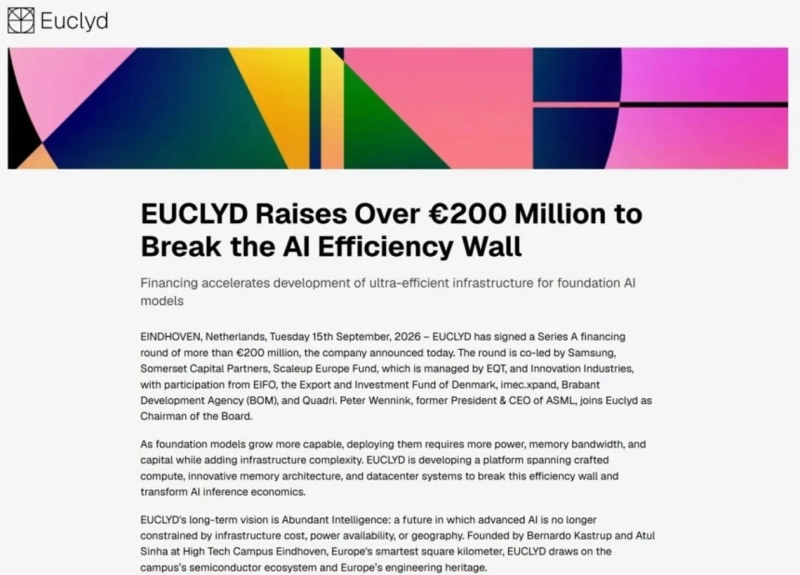
Samsung recently joined as a co-lead investor in Euclid’s Series A round of more than 200 million euros, or about $214 million, according to the semiconductor industry on September 19. Somerset Capital Partners, ScaleUp Europe Fund and Innovation Industries also co-led the investment. Samsung Catalyst Fund, the venture capital fund wholly owned by Samsung Electronics, participated in the round.
Euclid is a semiconductor startup founded in 2024 at the High Tech Campus Eindhoven in the Netherlands by Bernardo Kastrup and Atul Sinha. Former ASML Chief Executive Officer Peter Wennink joined as chairman of Euclid’s board as part of the fundraising.
The company takes its name from the ancient Greek mathematician Euclid. The idea is to redesign AI semiconductors from first principles rather than as an extension of existing products.
Euclid’s core strategy is processor-memory co-design. The approach breaks from the conventional AI data-center architecture of linking large numbers of general-purpose GPUs. According to the company’s published roadmap, it aims to raise computing, memory and system efficiency at the same time by pairing its Craftwork AI inference chip with a data-center system.
Craftwork is an ASIC-based system built for inference, the process of applying trained AI models in live services. It is designed so multiple compute processors work in parallel, allowing large AI models to be handled more efficiently. Put simply, the system distributes workloads across several compute devices instead of relying on a single powerful processor.
That is a different path from the traditional data-center model of connecting multiple GPUs to run AI. Euclid is designing the compute engine used for AI calculations and the memory that stores and supplies data as a single integrated set from the outset. Bringing compute and memory closer together reduces data-transfer time, which allows AI systems to run faster while consuming less power, according to the company.
Beyond HBM, Toward Integrated Computing and Memory for AI Inference
The most important reason Samsung invested in Euclid is that it wants to expand beyond being simply an HBM maker into a company involved in designing AI compute and memory architectures together.
Until now, competition in AI semiconductors has centered on raising GPU computing performance. As the inference market grows, however, a key battleground is shifting to how quickly data can be delivered from memory to processors and how little power that process consumes. Euclid is trying to solve that problem through simultaneous processor and memory design.
What stands out for Samsung is Craftwork’s memory architecture. For AI to generate answers, chips need not only computing power but also the ability to pull vast amounts of data from memory at high speed. Even a powerful chip cannot deliver full performance if it cannot obtain the data it needs in time. To address that bottleneck, Euclid designed 1 terabyte of ultra-bandwidth memory, or UBM, alongside the chip’s compute architecture.
Under Euclid’s published design targets, Craftwork is built to deliver memory bandwidth of as much as 8,000 terabytes per second. Memory bandwidth refers to how quickly data can be fetched from memory. The wider that data path, the more information can move at once. Euclid is focusing not just on compute speed but also on dramatically expanding that pathway.
Inside Samsung, the AI inference market Euclid is targeting is viewed as a new opportunity for the company. In the AI training market, Nvidia Corp.’s GPU performance and software ecosystem remain formidable barriers to entry. In inference, by contrast, the computing structure required can vary depending on the AI model and how it is used.
Even with the same AI model, the cost of answering users’ questions in real time depends not only on computing power but also on memory capacity, memory bandwidth and the power consumed in moving data. That is why Euclid is trying to tackle the problem with a structure different from GPUs.
Samsung has recently widened its investments beyond Euclid to companies with AI chip computing, design and data-processing technologies. In July, it co-led a $35 million Series A round for Oxmiq, which develops GPU design intellectual property. In March, it led a $50 million strategic investment round for Normal Computing, an AI-based semiconductor design automation company.
Samsung Catalyst Fund’s investment portfolio also includes AI inference chip company Groq, chiplet interconnect technology company Eliyan and low-power AI accelerator developer Axelera AI. More recently, it led an investment in Mistral AI, expanding its scope from semiconductor hardware to AI models.
Euclid Says Samsung Offers More Than Capital
Euclid plans to use the new funding to expand its engineering organization and speed up semiconductor and system development. Its goal is to launch a physical semiconductor system in 2028 and secure thousands of corporate customers by 2030.
Bernardo Kastrup, Euclid’s chief executive officer, told CNBC on September 14 that Samsung can help the company in many ways beyond funding. As one of the world’s largest memory manufacturers, Samsung brings an understanding of engineering and systems, along with supply-chain capabilities and a broad network.
Dede Goldschmidt, a Samsung Electronics vice president and head of the Samsung Semiconductor Innovation Center, said in Euclid’s investment announcement released on September 15 that the next phase of AI will be determined not only by model innovation but also by infrastructure efficiency and scalability. He added that Euclid has a differentiated vision for addressing the constraints of AI data centers.

A view of the High Tech Campus Eindhoven in the Netherlands. One of Europe’s leading advanced-technology clusters, it is home to AI chip startup Euclid. Euclid’s headquarters is located at High Tech Campus 84. / Photo: High Tech Campus Eindhoven
Kang Kyung-ju, Hankyung.com reporter qurasoha@hankyung.com

Korea Economic Daily
hankyung@bloomingbit.ioThe Korea Economic Daily Global is a digital media where latest news on Korean companies, industries, and financial markets.