PiCK
JPMorgan Says It ‘Honestly Doesn’t Know’ Oil Outlook as Iran War Exit Grows Murkier; China Is the Last Card
Summary
- JPMorgan said oil prices are the primary variable driving inflation and interest rates, and that the biggest risks are the durability of corporate earnings and geopolitical risk in the Middle East.
- The bank said that if this week’s US-China summit produces an agreement for China to pressure Iran, the geopolitical premium in oil prices could fade, opening a scenario of lower interest rates and a stock rebound.
- Conversely, if both TACO and Chinese mediation fail, $100 oil could become entrenched, keeping inflation and higher interest rates in place and putting pressure on equity valuations.
Forecast Trend Report by Period


Even With $100 Oil and 5% Rates
War Exit Strategy Grows More Opaque
JPMorgan: No Base Case
Hormuz, Red Sea and Saudi Pipeline
Plus Russia’s Refining Shortfall
Sept. 24 US-China Summit Is the Next Turning Point
“We honestly don’t know anymore.”
JPMorgan has effectively abandoned its base-case outlook for oil prices. The bank says the economic red lines once thought likely to constrain the Iran war have already been crossed, yet no clear exit is in sight.
After the Federal Reserve and the Bank of Japan both raised interest rates for the first time since 1989, the focus in global financial markets has swung back to oil. If crude prices stabilize lower, inflation fears would ease and at least one major driver of higher rates could be removed.
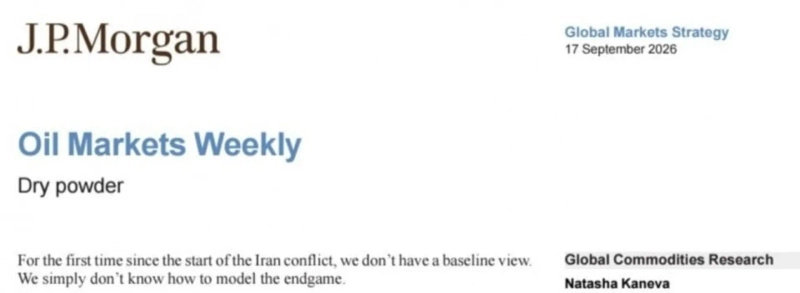
Instead, the conflict has become more complex. The Strait of Hormuz remains far from normalized. Saudi Arabia’s bypass pipeline has been shut, and disruptions to the Red Sea detour have deepened after Yemen’s Houthi rebels joined the fighting. That is why JPMorgan wrote on Sept. 17 that, for the first time since the Iran war began, it has no base case and cannot honestly determine how to model the endgame.
With equities still holding up relatively well despite high rates, the market’s biggest risk is oil. And the one card investors are still counting on to push prices lower in the near term is China.
$100 Oil and 5% Rates Prove No Red Line
In the early days of the Iran war, Wall Street laid out competing scenarios. Most were built on TACO, or “Trump Always Chickens Out.”
Natasha Kaneva, JPMorgan’s head of global commodities strategy, said the bank initially assumed there were economic red lines the US administration would not tolerate. It expected the Trump administration to move toward a deal if international crude prices approached $100 a barrel, US gasoline hit $5 a gallon, headline inflation reached 4%, and the 10-year Treasury yield neared 5%. Each time markets approached those thresholds, President Donald Trump appeared to fall back into the TACO pattern, and ceasefires were reached twice, in April and June.
Neither lasted. Six months on, crude is still above $100 a barrel and the 10-year Treasury yield has moved through 5%. US gasoline now stands at $4.37 a gallon, while diesel is at $6.45, near a record high. The exit strategy has only grown more ambiguous, Kaneva said, adding that markets are extremely anxious.
JPMorgan calculates that Brent’s fair value for September, based on current supply-and-demand conditions, is $90 a barrel. Yet Brent futures were trading at $103.37 as of Sept. 18. The bank estimates that every 1 million-barrel-a-day supply loss adds roughly $4 a barrel to prices. That means the current premium of about $13 implies the market is pricing in the risk that, beyond the 10 million barrels a day already disrupted, another 3 million to 4 million barrels a day could be lost.
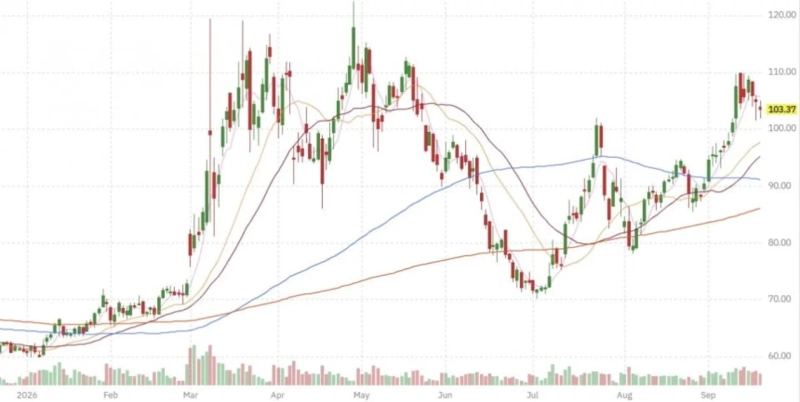
The main reason oil has not yet surged into the worst-case scenario of more than $120 a barrel is inventories and weaker demand. JPMorgan says the drawdown in global crude and petroleum-product inventories totaled 555 million barrels, about one-third of the 1.6 billion barrels initially expected. Global oil demand has also fallen by 4.4 million barrels a day from a year earlier.
But that only buys time. The longer supply disruptions last, the further inventories will fall. At that point, the only way to stabilize prices would be deeper demand destruction. Without a quick recovery in supply, the market would have to rebalance through an economic slowdown severe enough to curb demand on its own.
So far, signs of supply normalization remain weak. The war is at risk of widening after the Houthis stepped up their involvement, putting the Bab el-Mandeb Strait in the Red Sea, another key shipping route beyond Hormuz, under threat as well.
The Houthis said on Sept. 19 that they had launched additional attacks on Aramco facilities in Riyadh and Yanbu, Saudi Arabia. Saudi Aramco, whose key East-West pipeline has already been hit, has reportedly told at least two European refiners that it would be unable to supply crude for October. If European refiners move to secure replacement barrels from the US and elsewhere, that would add further upward pressure on WTI.
JPMorgan says there is still enough buffer in the system to prevent another immediate surge in crude prices. But if Middle Eastern oil flows remain stuck at current levels, the bank would have to raise its forecast. JPMorgan currently sees Brent at $80 a barrel in the fourth quarter and $78 in December. If the present stalemate persists, those forecasts could rise to $87 and $86, respectively.
Even TACO May Not Work; China Is the Last Hope
The oil market is now dealing with simultaneous instability across three transport routes: the Strait of Hormuz, the Red Sea and Bab el-Mandeb, and Saudi Arabia’s East-West pipeline. Even if one route is restored, another could break down. The bigger problem is that crack spreads, the gap between crude and refined-product prices, have widened to record levels, adding to inflation concerns. Refined-product transport has become severely constrained, while Ukraine’s drone strikes have also cut Russia’s refining capacity.
With so many variables tangled together and hard to predict or resolve, the market’s final hope is a diplomatic breakthrough involving China.
Iran has not completely shut the door to negotiations. Mohsen Rezaee, secretary of Iran’s Supreme National Security Council, said on Sept. 19 that Tehran had delivered its conditions for ending the war to the US through mediator Qatar and was waiting for Trump’s response. Al Jazeera reported that Iran’s terms include halting military action on all fronts, releasing frozen Iranian assets and ending the naval blockade, broadly in line with previous ceasefire demands.
For Washington, however, accepting those terms may not be easy. Iran also said it had tested anti-ship missiles near a US aircraft carrier, underscoring its ability to retaliate militarily. If the Trump administration accepts Tehran’s terms as they are, it could look as if Washington backed down first. CNN reported on Sept. 20 that Trump had considered military strikes on Yemen. US embassies across the Middle East, including in Oman, have issued security alerts.
As that hard-line standoff continues, the next turning point is the Sept. 24 summit in Washington between Trump and Chinese President Xi Jinping. JPMorgan said that if the meeting fails to produce a diplomatic breakthrough, it will become increasingly difficult to maintain the assumption that oil supply disruptions are temporary.
China is the biggest buyer of Iranian crude and one of the few countries with real leverage over Tehran. After a recent request from Saudi Arabia, China privately urged Iran to restrain Houthi military action, according to the report. Even so, Beijing is unlikely to want to appear to be pressuring Iran on Washington’s behalf. That means China could seek concessions in other negotiations, including on tariffs, rare earths or AI restrictions, in exchange for accommodating US demands on Iran.
Markets this week will focus on whether China takes on a concrete role in pressuring Iran and the Houthis at the US-China summit, and what it may demand in return.
The Oil-to-Rates-to-Stocks Chain
The Middle East war and the direction of oil prices have become the dominant issue for global markets because oil is now the primary variable shaping inflation and interest rates. There are plenty of structural forces pushing market rates higher, including policy tightening by major central banks, heavy sovereign debt issuance, corporate bond sales tied to the AI investment race, and AI-led global growth.
But the variable to which rates are most sensitive right now is still oil. If high crude prices persist, they can feed back into inflation through transport and production costs. That would put fresh upward pressure on US Treasury yields, which are already above 5%, and ripple through global rates and equities. One key difference from the 2022 bear market is that medium- and long-term inflation expectations have remained stable. If oil keeps refusing to come down, those expectations could become unanchored and central banks may be left with little choice but to raise rates sharply.
That is why JPMorgan said rising yields are unlikely to shake equities sharply in the current environment, where profit growth remains a firm anchor. Even so, the bank said the biggest risks are the durability of earnings growth and geopolitical risk in the Middle East.
If this week’s US-China summit produces an agreement for Beijing to pressure Iran, the geopolitical premium embedded in oil could unwind quickly. That would open the most bullish scenario for markets, with lower yields and a rebound in stocks. If Trump’s TACO pattern fails to reappear and China’s mediation also falls short, crude may struggle to move back below $100. In that case, inflation and higher rates could become entrenched, leaving equity valuations under continued pressure.
With even JPMorgan giving up on a base-case scenario for when the war might end and where oil might go, investors are no longer asking how high crude can rise. They are watching for when it can finally come down.
Bin Nan-sae, Hankyung.com reporter binthere@hankyung.com

Korea Economic Daily
hankyung@bloomingbit.ioThe Korea Economic Daily Global is a digital media where latest news on Korean companies, industries, and financial markets.