[Exclusive] Naver Pay Overtakes Lotte Card to Join South Korea’s Payment Top Five
Summary
- Naver Pay’s payment volume surpassed Lotte Card, pushing it into the domestic payments market top five and signaling that leadership in payments is shifting to platforms.
- As simple-payment usage rises, simple payments are taking a larger share of mobile card transactions, and fintech services account for most of that growth, intensifying competition with card issuers.
- There is growing concern that if won-based stablecoins are introduced, the lines among card issuers, electronic financial businesses, and virtual-asset service providers will blur, further squeezing the position of the credit-card industry.
Forecast Trend Report by Period


Naver Pay has joined the top five in South Korea’s payments market, overtaking Lotte Card 11 years after its launch. The shift highlights how control over payments is moving from card issuers to platforms as online and mobile spending expands.
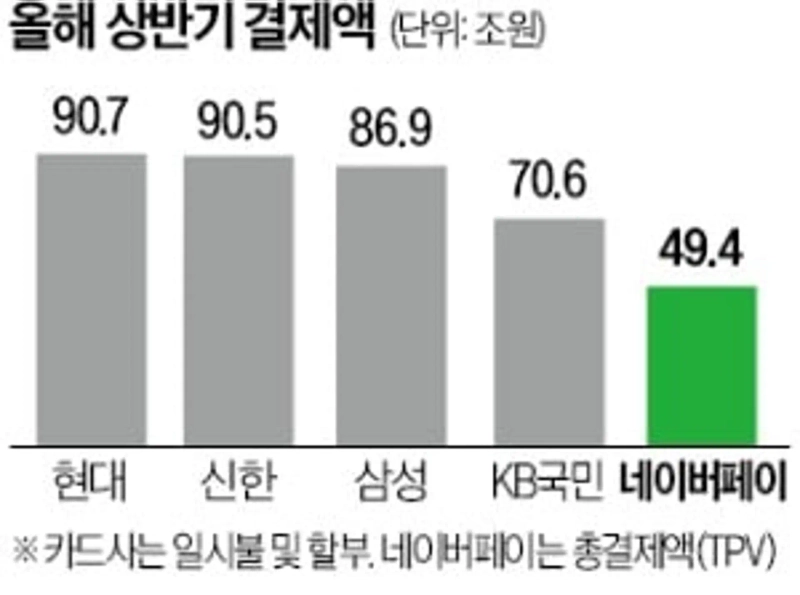
An analysis by the Korea Economic Daily published on Sept. 21 found that Naver Pay processed 25.2 trillion won ($18.2 billion) in payments in the second quarter, exceeding Lotte Card’s 24.2 trillion won ($17.5 billion) in lump-sum and installment credit-card transactions for the first time. Among South Korea’s eight standalone card issuers, Naver Pay’s payment volume ranked fifth, behind Hyundai Card, Shinhan Card, Samsung Card and KB Kookmin Card.
A single platform handling more payments than an individual card issuer points to a major shift in the market’s center of gravity. Cards remain South Korea’s core payment method, but platforms are rapidly taking the lead at the point of sale and in capturing customer and payment data.
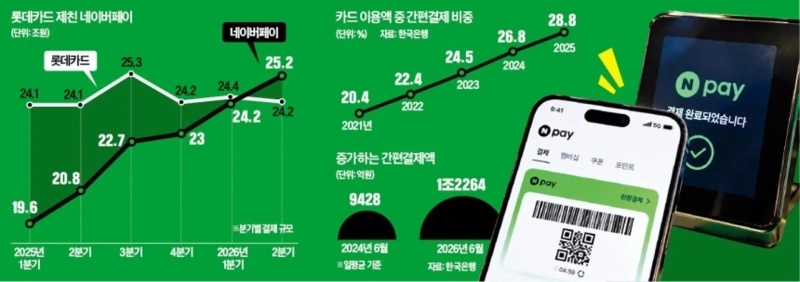
Bank of Korea data show the average daily value of simple-payment transactions in the first half rose 16.8% from a year earlier to 1.2264 trillion won ($886 million). Payments through platforms such as Naver Pay and Kakao Pay accounted for 55.4% of that total. Within simple payments, card-based transactions were the largest segment at an average 394.8 billion won ($285 million) a day.
Naver Pay Overturns 4.5 Trillion-Won Gap in a Year, Breaking Card Issuers’ Grip
Simple Payments Make Up 52% of Mobile Card Transactions, 73% of Them via Fintech Services
Naver Pay’s move past Lotte Card, South Korea’s fifth-largest card issuer, in payment handling volume underscores the growing clout of simple-payment platforms. As online and mobile spending rises, platforms are increasingly displacing card companies as the consumer-facing gateway for payments. With new payment tools such as won-based stablecoins also emerging, that shift is set to fuel louder calls to overhaul the current industry-by-industry regulatory framework.
Rapid catch-up
According to the financial industry on Sept. 21, Naver Pay handled 49.4 trillion won ($35.7 billion) in payments in the first half of this year. That was about 800 billion won ($579 million) more than Lotte Card’s 48.6 trillion won ($35.1 billion) in lump-sum and installment transactions over the same period. It was the first time Naver Pay had surpassed Lotte Card based on payment volume handled by each company.
Naver Pay’s catch-up has been steep. In the first quarter of 2025, it processed 19.6 trillion won ($14.2 billion), about 4.5 trillion won ($3.3 billion) less than Lotte Card’s 24.1 trillion won ($17.4 billion). By the first quarter of 2026, Naver Pay’s volume had climbed to 24.2 trillion won ($17.5 billion), narrowing the gap with Lotte Card’s 24.4 trillion won ($17.6 billion) to 200 billion won ($145 million). Just three months later, Naver Pay moved ahead. Even taking into account customer losses at Lotte Card after a data leak in August 2025, Naver Pay erased a gap of more than 4 trillion won in just over a year.
Different rules for cards and simple payments
Naver Pay’s growth has been driven largely by a shift in spending toward online and mobile channels. In online commerce, consumers now commonly pay with a card or bank account registered in advance on a platform instead of pulling out a physical card. Which platform a consumer uses has become nearly as important as which card they hold.
Bank of Korea data show card payments made through mobile devices and other channels without presenting a physical card averaged 1.7 trillion won ($1.23 billion) a day in 2025, up 7.3% from a year earlier. Simple payments accounted for 51.9% of that total, surpassing half. Within card-based simple payments, services provided by fintech firms made up 72.5%. Consumers are still using cards, but the gateway through which they use them is shifting toward platforms.
As the boundaries in the payments market blur, debate over the regulatory framework is poised to intensify. Card issuers and simple-payment providers are competing across a broader range of services, but they are subject to different levels of regulation. Card companies must obtain a credit-card business license under the Specialized Credit Finance Business Act and comply with rules on capital, major shareholders and financial soundness. By contrast, businesses such as the issuance and management of prepaid electronic payment instruments and electronic payment gateway, or PG, services operated by simple-payment platforms are governed by a registration system under the Electronic Financial Transactions Act. A card-industry official said the two sides are competing in similar areas in payments and argued that the “tilted playing field” needs to be addressed.
“Won stablecoins will shake up payments further”
The introduction of won-based stablecoins is expected to accelerate that debate. Until now, platforms have expanded their consumer reach by combining existing payment tools such as credit cards and bank accounts in a single app. If won-based stablecoins are used in real-world payments, they would add another payment option alongside cards, accounts and prepaid money. That would further blur the lines among card issuers, electronic financial businesses and virtual-asset service providers.
The sense of crisis in the card industry is growing. If won-based stablecoins gain traction as a payment method competing with cards, the role of credit cards could diminish. Some are also calling for a shift to functional regulation, under which rules are based on the functions a business performs and the risks it assumes.
An official at a major card issuer said card companies are already under pressure from simple-payment providers gaining ground from below, and their position could shrink further if stablecoins are introduced through banks. The industry now has to think about how the credit-card business can survive.
Cho Mi-hyun, Korea Economic Daily reporter mwise@hankyung.com
Bae Tae-woong, Korea Economic Daily reporter btu104@hankyung.com

Korea Economic Daily
hankyung@bloomingbit.ioThe Korea Economic Daily Global is a digital media where latest news on Korean companies, industries, and financial markets.