Trump Weighs Diesel Export Ban, Raising Risk of U.S.-Led Energy Shock After Middle East Turmoil
Summary
- President Donald Trump said he is considering a diesel export ban, stoking concern over surging U.S. diesel prices and a worsening global supply crunch.
- Because the U.S. is one of the largest diesel exporters, a ban could send international diesel prices up by as much as 100% and hit regions such as Europe and Latin America that are highly dependent on U.S. diesel.
- If U.S. diesel export controls become reality, Asian diesel refining margins could rise and Korean refiners may benefit, though gains in actual earnings could be limited by the South Korean government's diesel export restrictions.
Forecast Trend Report by Period


Global Supply Crunch Deepens
Europe, Latin America at Risk From Heavy U.S. Dependence
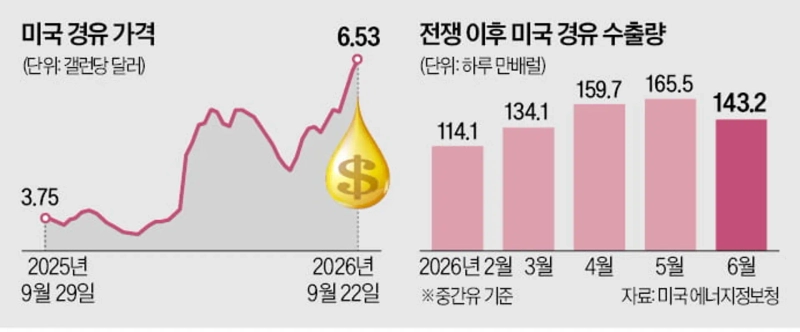
U.S. Diesel Hits Record $6.53 a Gallon
Export Volumes May Be Redirected to Domestic Supply
"Lower Refining Runs Could Push Prices Even Higher"
Korean Refiners Stand to Gain if Controls Are Imposed

President Donald Trump said he is considering a ban on diesel exports, a move aimed at redirecting supply to the domestic market as U.S. diesel prices climb to a record ahead of the midterm elections. The proposal is fueling concern that Europe, which depends heavily on U.S. diesel, could face another supply shock. South Korean refiners, for which diesel accounts for a large share of sales, stand to benefit.
Trump Reverses Course on Diesel Exports
The Financial Times reported on September 22 that Trump said, "I argued that we should stop sending diesel overseas," adding that he had instructed aides to review the matter and had continued discussing it. He also signaled that a decision on a diesel export ban could come soon.
Treasury Secretary Scott Bessent confirmed the discussions that day. The administration is examining whether such a step would be feasible given overall U.S. refining capacity, and whether a full or partial export ban would be effective, he said.
The Trump administration had previously denied the possibility of banning exports of refined petroleum products. It appears to have shifted its stance as calls to halt diesel exports spread among Republicans after the recent price surge.
U.S. diesel prices had already been rising since the outbreak of war with Iran and jumped further as Ukraine stepped up strikes on Russian energy facilities. Consumer diesel prices hit a record $6.53 a gallon that day.
U.S. diesel inventories have also been declining. Energy Information Administration data showed stockpiles at 96.97 million barrels, about 13% below the five-year average.
Could It Drive Up Global Diesel Prices?
Industry officials say an export ban would be only a short-term fix. If overseas sales are blocked, U.S. refiners could reduce crude processing runs. That would also curb gasoline and jet fuel output, potentially lifting prices across petroleum products. The Baker Institute for Public Policy said refiners would likely cut operating rates because the market available to sell into would shrink. No participant in any market sells products at a loss, it added.
Another complication is that some U.S. regions, including the Northeast, import diesel. The American Petroleum Institute said the Gulf Coast produces more diesel than the region consumes, but geographic and infrastructure constraints make it difficult to quickly move surplus supply to other parts of the country.
The risk of higher global prices is substantial because the U.S. is one of the world's largest diesel exporters. Energy economist Philip Verleger told Reuters that international diesel prices could rise by as much as 100% if exports are banned, because demand for the fuel does not fall sharply even when prices increase.
That would hit Europe and Latin America, where dependence on U.S. diesel is high. Reliance has increased further since the war with Iran began. Kpler data showed U.S. diesel exports rose from about 1 million barrels a day in February to 1.6 million barrels a day in August. In Europe, imports of U.S. diesel climbed about 50% after the war with Iran broke out, reaching 506,000 barrels a day last month. Any disruption in diesel supply that brings European farm machinery to a halt would deal another blow to crop output already hurt by summer heat.
A Tailwind for Korean Refiners?
If the U.S. moves ahead with controls on diesel exports, South Korea's refining industry could reap a windfall as demand for Korean cargoes rises. Amid concern over supply disruptions, the Asian diesel refining margin jumped to $60.4 a barrel in the third week of September from $50.4 a barrel.
Diesel has broad demand across transportation, heating and industry. It accounts for about 30% of revenue at South Korea's four refiners. As of the first half, the share was highest at HD Hyundai Oilbank with 38.5%, followed by SK Energy at 33.8%, S-Oil at 31.6% and GS Caltex at 29.2%. Diesel exports totaled $14.73002 billion in January through July, nearly half of the country's total petroleum-product exports of $34.22619 billion.
Still, the improvement in refiners' actual earnings may be limited because of government export controls. To stabilize domestic supply, the South Korean government has capped diesel exports at no more than 100% of the level in the same month a year earlier.
Han Myung-hyun and Ahn Si-wook, Hankyung.com reporters
wise@hankyung.com

Korea Economic Daily
hankyung@bloomingbit.ioThe Korea Economic Daily Global is a digital media where latest news on Korean companies, industries, and financial markets.