Meta’s Shopping AI ‘Muse’ Creates Winners and Losers as E-Commerce Gains, Insurance and Travel Slip
Summary
- Meta’s AI agent ‘Muse’ is making commerce platforms such as Shopify, Walmart, Naver and Coupang stand out as beneficiary stocks.
- Infrastructure names tied to CPUs and SSDs, including AMD, Intel and Fadu, are gaining on expectations that demand will rise as agentic commerce expands.
- Consumer inertia sectors such as insurance, finance, travel and telecom are coming under pressure as AI makes price comparisons and switching easier, raising concern over customer defections.
Forecast Trend Report by Period


The Age of Agentic Commerce: Winners and Losers
Walmart, Shopify Among Shopping Stocks in Focus
Advantage Goes to Companies With Price, Inventory and Payment Data
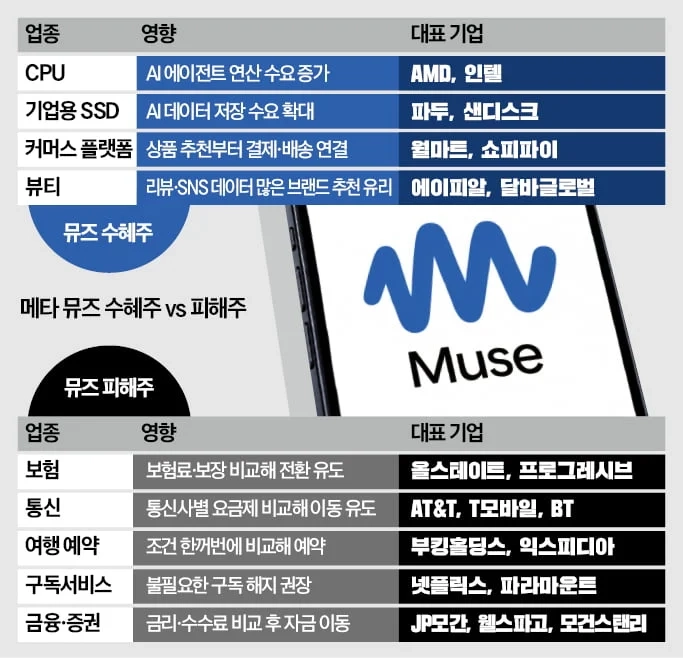
AMD Also Rises on Higher CPU Demand
Telecom and Service Sectors Face Easier Price Comparisons
Agentic AI Raises Risk of Customer Defections
Meta Platforms Inc.’s personal AI agent, Muse, is creating a split among related stocks as it handles product searches, bookings and payments. Commerce platforms that can turn AI recommendations into purchases, along with AI infrastructure providers, are emerging as beneficiaries. By contrast, finance, insurance and travel companies may come under pressure if AI makes it easier for consumers to compare prices and switch services.
Muse is an AI agent that searches and compares products, books travel and sends messages based on user prompts. Since its Sept. 8 launch, it has overtaken ChatGPT to rank No. 1 among free apps on Apple’s US App Store.
Walmart, Shopify Among Beneficiaries
Commerce platforms that can convert AI product recommendations into actual transactions are among the clearest beneficiaries. For AI agents to shop on behalf of users, they need access to pricing and inventory data and must also be able to handle payments and delivery. That could funnel more transactions to platforms that hold both product and customer data and can connect the entire purchase process.
Canada’s e-commerce platform Shopify is one of the stocks linked to Muse through a partnership. Muse users can search products sold by merchants on Shopify and complete purchases through Shop Pay. News of the tie-up lifted the shares. Shopify rose 7.12% to close at $147.74 on Sept. 22.
Walmart also stands to benefit if agentic commerce spreads. LS Securities highlighted the retailer’s customer purchase histories, product data, and inventory and delivery network built around its physical stores. As agentic commerce becomes more established, Walmart’s edge will become clearer because it combines consumer touchpoints, product data, inventory and logistics, LS Securities analyst Oh Rin-a said.
In South Korea, Naver and Coupang are also being cited as candidates to benefit. Naver links search, shopping and payments data, while Coupang is extending its demand-forecasting and inventory and delivery capabilities into shopping recommendations.
Expectations are also rising for chipmakers and storage companies that supply the hardware needed to run AI agents. As AI agents handle multiple tasks, use of server central processing units, or CPUs, and data storage devices could increase. Shares of CPU makers Advanced Micro Devices Inc. and Intel Corp. have surged recently, while Fadu Inc., which supplies enterprise solid-state drive, or SSD, controllers to Meta, climbed more than 11% early on Sept. 23.
Insurance and Travel Stocks Shake as Switching Gets Easier
Sectors that rely on customers staying with existing services are facing growing concern. Switching insurance policies or mobile plans usually requires consumers to compare terms themselves and cancel existing contracts. If AI takes over that process, customers may find it easier to leave.
According to Bloomberg, the S&P 500 Financials Index fell about 2% on the day, touching its lowest level since July. The broader market was little changed, but JPMorgan Chase & Co. and Wells Fargo & Co. each slid more than 3%, while Morgan Stanley dropped 2.9%. Insurer Allstate Corp. fell 5.5%, and brokerage Charles Schwab Corp. lost more than 6%.
Travel, telecom and consumer service companies also weakened. Booking Holdings Inc. fell 2.6%, while France’s Orange SA and the UK’s BT Group Plc each dropped about 4%. A Goldman Sachs basket of consumer-inertia stocks — companies that depend on recurring payments, add-on sales and customer indifference — fell 2.6%, its biggest decline since February.
Goldman Sachs said consumers will find it easier to switch insurance providers, mobile carriers and electricity suppliers as AI agents improve at comparing prices and making bookings. In two years, most people will cancel services through AI, Rhys Williams, chief strategist at Wave Capital Management, said, calling that a negative shift for the companies involved.
Yang Ji-yun / Oh Se-song, Hankyung.com reporters yang@hankyung.com

Korea Economic Daily
hankyung@bloomingbit.ioThe Korea Economic Daily Global is a digital media where latest news on Korean companies, industries, and financial markets.