PiCK
Altcoins Mount Broad Rally Even After Fed Rate Hike, CLARITY Act Senate Vote Failure: Kang Min-seung’s Altcoin Now
Summary
- The report said gains spread across the broader altcoin market alongside rebounds in Bitcoin and Ether even after the CLARITY Act failed to clear a procedural Senate vote and the Fed raised rates.
- It said CME’s plan to launch UNI and BCH futures, the SEC’s easing of tokenized stock rules, and growing AI and privacy themes acted as bullish catalysts for major altcoins including Near, Aptos and Arbitrum.
- Analysts said an altcoin-led rally, capital rotation, lower market volatility, and declining Tether dominance signal recovering risk appetite, though the possibility of a sharp correction remains after the recent surge.
Forecast Trend Report by Period



Bitcoin and Ether rebounded even after a procedural vote in the U.S. Senate failed to advance the CLARITY Act, a crypto market structure bill, and the Federal Reserve raised interest rates, helping lift the broader altcoin market.
294 of Top 300 Tokens Rise as Altcoins Stage Broad Rally
The altcoin market effectively rallied across the board. Data from CoinMarketCap on Sept. 23 showed 294 of the top 300 tokens by market capitalization rose, while only six fell. The simple average weekly gain among those tokens also exceeded 20%. While sharp jumps in some smaller tokens boosted the average, buying interest appeared to spread across the market.
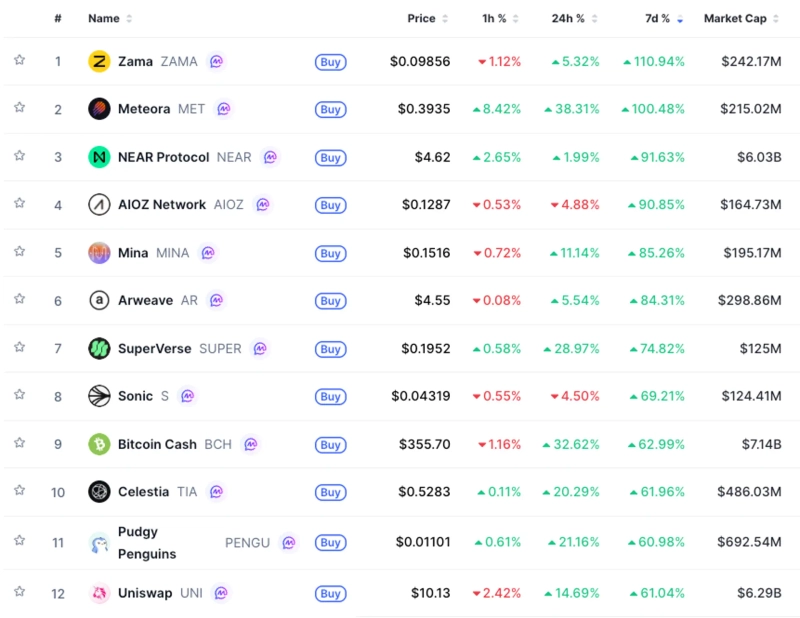
Smaller-cap tokens led the gains. Bedrock (BR) soared 393% over the past week, followed by Derive (DRV) at 174%, ZAMA at 108% and STONK at 105%. BR extended gains alongside a broader recovery in risk appetite despite the absence of a clear token-specific catalyst. ZAMA drew investor attention as privacy-related themes gained traction and the project recently expanded private DeFi vaults and private swap functions built on Morpho. STONK also advanced on broader trading support and expectations tied to tokenized stocks.
Large- and mid-cap altcoins also posted strong gains. Near (NEAR) climbed 88.5%, Bitcoin Cash (BCH) 63.5%, Uniswap (UNI) 63.4%, Aptos (APT) 57%, Arbitrum (ARB) 52.9% and Avalanche (AVAX) 52.6%. Bitcoin Cash and Uniswap, in particular, attracted buying after CME Group announced plans to launch futures on the two assets on Oct. 19, subject to regulatory review.
Token-specific technical and regulatory developments also underpinned the rally. Near has been in focus since Sept. 17 after applying privacy features by default to Hyperliquid-based perpetual futures trading, obscuring traders’ funding sources and account-linking information. Aptos drew attention after introducing a mainnet feature that allows transfer amounts to remain private. Arbitrum benefited after the U.S. Securities and Exchange Commission introduced an Innovation Exemption for on-chain trading in tokenized stocks, fueling expectations for related infrastructure expansion. Under the measure, tokenized securities venues that meet certain conditions would receive a temporary five-year exemption from the application of the term “exchange” under securities law, allowing on-chain trading in tokenized U.S.-listed equities, or NMS stocks.
Major altcoins including Sui (SUI), up 47.8%, Jupiter (JUP), up 41.8%, Cardano (ADA), up 31.1%, XRP, up 24.1%, and Solana (SOL), up 21%, also posted double-digit gains. Solana ecosystem tokens including Jupiter were supported by expectations for a larger tokenized-stock market. Solana’s rise was also backed by spot exchange-traded fund inflows and hopes for further ecosystem expansion. Over the same period, Bitcoin gained 13.2% and Ether rose 13.9%, underscoring the relative strength of major altcoins.
Recent altcoin strength reflects both a broader recovery in risk appetite and token-specific themes. Brian Huang, co-founder of on-chain asset-management technology firm Glider, said the altcoin market remains highly correlated with Bitcoin, while some tokens including VVV, Zcash and Uniswap have shown relatively stronger momentum.
AI- and privacy-related themes are helping drive the rally, Huang added. The SEC’s easing of tokenized-stock rules and CME’s plan to launch UNI and BCH futures are also acting as catalysts.
Altcoins Shake Off Headwinds as Capital Rotation Picks Up
Analysts say the market backdrop is becoming more supportive for altcoins, though they also caution that the recent sharp gains could lead to greater volatility.
Crypto market maker Wintermute said capital rotation into altcoins continued even after the market absorbed two key developments: the failed CLARITY Act vote and the Fed’s rate increase. According to Wintermute, Ether rose 6.7% last week and the broader altcoin market gained 4.8%, while Bitcoin finished the week at $81,159 and broke above the top of its recent range. If Bitcoin extends gains, Bitcoin dominance could rise again before capital spreads back into small- and mid-cap altcoins, the firm said.
Some analysts also argue that altcoins are moving ahead of Bitcoin and leading the rally. Alex Kuptsikevich, chief analyst at FxPro, said the total crypto market capitalization climbed to $2.8 trillion, the highest since late January, and was up 6% from a week earlier. The recent advance is once again being led by altcoins, he said. He added, however, that while altcoin strength increases the chances of further gains in Bitcoin, the risk of a sharp correction remains and traders should wait for confirmation of another leg higher.
Lower market volatility is also being cited as a tailwind for altcoins. Huang said volatility gauges for both U.S. and South Korean stock markets have fallen to their lowest levels in six months, while Bitcoin’s rise has created favorable conditions for an altcoin rally. He added that investors should watch U.S. Treasury yields. If yields fall, stronger risk appetite could drive flows into more volatile assets such as altcoins.
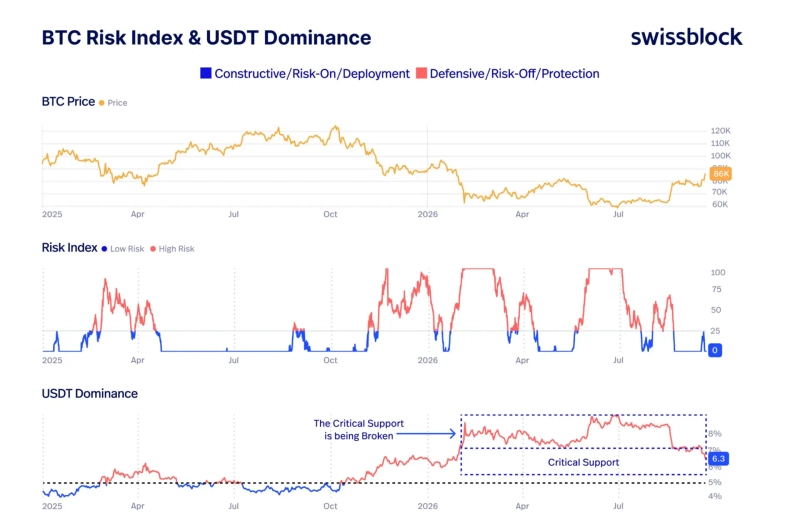
Some market participants also interpret Tether’s waning market dominance as a sign of recovering risk appetite. Crypto analytics firm Swissblock said USDT dominance has slipped below the 7% range that held for most of 2026, reducing the relative share of defensive capital. Its risk index has also fallen to zero, creating a more favorable backdrop for additional inflows. If USDT dominance remains below 7%, broader market flows could become more pronounced, the firm added.
Kang Min-seung, Bloomingbit reporter minriver@bloomingbit.io

Minseung Kang
minriver@bloomingbit.ioBlockchain journalist | Writer of Trade Now & Altcoin Now, must-read content for investors.