PiCK
Hashed CEO Kim Seo-jun Says AI Will Drive Economic Activity, Blockchain to Serve as Trust Infrastructure at EastPoint: Seoul 2026
Summary
- Hashed CEO Kim Seo-jun said advances in AI have lowered the cost of trying new businesses and reduced the opportunity cost of failure, making optimistic strategies more viable for individuals and companies.
- He said systems that can verify the identity, authority and reliability of AI agents will grow into a new industry, and that blockchain and digital assets could serve as the core infrastructure.
- He also said South Korea, backed by strong interest in digital assets and its AI and robotics base, could hold an advantageous position in new financial infrastructure such as tokenized products and decentralized exchanges.
Forecast Trend Report by Period


In the AI Era, the Speed of Failure Is National Competitiveness
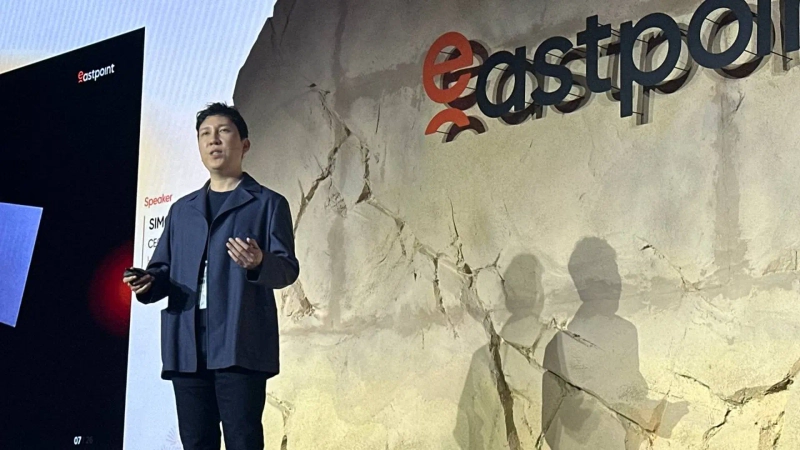
"The cost of trying new ideas has fallen sharply with the advance of artificial intelligence. Regulators also need to present clear standards and timelines so innovative experiments can move forward."
Kim Seo-jun, chief executive of Hashed, made the remarks during a keynote speech at EastPoint: Seoul 2026, held on Sept. 28 at the Westin Seoul Parnas in Seoul's Samseong-dong. In an era with no single right answer, he said, the speed at which countries and companies can be wrong has become a source of competitiveness.
Kim said advances in AI have sharply reduced the time and money needed to test new businesses and ideas. "Experiments that once took weeks or even years can now be run by individuals overnight," he said. As the opportunity cost of failure falls, optimism that does not fear repeated failure can become a rational strategy for both individuals and companies.
He cited open-source development, accumulated data, the emergence of AI that understands natural language and lower trial-and-error costs as the forces behind the shift. The massive uncertainty of the past is now being compressed into experiments lasting only a few hours, he said.
Kim said trust will become a new business opportunity in a world where AI agents carry out economic activity on behalf of humans. That will require systems that can prove who instructed an agent, what authority it has and how far it is allowed to act.
"The cost of proving who an AI agent represents and how far it can work remains high," Kim said. Verifying an AI's identity, permissions and the reliability of its activity will grow into a new industry.
He said blockchain could become the core infrastructure supporting that shift. "The digital-asset ecosystem has been inconvenient for humans, but machines are familiar with the environment of smart contracts," Kim said. "The first real users of blockchain and digital assets may be machines, not humans."
Kim also said blockchain-based changes in capital markets are beginning in earnest. "Tokenized products tracking shares of Korean companies have begun trading around the clock on blockchains and decentralized exchanges," he said. "This is moving beyond simply transferring existing ledgers onto blockchains. A new financial infrastructure is being built around tokens."
He said South Korea could hold an advantageous position in that transition. The country has high interest in digital assets, along with an industrial base in AI and robotics. It also sits between the world's two biggest economic blocs, the US and China, which could help it shape rules for the emerging digital economy.
"If South Korea can secure a position trusted by both the US and China, its value could rise further," Kim said. "If global AI agents can verify identity and make payments in Seoul, South Korea can move beyond being a country that follows rules and become one that creates new ones."
Kim said regulators need to give the market a predictable timeline. "Rather than simply saying no, they need to clearly state what is restricted until when and what becomes possible from when," he said. That would allow companies to prepare for the future. In an era when machines can perform much of the work, the role left to humans is to start first, he added.
Cho Mi-hyun, Hankyung.com reporter / Jin Uk, Bloomingbit reporter mwise@hankyung.com

Korea Economic Daily
hankyung@bloomingbit.ioThe Korea Economic Daily Global is a digital media where latest news on Korean companies, industries, and financial markets.