PiCK
Lee Jun-seok Says Crypto Rules Must Be Compatible With Global Markets at EastPoint: Seoul 2026
Summary
- Rep. Lee Jun-seok said crypto asset regulation should have international compatibility so overseas investors and companies can easily understand it.
- He said regulation focused only on the domestic market could block the entry of foreign capital and companies, and that clear standards are needed for global companies and investors.
- Utah Senate Majority Leader Kirk Cullimore and MoonPay Institutional CEO Caroline Pham said regulatory sandboxes, technology-neutral regulation, and stronger market trust are important for testing new technologies and blockchain business models.
Forecast Trend Report by Period


"South Korea Strong at Commercializing New Technologies"
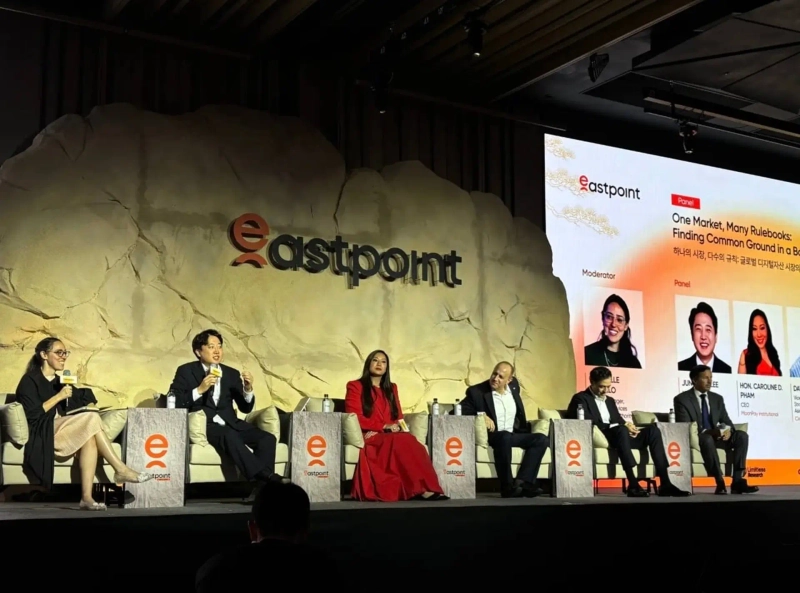
"South Korea's strength lies not in being the first to invent new technologies, but in quickly commercializing technologies that emerge elsewhere and generating profits from them. Crypto regulation should also be internationally compatible so overseas investors and companies can easily understand it."
Lee Jun-seok, a lawmaker from the Reform Party, made the remarks on Sept. 28 at EastPoint: Seoul 2026, held at the Westin Seoul Parnas in Samseong-dong, Seoul. He said that while it may be difficult to unify crypto regulations across countries, common standards are still needed so companies can compare national systems and anticipate how they will operate.
A panel discussion at the event was held under the theme, "One Market, Many Rules: Finding Common Ground in Borderless Markets." Participants included Lee; Caroline Pham, chief executive officer of MoonPay Institutional; David Katz, Circle's vice president for strategy and policy in Asia-Pacific; Yuval Rooz, chief executive officer of Canton Network; and Kirk Cullimore, the Republican majority leader in the Utah State Senate.
Lee said South Korea has both the technical capability and the market demand to quickly commercialize blockchain-based services, including stablecoins. He said the country is strong at adopting new technologies and turning them into actual services. Clear standards are needed so global companies and investors can easily understand Korean regulations and compare them with those in other markets.
He also said regulations focused only on the domestic market could block the entry of foreign capital and companies. Even if countries maintain policy sovereignty, basic regulatory frameworks such as crypto asset classifications and business requirements should still be able to connect with international markets.
Cullimore said local governments, which are closer to companies than central governments, may be better positioned to provide testing grounds for new technologies. With technological development moving faster than legislation and regulatory overhauls, new business models should be tested first through measures such as regulatory exemptions.
"Companies can access state and local governments more easily than the federal government," Cullimore said. "Regulatory sandboxes and temporary regulatory relief can help test new technologies safely." If several states adopt similar systems and produce results, that could also influence federal policy, he added.
He also said blockchain's use cases should not be limited to crypto trading. It can be applied in administrative areas handled by state governments, such as real estate transactions and vehicle title management. He added that entities with control authority must also bear the responsibility that comes with it, and that clear accountability is important.
Pham said regulators should be cautious about creating a separate set of rules every time a new technology emerges. Regulation should be based on the function and risks of a financial product, not the form of the technology.
"A token is just a technological form for a financial product," Pham said. "Tokenizing a security does not make it something other than a security." The same activity carries the same risks, and the same risks should be subject to the same rules, she added. A technology-neutral, principles-based regulatory framework is needed.
Katz said market trust must come before linking financial networks across countries. Interoperability matters, he said, but the more fundamental condition is that users believe the market operates fairly and that they will be protected.
Rooz said a single global regulatory framework is unlikely to emerge quickly because countries differ on rules covering currencies and data privacy. "We cannot wait until every country has the same regulation," he said. "We need a structure that allows blockchains and financial networks operating under different rules to connect safely."
Kim Su-hyeon / Hwang Doo-hyun, Bloomingbit reporter

Doohyun Hwang
cow5361@bloomingbit.ioKEEP CALM AND HODL🍀