On-Chain Finance Gains Ground, but Regulation and Liquidity Will Determine Its Fate: EastPoint: Seoul 2026
Summary
- Speakers said wider adoption of on-chain finance will require clear regulation, ample liquidity, and stable payment and settlement infrastructure.
- They said Hong Kong is a market companies should watch because of its regulatory clarity on tokenized assets and traditional financial firms’ adoption of digital-asset services.
- They said future tasks include the tokenization of real-world assets such as South Korean stocks, K-pop and cultural content, and AI computing resources, along with building a risk-management framework.
Forecast Trend Report by Period


On-chain finance expands on accessibility and automation
Building payment, pricing and settlement infrastructure is the key task
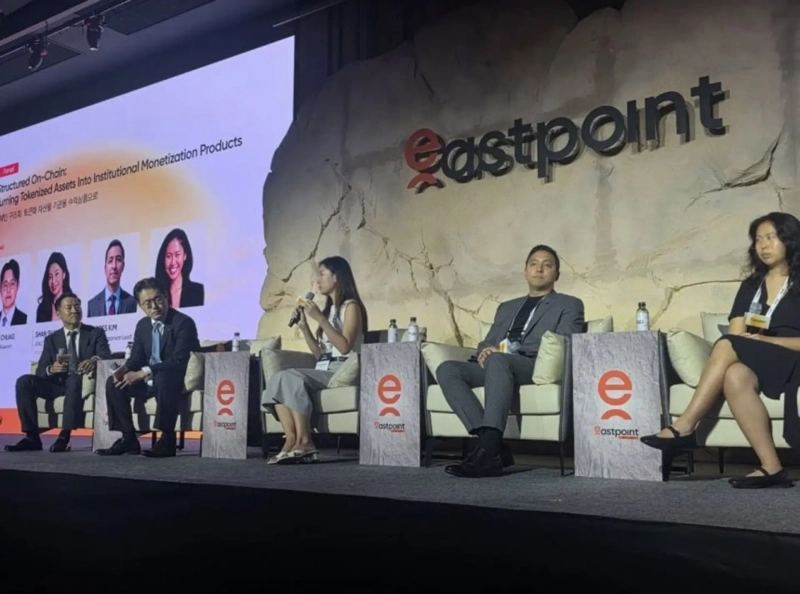
On-chain finance — the issuance and trading of financial assets on blockchain networks — will need clear regulation, ample liquidity and reliable payment and settlement infrastructure to broaden its adoption, according to speakers at EastPoint: Seoul 2026. They also said the range of tokenized assets could expand beyond US Treasuries and gold to include South Korean stocks, cultural content and even artificial intelligence computing resources.
The discussion on the conditions needed for the shift of financial assets on-chain and the growth of the real-world asset tokenization market took place on Sept. 28 at the Westin Seoul Parnas in Seoul’s Samseong-dong. Participants included Jeong Seok-moon, head of research at Presto Research; Sansan Sui, head of growth for Asia-Pacific at M0; Andres Kim, head of regional expansion; and Anlin Zhang, senior protocol strategist at Gauntlet.
Jeong cited accessibility and automation as the main advantages of blockchain-based financial networks, or on-chain rails. By reducing intermediary steps, they can improve transaction efficiency and boost both asset liquidity and collateral utility.
“The market is starting to recognize the benefits of putting assets on blockchain,” Jeong said. “The shift is already visible in the US, and major financial markets will soon adopt on-chain infrastructure.”
He added that cooperation among market participants in using on-chain rails could take the existing financial system a step further.
In Asia, Jeong described Hong Kong as a testing ground for tokenized finance. Hong Kong is about two years ahead of South Korea in regulatory clarity, he said, and traditional financial firms have been actively adopting digital-asset services since the government laid out its virtual-asset development policy in 2022.
While some critics say Hong Kong is not moving quickly enough, it remains the clearest regulatory market in Asia relative to its regional peers. Companies seeking to issue tokenized assets or build related businesses should pay close attention to Hong Kong, he said.
Jeong also said global demand in tokenization will depend on how widely usable the underlying assets are. For now, demand is concentrated in internationally accepted assets such as the US dollar, Treasuries and gold. AI computing resources could eventually be tokenized and used for trading and collateral as well.
Sui identified regulatory compliance and liquidity as the central challenges for on-chain finance. Crypto firms need considerable time to build compliance systems that meet the standards of traditional finance, and trading structures also differ between traditional assets and on-chain markets.
Traditional assets do not trade and settle around the clock, while on-chain lending markets operate continuously. That can create timing gaps in pricing and liquidation.
“To move beyond a simple proof of concept and offer real services, institutions first need to identify which assets they want to bring on-chain,” Sui said. Issuers, on-chain market makers and curators that manage asset allocation and risk must build liquidity together.
Speakers also said the success of tokenized assets may hinge less on issuance than on distribution and settlement. Kim said that if an investor in Africa wants to buy South Korean stocks, the market must also solve how that investor can make payment locally and receive the asset.
Tether’s strategy is not to own every blockchain and service directly. Instead, Kim said, it aims to provide the payment and liquidity foundation that allows partners to distribute assets.
Kim also identified South Korean stocks and cultural content as promising candidates for tokenization. He cited rights tied to participation in K-pop album production, as well as shares and funds linked to South Korean companies.
“K-pop and South Korean consumer and content companies already have global recognition,” Kim said. “If the regulatory framework is put in place, they could attract demand from overseas investors.”
Building a risk-management framework is another challenge, Zhang said. When tokenized assets are brought into on-chain finance, the first issues to assess are settlement lags, the accuracy of price data and whether liquidation is feasible.
Real-world assets, unlike blockchain-native assets, are harder to trade or convert to cash immediately. That means investment limits should be set conservatively for each asset, Zhang said.
“If on-chain price data is delayed, or if settlement of the real asset takes more than a day, risk can rise,” Zhang said. Gauntlet allocates position limits by asset after analyzing liquidity and the reliability of price data.
He added that AI-based risk-management technology and the tokenization of computing resources could become a new market for on-chain finance.
Jang Hyun-joo, reporter / Hwang Doo-hyun, Bloomingbit reporter

Korea Economic Daily
hankyung@bloomingbit.ioThe Korea Economic Daily Global is a digital media where latest news on Korean companies, industries, and financial markets.