‘All Companies Will Use Digital Assets’ at EastPoint: Seoul 2026
Summary
- Speakers said most companies will eventually use digital assets, virtual assets, and artificial intelligence (AI) across their business operations.
- Participants said corporate use of digital assets in South Korea could expand beyond simple storage into a wider range of applications if related domestic legislation, including the Framework Act on Digital Assets, is put in place.
- Speakers said the expansion of institutional participation will make custody, self-custody, institutional-grade custody services, and a safe custody framework more important, with segregation of client assets and clear liability serving as the key standards.
Forecast Trend Report by Period


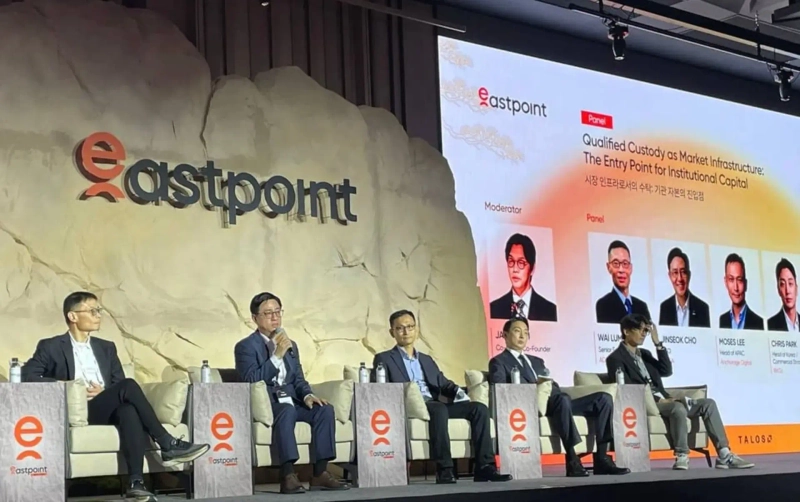
“Most companies will use digital assets in the future. As institutional adoption increases, custody will become essential infrastructure.”
Moses Lee, head of Asia-Pacific at Anchorage Digital, made the remarks on Sept. 28 at EastPoint: Seoul 2026, held at the Westin Josun Seoul Parnas in Seoul’s Samseong-dong. He said artificial intelligence and digital assets will eventually be used across corporate activity, much as all companies use the internet today.
Yu Min-ho, chief strategy officer at iotrust, offered a similar outlook. Most companies will eventually handle virtual assets and digital assets, he said. One model will be custody, in which assets are entrusted to specialist institutions, while another will be self-custody, in which companies manage assets themselves.
Speakers also said corporate use of digital assets in South Korea could broaden once related laws are put in place. Cho Jin-seok, CEO of Korea Digital Asset, or KODA, said domestic corporations are currently limited to simply holding digital assets. If the Framework Act on Digital Assets is established, a wider range of use cases could emerge.
The importance of the custody industry is also set to increase as more companies and institutions enter the market. Lee called custody the most fundamental part of the digital-asset industry. Anchorage’s federal charter in the US shows digital assets can be handled safely within the existing banking regulatory framework, he added.
Speakers identified segregation of client assets and clear liability in the event of an incident as the key requirements for institutional-grade custody services. Beyond technical security, custodians need a legal structure that protects client assets if the custodian goes bankrupt or is hacked.
Chris Park, BitGo’s Asia CEO, said the most important criterion is accountability, not technology. Clients should examine whether customer assets are clearly separated from a custodian’s own assets and whether those assets can be safely returned in the event of an accident or bankruptcy, he said.
Speakers also said regulators should establish a safe custody framework as institutional use of digital assets expands. At the same time, they said the pace of technological change makes it difficult for regulators alone to respond to every risk, underscoring the need for custodians to build their own risk-management capabilities.
Wai Lum Kwok, executive director at Abu Dhabi Global Market, said that when ADGM created its digital-asset regulatory framework in 2018, it built a foundation for safe custody by extending traditional financial rules to the sector. More recently, however, rapid technological change has made it difficult for regulators to respond to every development individually.
He added that custodians need ongoing monitoring, stress tests and penetration tests, as well as internal controls and governance systems that allow them to respond independently to new technology risks.
Park Si-on, reporter / Jinuk, Bloomingbit reporter

Korea Economic Daily
hankyung@bloomingbit.ioThe Korea Economic Daily Global is a digital media where latest news on Korean companies, industries, and financial markets.