Modhaus, SM Say AI, Blockchain Lower Barriers to K-Pop Entry for New Agencies at EastPoint: Seoul 2026
Summary
- Artificial intelligence and blockchain technology are lowering barriers to entry in the K-pop industry and creating new growth opportunities for new agencies.
- Lee Sung-soo, SM Entertainment's CAO, said companies that can design systems suited to the current era have a major opportunity as global content distribution and new forms of marketing become possible without physical album distribution networks.
- Modhaus CEO Jaden Jeong said K-pop fandom is highly sensitive to AI involvement, making it preferable to expand its use only after broader consensus forms among fans, and added that participatory governance models must also account for fan fatigue.
Forecast Trend Report by Period


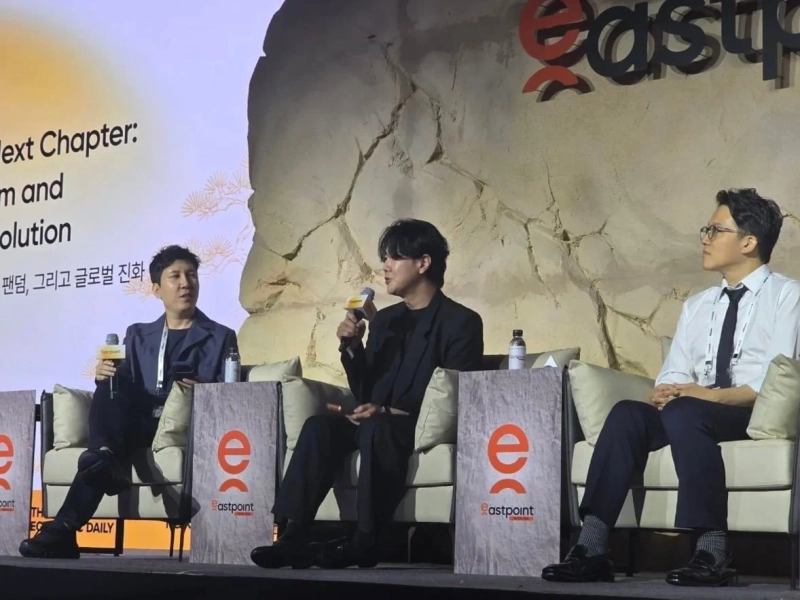
Artificial intelligence and blockchain are lowering barriers to entry in the K-pop industry, opening new growth opportunities for emerging agencies, according to speakers at a conference in Seoul. At the same time, they said companies should be careful about adopting the technology because fans remain wary of AI intruding into artists' creative work.
Lee Sung-soo, chief A&R officer at SM Entertainment, and Modhaus Chief Executive Officer Jaden Jeong discussed structural changes in the K-pop industry, the use of AI and the future of fandom at EastPoint: Seoul 2026, a global private Web3 conference held at the Grand InterContinental Seoul Parnas in Samseong-dong on Sept. 28.
Lee said advances in information technology, AI and blockchain are changing an industry structure long centered on large agencies. In the past, record production and securing distribution networks were key to business expansion. Now, companies can deliver content to fans worldwide and market it in new ways without physical album distribution channels.
"I think there is a major opportunity for companies that can quickly build and design systems suited to the current era," Lee said. New agencies can be competitive because they are not bound by existing business structures and can apply new technologies and fan participation models from the outset.
He added that large agencies are responding through multi-label strategies. As K-pop has grown into an industry encompassing a range of genres and production methods rather than a single music genre, each segment needs its own production capabilities and business strategy.
Jeong stressed that the K-pop industry needs to take a cautious approach to AI adoption. "K-pop may be the most conservative market when it comes to accepting AI," he said. "The current K-pop fandom is not fully ready to embrace AI."
He said using AI to reduce production time and costs is viewed differently from allowing it into an artist's core creative domain. Fans are especially sensitive to AI involvement in elements that shape an artist's identity, including music and imagery.
Jeong said that reaction should not be dismissed simply as resistance to technology. He said it would be preferable to expand the scope of AI use only after sufficient consensus has formed within fandom.
The way the industry measures the value of fandom is also changing. In the past, the focus was on how much money fans spent on albums and merchandise. More recently, a key metric has become how much time they devote to content and how actively they participate.
"Modhaus operates a participatory governance model in which fans decide the direction of artists' activities through voting," Jeong said. "But if fans are asked to take part in every decision, fatigue can build, so the scope and frequency of participation need to be managed."
Lee also said K-pop must preserve its musical identity even as it undergoes technological change. The concern is that K-pop's distinct character could weaken as content is localized for global markets.
"The most important thing is the essence of music and the fans who consume it," Lee said. "Even if new technologies and business models are used, K-pop can continue to grow only if music and fans remain at the center."
Kim Soo-hyun, Hankyung.com reporter / Lee Soo-hyun, Bloomingbit reporter ksoohyun@hankyung.com

Korea Economic Daily
hankyung@bloomingbit.ioThe Korea Economic Daily Global is a digital media where latest news on Korean companies, industries, and financial markets.