OpenAI Launches 24/7 AI Agent Dots at DevDay in Challenge to Meta’s Muse
Summary
- OpenAI said it has unveiled Dots, an always-on AI agent, along with the collaborative workspace ChatGPT Space.
- OpenAI said it will offer lower-cost, faster AI services through the new model GPT-6.1 Sol and the Ultra Fast feature.
- OpenAI said Dots and Space will be available starting today to ChatGPT Pro ($100 and $200 monthly plans), Business Premium, and Enterprise users.
Forecast Trend Report by Period


Learns user habits to handle schedules, bookings and coding
Comes with a cloud PC and browser, linking to more than 4,000 apps
Available starting today for users on plans costing $100 or more
‘ChatGPT Space’ and GPT-6.1 Sol also unveiled
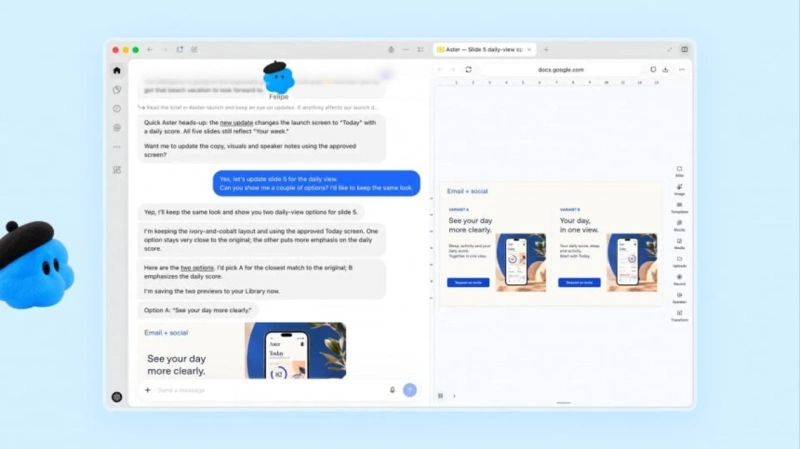
OpenAI has launched Dots, an always-on artificial-intelligence agent designed to work around the clock. The product appears set to compete with Muse, the AI assistant Meta released earlier.
OpenAI unveiled Dots on Sept. 29 at its DevDay developer event in San Francisco. The company described it as AI that takes over tasks users do not want to do so they can focus on more important work.
The biggest difference from existing AI assistants is that Dots does not wait for the next command. It learns over time how a user works and what that person considers important. OpenAI gave the example of checking tasks that came in overnight and surfacing only urgent items the next morning.
In demonstrations at the event, Dots updated meeting materials, reviewed app-testing results, and found a replacement caterer for a canceled wedding before suggesting available booking times. It also rescheduled a flight after it conflicted with a child’s presentation. Rather than simply retrieving information, it carries tasks through to the next step.
OpenAI is targeting work far more complex than restaurant reservations or airline ticket purchases.
For example, if a developer asks it to replace a legacy application programming interface, or API, that is about to be shut down with a new one, Dots can find every place that API is used across the codebase. It checks which functions could break during the change, rewrites the code and runs tests. It then submits the proposed changes as a pull request, or PR, for human review.
That is possible because Dots is not just an AI that generates answers inside the ChatGPT interface. Each Dots instance gets a separate cloud-based computer and browser. It can write and test code directly. It can also use the plugins a user has already connected to ChatGPT. Dots links with more than 4,000 apps.
OpenAI plans to provide one Dots agent per user at first. Over time, it aims to expand that so users can run multiple Dots agents at once. The company also plans to let users assign work and receive progress updates by text message without opening the ChatGPT app, and to add phone-call functions.
OpenAI’s broader goal is to reshape collaboration software as AI begins working on its own.
The company also unveiled ChatGPT Space, where people and AI agents work together in a single workspace. Documents and files can be kept in one place, and users can tag Dots the way they would assign work to a colleague. If a user instructs it on a specific page to check the content every day and update new information, Dots continues managing that task.
Tasks coming from Slack can also be handed directly to Dots. OpenAI said its own developers already use the system internally, assigning investigations to their Dots when error logs appear. Dots then finds the problem, generates a fix and submits a PR. The company said that process is helping it fix dozens of bugs a day.
OpenAI is also testing enterprise-focused specialist Dots. Companies would build Dots for specific functions such as accounting, marketing and legal work, and employees would use them jointly. When workers review the output and provide feedback, that information is shared across the company. OpenAI plans to work with Microsoft so companies can manage Dots through Microsoft’s existing administration tools.
As AI takes on more work, the damage from mistakes could also increase. Unlike AI that only reads email, AI that directly accesses websites, edits code or acts inside external services can turn a single bad judgment into a real business problem.
OpenAI said it had taken that into account by letting users define the range of apps and computer functions Dots can access, while also setting separate instructions for each app. Important decisions are designed to require user approval.
OpenAI also unveiled a broad set of new AI models and developer tools to support Dots. The new model, GPT-6.1 Sol, is aimed at delivering performance close to Astra, the company’s top-performing model, at a much lower cost. OpenAI positioned it as the main model developers would use every day. It also introduced Ultra Fast, a feature designed to increase model speed. According to the company, it is as much as eight times faster than the standard mode but costs six times more and generates about 300 tokens a second.
OpenAI said Dots and Space will be available starting Sept. 29 to ChatGPT Pro users on the $100 and $200 monthly plans, as well as Business Premium and Enterprise customers.
Kim In-yeop, Silicon Valley correspondent, Hankyung.com, inside@hankyung.com

Korea Economic Daily
hankyung@bloomingbit.ioThe Korea Economic Daily Global is a digital media where latest news on Korean companies, industries, and financial markets.