US State Department Says South Korea’s Labor Policy Is Rigid, Cites ‘Yellow Envelope Law’
Summary
- The US State Department said aggressive regulatory enforcement by the Korea Fair Trade Commission against foreign companies and the use of departure bans were barriers to South Korea’s investment climate.
- The report said risks have increased by specifying that foreign executives may face personal criminal liability for industrial accidents and workplace harassment.
- The State Department said the Lee Jae-myung government has shifted toward stronger worker protections, citing the Yellow Envelope Law, the 52-hour workweek rule, and rigid labor policies as factors affecting the investment climate.
Forecast Trend Report by Period


"Lee Jae-myung government shifts toward stronger worker protections"
Personal liability for foreign executives stressed in industrial accidents and workplace harassment
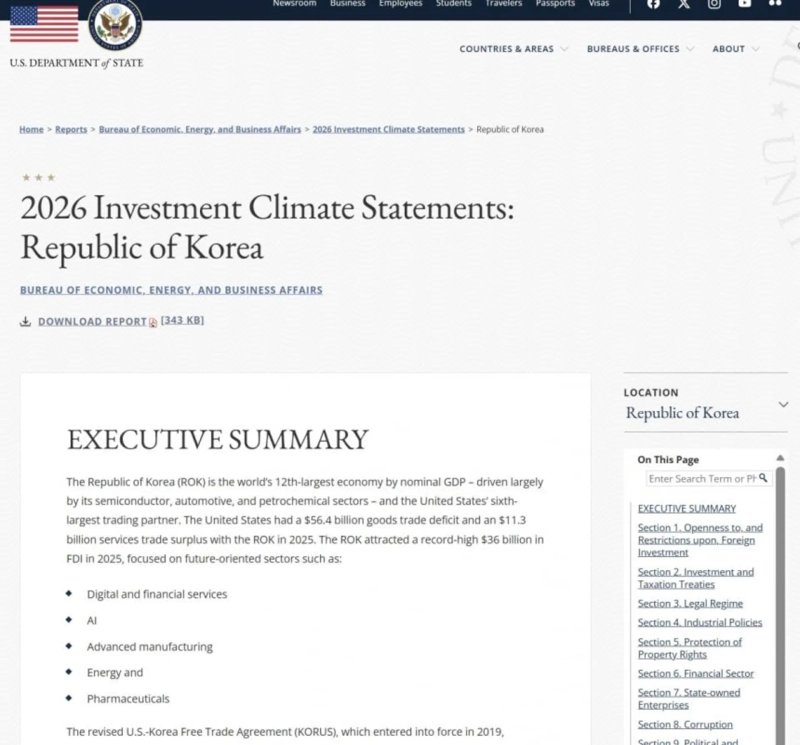
The US State Department said in a report on South Korea’s investment climate that the government uses aggressive investigations and departure bans against foreign companies. It also said Seoul’s policy direction has shifted toward stronger worker protections, citing the implementation of the so-called Yellow Envelope Law.
In its 2026 Investment Climate Statement for South Korea, released on September 29, the State Department said US companies have raised concerns that the Korea Fair Trade Commission, the country’s antitrust regulator, targets foreign firms with aggressive investigations. A similar point appeared in last year’s report, but this year the department added the phrase “aggressive regulatory enforcement, including excessive audits and investigations” to a three-page list of barriers.
Earlier reports mentioned the Fair Trade Commission later in the document. This year’s report elevated the issue to a core concern. That appears to reflect friction between the two countries over Coupang. The US view is that departure bans on foreign executives can be used as a pressure tactic. South Korea’s government earlier this year reviewed whether to impose a departure ban on Harold Rogers, Coupang’s interim chief executive officer, but did not carry it out because he had already left the country.
The possibility that foreign executives could face criminal liability has long been a US concern, and this year’s report set it out in greater detail. It added that foreign executives may bear personal liability for industrial accidents and workplace harassment even if they were not directly involved. Last year’s report introduced the Serious Accidents Punishment Act and cited the first guilty verdict against a chief executive in April 2023. This year’s version provided a more detailed description.
The State Department said South Korea’s regulations lack transparency, legal interpretations are inconsistent and labor policy is rigid. It also added language related to the Yellow Envelope Law. In its discussion of South Korean regulations, the report referred to “rigid labor policies” and said the Lee Jae-myung government “has shifted toward stronger worker protections.” It said the Yellow Envelope Law passed in August 2025 and took effect in March 2026, and that the 52-hour workweek rule is being strictly enforced.
Reducing non-tariff barriers was another key issue raised in the report. The State Department wrote that President Lee Jae-myung pledged in October 2025 to reduce non-tariff barriers in digital services, automobiles, and agricultural and food products. As of April 2026, when the report was drafted, the US government was still calling for their removal.
The report gave a positive assessment of South Korea’s recent efforts to improve corporate governance, including moves to expand directors’ fiduciary duty to shareholders. It also noted the launch in June 2026 of the Korea-US Strategic Investment Corporation to increase investment in the US and strengthen supply-chain cooperation.
Lee Sang-eun, Washington correspondent, Hankyung.com selee@hankyung.com

Korea Economic Daily
hankyung@bloomingbit.ioThe Korea Economic Daily Global is a digital media where latest news on Korean companies, industries, and financial markets.