PiCK
Meritz Securities to Launch Fractional Ship Investment in November, Expand Into Tokenized Securities Next Year
Summary
- Meritz Securities said it is pursuing a pilot fractional ship investment project with the Korea Ocean Business Corp. and preparing to expand its tokenized securities (STO) business next year.
- It said revenue related to real-world assets (RWA) at traditional financial institutions is currently close to zero, but the firm is investing in infrastructure with an eye on revenue over the next three to five years.
- Kang said product diversity, including ships, bonds, money-market funds (MMFs) and stock tokenization, is critical, and that tokenizing Korean assets could attract more overseas capital.
Forecast Trend Report by Period


Fractional ship investment to start in November, expand into STOs next year
Korea’s RWA market remains in an infrastructure investment phase, not a revenue phase
Stock tokenization could draw more overseas capital
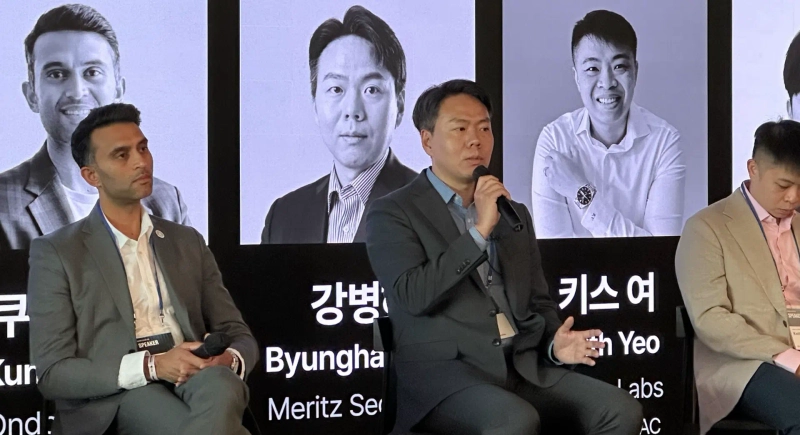
Kang Byung-ha, a managing director at Meritz Securities, outlined the plan on Sept. 30 at the Seoul Digital Money Summit 2026 Q4, held at Hashed Lounge in Seoul’s Gangnam district. The brokerage plans to broaden its investment lineup starting with fractional ship investment and expand its tokenized securities, or STO, business in line with the rollout of the regulatory framework.
The event, hosted by Suho.io, featured a panel discussion on “Tokenized Stocks and the Structural Shift in Capital Markets.” Participants included Kang, Kunal Patel, head of Asia at Ondo Finance, Keith Yeo, head of Asia-Pacific at Allium Labs, and Ahn Kwang-ho, a researcher at Tiger Research.
Meritz Securities is preparing a pilot fractional ship investment project with the Korea Ocean Business Corp. The state-run maritime policy finance agency said at a Sept. 29 meeting on developing the fractional ship investment market that it plans to issue bond-type trust beneficiary certificates backed by ships it owns and pursue a listing on the Korea Exchange’s market for innovative securities within this year. Meritz Securities will support product structuring and risk management.
Kang described the market for innovative securities as a stepping stone toward a tokenized securities market. He said the sector can enter a full-fledged growth phase only when retail investors begin buying actual products, beyond infrastructure investment by financial firms.
“Revenue tied to real-world assets, or RWA, at traditional financial institutions is currently close to zero, and once investment costs are taken into account it is negative,” Kang said. “We are investing in building stable infrastructure while looking ahead to revenue over the next three to five years.”
For now, financial institutions are bearing the investment costs while systems integration firms and developers generate revenue. Financial companies themselves can only begin to book revenue once investors start buying the products.
Kang said product diversity will be key to expanding the market. Fractional investment in Korea has been concentrated in a narrow set of assets such as art and copyrights, and the investment universe needs to widen to include ships and other new asset classes.
“The market was not small because there were no attractive products,” he said. “It is more accurate to say the products the market wants have not yet appeared because of regulation.” Overseas, tokenized bond and money-market fund products have shown a strong ability to attract capital, he added.
Over the longer term, Kang said stock tokenization could drive broader changes in capital markets. That could allow Korean investors to buy shares in privately held U.S. companies, while investors in the U.S. or Southeast Asia could trade shares of Samsung Electronics Co. and SK Hynix Inc. without time constraints.
“Tokenization is closer to removing the borders of capital than the borders of assets,” Kang said. “Korean assets are attractive in global markets, and tokenizing them could draw in more overseas capital.” Assets that were previously difficult to distribute in conventional securities form could also be matched with investor demand.
Still, he stressed that not every financial asset needs to move onto a blockchain. Existing financial systems and distributed ledgers are likely to be used side by side, with the most efficient structure chosen depending on the asset and the purpose of the transaction. Regulation should also reflect real market demand while maintaining safeguards needed for investor protection. He cited the scalability and compatibility of infrastructure that can connect with overseas markets as another major challenge.
On concerns about capital outflows, Kang said tokenization itself does not determine the direction of money flows. Korean investors may increase overseas investment, but easier access could also lift participation by foreign investors seeking Korean assets. He said any assessment of actual inflows should distinguish between funds entering Korea and money that remains in offshore special-purpose vehicles or funds.
“Tokenization creates channels that make money and assets easier to move,” Kang said. “What matters fundamentally is demand for the asset and the currency.” He added that Korean financial institutions are competitive in packaging and selling assets, technology and products, and that over the long term, inflows into Korea could exceed outflows.

Doohyun Hwang
cow5361@bloomingbit.ioKEEP CALM AND HODL🍀