No AI Slowdown in Sight as Anthropic Commits $518 Billion to Infrastructure
Summary
- Anthropic has committed $518 billion in non-cancelable AI infrastructure investment over the next decade, supporting long-term demand across the AI value chain including semiconductors and memory.
- Nomura’s semiconductor shortage index hit a record high, while lead times and prices for key components including HBM, DRAM, HDD, ABF and MLCC surged, raising expectations that the profit cycle for related industries will last longer.
- The market is focused on Micron earnings, whether it discloses long-term supply agreements (LTAs), and the potential for short-term stock selling tied to quarter-end pension-fund rebalancing as key variables for the memory outlook and volatility.
Forecast Trend Report by Period


Anthropic spent $7.3 billion on infrastructure last year
Commits $518 billion over the next decade
80% is non-cancelable, boosting supply-chain revenue visibility
OpenAI annualized revenue growth also accelerates
Memory, HDD, substrates and MLCC face shortages
Micron earnings due tonight
Quarter-end rebalancing another variable

The race to secure more computing infrastructure is intensifying, making calls to slow the pace of artificial intelligence development look increasingly hollow. Noise has persisted around AI safety debates, OpenAI’s cancellation of its latest model release and permitting setbacks for Oracle data centers. Actual spending and supply-chain data, however, point instead to acceleration. That is reviving expectations that the profit upswing across the AI value chain — including semiconductor materials and equipment, memory, power and optical communications — will last longer.
Anthropic Commits to $518 Billion of Spending
Reuters reported on Sept. 30 that Anthropic committed to spend at least $518 billion over the next decade with six partners to build AI infrastructure. The company signed long-term cloud contracts with Google worth $111.1 billion, Amazon worth $110 billion and Microsoft worth $31.4 billion. It also has equipment lease obligations tied to Broadcom totaling $161.2 billion. Reuters cited a leaked confidential initial public offering prospectus from Sept. 29.
About 80% of those commitments are non-cancelable, meaning Anthropic must pay regardless of actual usage. Even if future demand weakens or the company slows the rollout of AI services, it would not be easy to cut the infrastructure spending it has already committed to. For cloud and equipment suppliers, that improves revenue visibility and supports long-term demand across the semiconductor and memory supply chain.
Anthropic is also shifting away from renting cloud capacity toward building dedicated data centers and leasing chips directly. The company is also reviewing direct memory purchases from Samsung Electronics and SK Hynix. Edgewater Research projects Anthropic will procure DRAM directly next year on a scale comparable with Nvidia.
Costs are already swelling rapidly. Anthropic’s computing costs rose from $400 million in 2023 to $2.5 billion in 2024 and $7.3 billion last year. Revenue jumped more than elevenfold to $4.6 billion last year, but computing costs still far exceeded sales. Operating loss topped $8 billion.
Even so, Anthropic said in the prospectus that future growth is constrained not by demand but by a shortage of computing resources, underscoring the case for further investment. Its willingness to enter into non-cancelable commitments also shows how severe supply shortages have become.
Such contracts are a significant burden for Anthropic because the company must pay even if demand falls short of expectations. Financial risk could increase if revenue growth falters or fundraising runs into trouble. That also helps explain why investors have reacted sensitively to the latest AI safety debate and calls for restraint. After companies have poured vast sums into AI chips and data-center infrastructure, any slowdown in development would hit not only the AI industry but also the broader global economy that has ridden the investment boom.
For now, there is little sign those risks are materializing. Anthropic, OpenAI and xAI — all of which had raised the idea of slowing development — have recently rolled out new models in succession, including Claude Opus and Sonnet 5.5, GPT-6 Astra Sol and Luna, and Grok 4.7.
OpenAI’s growth has also accelerated. Its annualized revenue is estimated to have approached $70 billion recently, up more than 70% from $40 billion in July. Enterprise revenue has more than doubled since July. OpenAI is also discussing plans to raise at least $30 billion more at a valuation target of about $1.4 trillion, depending on investor demand. A substantial share of that funding is expected to go toward computing investment.
Semiconductor Shortage Hits a Record
The supply chain is failing to keep up with demand. Nomura’s semiconductor shortage index hit a record 103.9 in September. A reading above 100 indicates shortages. Nomura said the index regained momentum after moving sideways for about two months and projected shortages would deepen further in October as the supply-demand imbalance persists.
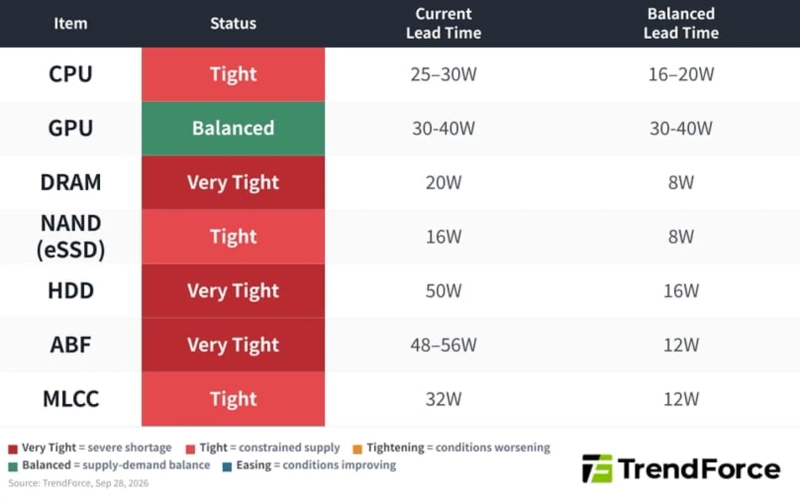
Bottlenecks are spreading. Of the seven major AI infrastructure components tracked by TrendForce on Sept. 28, only GPUs were in balance. DRAM lead times stretched to 20 weeks, 2.5 times the normal eight-week level. Lead times for HDDs reached 50 weeks, while ABF semiconductor package substrates stood at 48 to 56 weeks, or three to four times normal. That underscores the severity of supply tightness.
Server CPUs, NAND flash for server SSDs and multilayer ceramic capacitors, or MLCCs, also had lead times 1.5 to two times longer than normal, indicating tight supply. As AI agents handle multiple tasks simultaneously over long periods, demand has expanded beyond GPUs to CPUs, memory and storage. Samsung Electro-Mechanics is pursuing a 6 trillion won ($4.3 billion) investment to expand production capacity for high-value substrates. It also signed an MLCC supply contract worth $290 billion on Sept. 29.
Prices continue to rise as bargaining power shifts toward suppliers. TrendForce expects average selling prices for high-bandwidth memory, or HBM, to jump 121% next year from this year. Edgewater Research said the three memory makers are contracting for less volume than customers want under long-term supply agreements and selling excess demand at market prices to maximize profit. That structure lets them secure baseline volumes through long-term contracts while still capturing some upside from rising prices.
AI investment is also pouring into power, the biggest bottleneck in completing data centers. Demand is especially strong for behind-the-meter generation such as fuel cells, solar and gas turbines, which are relatively insulated from risks including grid shortages and permitting delays. In South Korea’s stock market, Bloom Energy value-chain names such as Vinatick, Hansun Engineering, Koses and Seojin System, along with solar-related shares including OCI Holdings and Hanwha Solutions, have continued to gain.
Focus on Micron Earnings, Quarter-End Rebalancing
Markets are watching Micron’s June-August earnings, due on Sept. 30. Investor sentiment on earnings visibility in the memory market could improve depending on whether the company beats expectations not only for the quarter but also for next-quarter guidance, for which the market expects revenue of $56.3 billion, and whether it discloses further progress on long-term supply agreements.
Wariness over high oil prices and elevated interest rates remains, while month-end and quarter-end pension-fund rebalancing could also fuel very short-term volatility. Goldman Sachs estimated that U.S. pension funds alone may sell about $33 billion of stocks at quarter-end, given the recent sharp drop in bond prices relative to stocks as yields rose. That suggests technically driven volatility could persist for a day or two regardless of the stock market’s fundamentals.
Bin Nan-sae, Hankyung.com reporter binthere@hankyung.com

Korea Economic Daily
hankyung@bloomingbit.ioThe Korea Economic Daily Global is a digital media where latest news on Korean companies, industries, and financial markets.