Why the Won Is Strengthening Even as US Yields Surge, Breaking the Usual FX Rule
Summary
- The article said the won has remained strong on the back of a large current-account surplus even as US Treasury yields rise.
- It said exporters' dollar conversion orders are doing more than the domestic-US rate gap to limit gains in the won-dollar exchange rate and cap its upper range.
- The article said flow factors such as securities investment by retail and foreign investors, corporate dollar conversions, and overseas asset allocation by pension funds are becoming decisive in setting the exchange rate.
Forecast Trend Report by Period


The usual rule of 'higher US yields, weaker won' has broken down
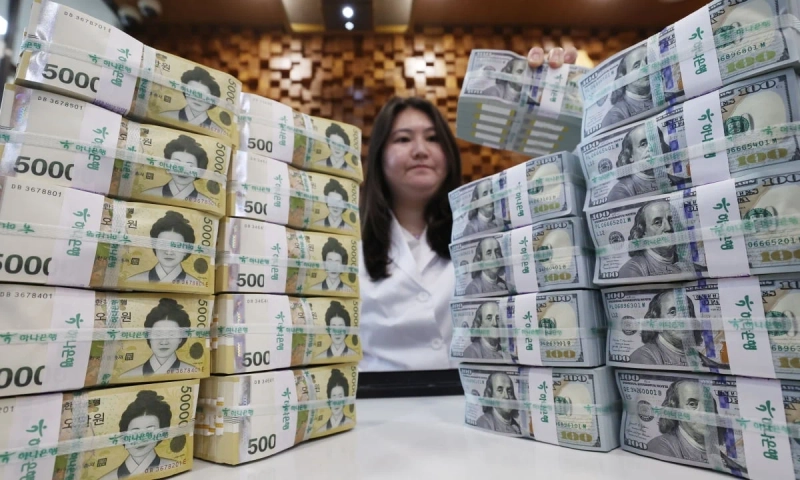
The long-held rule that the won weakens when US interest rates rise is no longer holding.
US Treasury yields have continued to climb, but the won has stayed firm. Supply-and-demand factors, including a large current-account surplus generated by exporters, are having a bigger impact than US rates.
According to the Bank of Korea, the won averaged 1,358.75 per dollar last month. That was the lowest monthly average since August 2024, when it stood at 1,352.87 per dollar. US Treasury yields rose sharply throughout the month, yet the won-dollar exchange rate remained stable in a roughly 1,350-1,400 won range.
On Sept. 22, when the US 10-year Treasury yield rose to just below 5%, the won actually strengthened, with the won-dollar rate falling by more than 20 won. The next day, even after the yield broke above 5%, the exchange rate held near the previous day's level.
During trading on Oct. 1, the US 10-year Treasury yield climbed above 5.3%, while the dollar index also traded above 101. Even so, the won-dollar rate stayed in the 1,350-1,360 won range.
US rates have long been seen as the single most important driver of the won-dollar exchange rate. When US market rates rise, global investors have less incentive to hold emerging-market assets. They tend to sell won and buy dollars to shift money into the US, where assets are seen as safer and offer higher yields, pushing down the Korean currency.
More recently, however, dollar selling by exporters has done more to cap the exchange rate than the gap between domestic and US interest rates. External factors continue to support a stronger dollar, but solid earnings at South Korea's exporters have kept a steady flow of conversion orders in the Seoul foreign-exchange market, where companies sell dollars and buy won. That has capped the exchange rate's upside. Exports topped $120 billion for the first time last month, up 83.5% from a year earlier. Min Kyung-won, an economist at Woori Bank, said strong semiconductor exports were bringing in large dollar inflows. With the won-dollar rate recently stuck in a relatively narrow 1,340-1,390 won band, speculative players have also shown little appetite for aggressive bets, he added.
This is not entirely unprecedented. During 2004-2006, when the Federal Reserve was raising rates, US long-term Treasury yields also climbed. Even so, the won-dollar rate fell from the 1,200 won range in 2004 to the 900 won range in 2006. Strong Chinese growth and an increase in global trade fueled a boom in emerging-market economies, adding upward pressure on the won.
The won-dollar market has also repeatedly defied other conventional rules in recent months. In the first half of this year, the exchange rate climbed into the 1,560 won range despite a large current-account surplus. Dollar demand surged as foreign investors rebalanced their holdings of Korean stocks. Exporters also delayed converting their dollar receipts into won. Flow-related factors are increasingly becoming decisive in setting the exchange rate, including securities investment by retail and foreign investors, corporate dollar conversions and overseas asset allocation by pension funds.
Shim Sung-mi, Korea Economic Daily reporter smshim@hankyung.com

Korea Economic Daily
hankyung@bloomingbit.ioThe Korea Economic Daily Global is a digital media where latest news on Korean companies, industries, and financial markets.