Beyond Trading, a16z Sees Blockchain Evolving Into Financial Infrastructure
Summary
- Guy Wuollet said stablecoins and blockchain are expanding beyond retail trading into institutional financial infrastructure.
- He identified financial-market infrastructure, stablecoin-based digital finance, and new exchanges as key investment themes, and said trading in traditional assets on-chain is expanding.
- Wuollet said the potential from South Korea's discussion of won stablecoin legislation and institutional participation in the market has yet to be fully appreciated.
Forecast Trend Report by Period


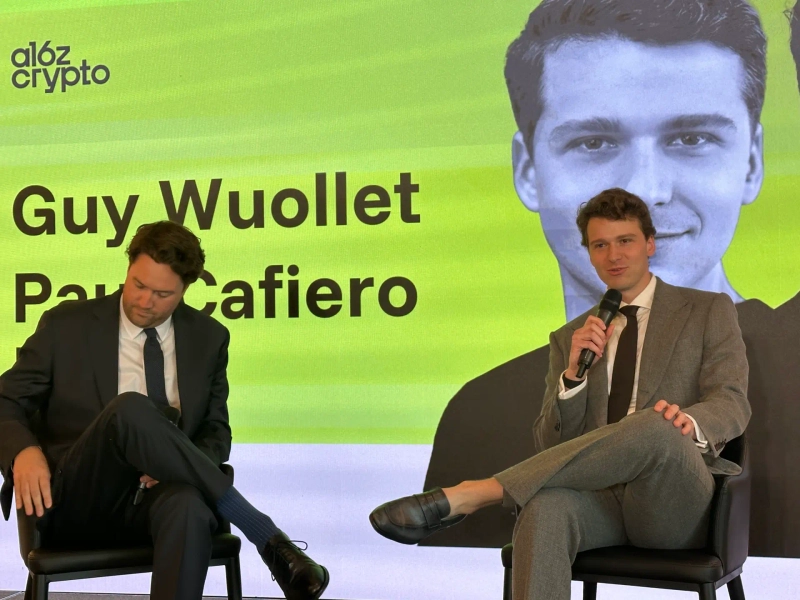
Some limited partners asked whether they could pay capital commitments to an Andreessen Horowitz venture fund in stablecoins. Guy Wuollet, a general partner at a16z Crypto, said some investors raised the question earlier this year when the firm was launching its fifth fund. He cited it as an example of blockchain spreading beyond personal crypto trading into institutional finance.
Speaking on Oct. 1 at the a16z Crypto Korea Summit at Josun Palace in Seoul's Gangnam district, Wuollet said crypto, which began with retail users, is expanding across the broader financial system. He added that the scale of institutional adoption has yet to receive enough attention.
He outlined three investment themes: financial-market infrastructure, stablecoin-based digital finance and new exchanges. The industry has moved past the phase of building blockchain's underlying technology, he said, making services used by financial institutions and customers more important. Large financial institutions in the US and other markets have begun adopting blockchain as an alternative to, and an upgrade for, core legacy ledgers.
He also said stablecoins will play a broader role than remittances and payments. In emerging markets, digital finance companies are emerging that use stablecoins to offer dollar savings and fast, low-cost payments. That circulation creates multiple follow-on effects, he said, leading to lending and new banking services.
Wuollet also pointed to change in trading markets. Traditional assets such as stocks, in addition to crypto, are being traded on blockchain networks, while products such as perpetual futures and prediction markets are also growing. Building open markets that allow more people to participate could expand asset circulation and improve price discovery, he said.
On prediction markets, he placed more weight on the value of information than on trading itself. Prediction markets are platforms where users buy and sell contracts tied to whether a specific event will occur. Contract prices serve as an indicator of how participants assess the probability of that event.
The most interesting part of prediction markets is the information the market itself provides, Wuollet said, adding that he spends more time checking the probability of an event than trading directly. While trading is increasing in areas such as sports and elections, he said, their role in aggregating views about the future and using them for decision-making is also important. Markets should draw out information and use it in price formation across the economy, he added.
Wuollet said artificial intelligence could become a new user of that financial infrastructure. But he distinguished between today's services, where AI makes purchases using a person's credit card, and a market where AI agents transact directly with one another. The latter is when stablecoin use could begin expanding in earnest.
If the main actors in economic activity shift from people to machines, the financial infrastructure will need to support transactions that move at machine speed, he said. Blockchain and stablecoins could become a payment network suited to transactions between agents.
He also described South Korea as an important market in that shift. Among companies backed by a16z, some count South Korean users as their largest user base, he said. The country also offers major conglomerates many opportunities to work with new startups. a16z opened its first Asia office in Seoul in June and is supporting portfolio companies' market entry and collaboration with domestic businesses.
Wuollet also expressed optimism about the introduction of a won stablecoin. He said he was particularly encouraged by discussions in South Korea over legislation for a won stablecoin and added that the potential created by wider stablecoin adoption and greater institutional participation in the market still is not fully appreciated.

Doohyun Hwang
cow5361@bloomingbit.ioKEEP CALM AND HODL🍀