As Other Economies Tighten, China Rolls Out Cash for Golden Week
Summary
- China has launched its biggest stimulus push since September 2024, including mortgage-interest subsidies, rate cuts, consumer vouchers and subsidies.
- Weakness in property development investment, private investment, new home sales, retail sales growth and GDP growth has raised warning signs over whether China can meet its growth target.
- Experts said the latest stimulus measures may help defend the growth target, but they are insufficient to fundamentally resolve weak domestic demand, leaving room for broader additional fiscal spending and housing support later this year.
Forecast Trend Report by Period


All-out fourth-quarter stimulus push... Can it reverse weak consumption?
Warning lights flash for growth target
Loan quotas expanded and rates cut
Local governments also roll out consumer vouchers
Experts say measures fall short of reviving domestic demand
China entered its weeklong National Day holiday on Oct. 1, and the government has launched its biggest stimulus push in two years. The goal is to maximize holiday spending and lift domestic demand. The central government has decided for the first time to subsidize mortgage interest payments, while local governments are rolling out consumer vouchers and logistics subsidies for companies. With a property slump, weak private investment and sluggish consumption putting this year's growth target at risk, Beijing has stepped up stimulus at the start of the fourth quarter.
China opens its wallet for Golden Week
The National Day holiday is one of China's peak consumption periods, when demand for air travel, hotels, dining and shopping rises all at once. Beijing is deploying multiple policy tools simultaneously in an effort to use the break as a catalyst for a recovery in domestic demand.
The most notable step is support for the housing market. China's Ministry of Finance said first-time homebuyers will receive mortgage-interest subsidies of 1 percentage point a year for up to five years starting this month. It is the first time the central government has subsidized interest on individual mortgages. The move is intended to draw in genuine homebuyers who have delayed purchases during the housing downturn.
The People's Bank of China has also eased credit conditions. It cut the one-year rate on pledged supplementary lending for major banks by 0.25 percentage point to 1.5% from 1.75%. The move could help lower borrowing costs across the market. Authorities also expanded lending quotas for technology innovation, agriculture and small businesses. Bloomberg described the package as China's biggest stimulus move since September 2024.
Local governments are also ramping up fiscal support. Sichuan province issued consumer vouchers late last month that can be used to buy goods and attend sports and cultural events.
Chongqing said it will provide up to 80 million yuan ($11 million) in research and development support to automakers mass-producing new electric-vehicle models. It will also subsidize manufacturers by as much as 5 million yuan to offset higher logistics costs linked to market expansion. Jiangsu province said it will extend subsidies for digital-device purchases and accelerate efforts to foster nighttime shopping districts.
Can it revive domestic demand?
Behind the aggressive policy push is domestic demand that has shown little sign of recovery. Fixed-asset investment in the first eight months of the year fell 7.2% from a year earlier, according to China's National Bureau of Statistics. Property development investment dropped 19.9%, while private investment fell 10.1%. The value of new home sales declined 13%. Retail sales rose just 1.1% in the same period. Second-quarter gross domestic product growth slowed to an annualized 4.3%, below the lower end of the government's full-year target range of 4.5% to 5%.
The root cause is falling property prices. As asset values decline and anxiety over future income grows, consumers are hoarding cash and companies are delaying investment. Even with lower borrowing costs, buyers remain reluctant to purchase homes and land. That is why Beijing has moved beyond rate cuts to cover part of mortgage interest and offer vouchers and subsidies. A representative of a foreign company in Beijing said the government appears to be trying to use National Day holiday spending to reverse the fourth-quarter economic trend as the property slump and weak private investment increase downward pressure on growth.
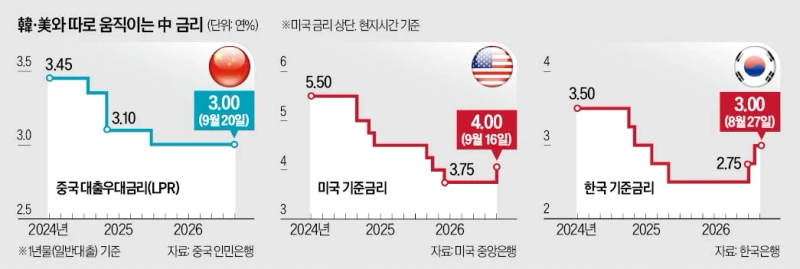
China is now moving in the opposite direction from monetary policy in the US and the European Union. The five-year loan prime rate, which effectively serves as the country's benchmark lending rate, has fallen to 3.5% from 4.8% in 2020. That contrasts with tightening cycles in the US, the EU, South Korea and Australia.
Experts say the latest stimulus package may help defend the growth target but will not be enough to fundamentally fix weak domestic demand. Some forecasts suggest China may barely meet the lower end of the official 4.5% growth goal. Many expect Beijing to rely more on fiscal policy and targeted financial support than on large-scale rate cuts. A Beijing finance-industry official said additional fiscal spending and broader housing support could follow later this year if National Day holiday spending and third-quarter growth disappoint or if property sales weaken again.
Kim Eun-jung, Beijing correspondent, Korea Economic Daily, kej@hankyung.com

Korea Economic Daily
hankyung@bloomingbit.ioThe Korea Economic Daily Global is a digital media where latest news on Korean companies, industries, and financial markets.