MOA Protocol, World Liberty Financial Sign MOU to Expand USD1-Based Finance, Payment Cooperation
Summary
- MOA Protocol and World Liberty Financial said they will expand cooperation in real-world financial services such as asset management and payments centered on USD1.
- MOA Protocol said it aims to connect holding, earning, moving and spending around the USD1 stablecoin into a single flow and build a financial environment powered by AI agents.
- World Liberty Financial said it plans to expand USD1 use from trading into remittances and cross-border payments, while seeking business opportunities in the South Korean market.
Forecast Trend Report by Period


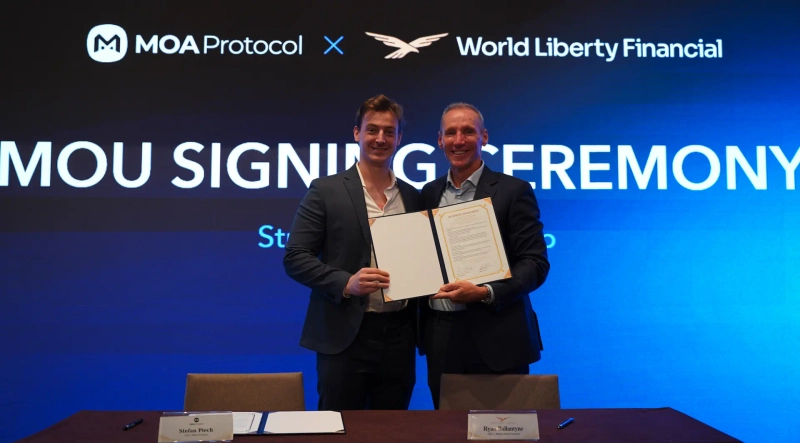
MOA Protocol, which is building a digital-asset financial ecosystem, and World Liberty Financial jointly hosted the “My Own Access: The Future of Borderless Wealth & Lifestyle” event at Grand Hyatt Seoul in Yongsan-gu, Seoul, on Oct. 1, where they signed a strategic memorandum of understanding.
About 200 people attended, including founders, investors, institutional representatives and global blockchain industry participants. The two companies said they plan to use the USD1 stablecoin in real-world financial services such as asset management and payments, with plans to broaden the partnership to AI-agent payments and cross-border settlement.
Bridging Fragmented Finance, Linking USD1 to the MOA Card
Stefan Piech, chief executive officer of MOA Protocol, said in welcoming remarks that traditional finance and the digital-asset ecosystem remain fragmented and outlined a plan to build a financial ecosystem that connects the two.
“There is still a great deal of fragmentation between the current financial system and the digital-asset ecosystem,” Piech said. “We want to connect assets that remain on crypto exchanges or on-chain to everyday uses such as yield generation and payments.”
As one example of the partnership, he introduced the MOA Card, which can be loaded with USD1 for payments.
Ryan Ballantyne, chief business officer of World Liberty Financial, said broader real-world adoption of stablecoins will require combining distribution networks with actual services.
“Expanding USD1 liquidity and exchange access alone is not enough,” Ballantyne said. Users need services that let them actually use stablecoins, he added, and the partnership with MOA Protocol should help broaden those use cases.
MOA Protocol Says It Will Connect Holding, Yield and Payments, Pursue AI-Agent Finance
Leo, chief operating officer of MOA Protocol, said in the first keynote that stablecoin use remains fragmented across multiple services and networks, and that the company aims to connect that process into a single financial flow.
“MOA Protocol aims to connect the hold, earn, move and spend stages of stablecoin use into one,” Leo said. “The core is to make it easier to connect stablecoins across multiple blockchains to yield products and payment services.”
MOA Protocol also plans to build a financial environment in which AI agents manage funds and make payments based on conditions set by users.
Leo said the company is developing infrastructure that would allow AI agents to manage funds under preset rules such as spending limits and approval conditions, and execute payments when needed.
World Liberty Says USD1 Will Expand Beyond Trading Into Remittances, Payments, Signals Korea Push
In a subsequent keynote, Jeffrey Ma, senior vice president at World Liberty Financial and head of exchange partnerships, said stablecoin use will expand beyond trading into remittances and payments.
“Stablecoins are becoming the currency of the digital economy, and some forecasts put the market at as much as $2 trillion in the future,” Ma said. “Stablecoin use is currently centered on exchanges, but it will expand into remittances and cross-border payments.”
He also said that, through the partnership with MOA Protocol, the company plans to broaden its touchpoints with South Korean users and seek more business opportunities in the country.
World Liberty Financial is expanding into lending and borrowing, AI-agent payments and real-world asset tokenization centered on USD1. Ma also introduced WorldSwap, a cross-border settlement project under development, saying the company is preparing infrastructure to support settlement between different currencies using USD1.
“We see USD1 not simply as money, but as infrastructure through which funds move,” Ma said, adding that the company aims to build financial infrastructure linking the digital economy with global financial markets.

Minseung Kang
minriver@bloomingbit.ioBlockchain journalist | Writer of Trade Now & Altcoin Now, must-read content for investors.